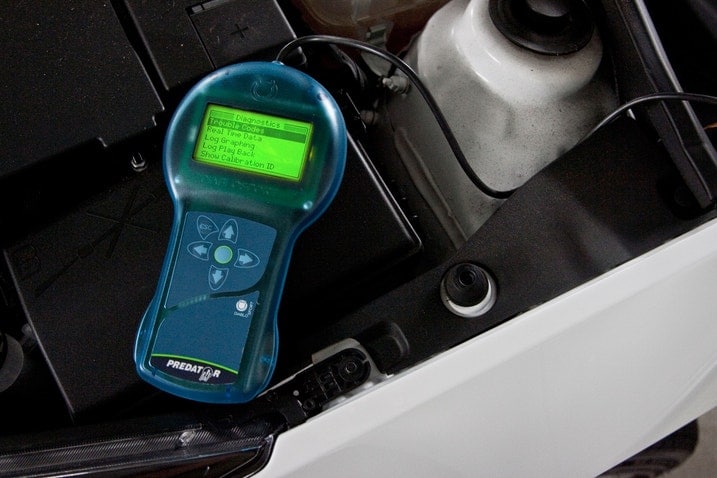
How to decipher the check engine light with a code reader
The possible causes for a check engine light (distinct from a service engine light, which is a scheduled maintenance timer) number in the thousands. A local mechanic or dealership can easily troubleshoot the problem for about an hour of labor — some may even provide the diagnostic service for free.
But there's a way to preview what the problem might be. Some auto parts stores will lend out code readers to use in the parking lot, and do-it-yourselfers can buy those same code readers as well. The devices connect to the onboard diagnostics (OBD) port, which will spit out an alphanumeric code. Edmunds has several articles on these OBD-II diagnostic trouble codes, but if we don't have your particular code, you can also search for the code's meaning on websites such as Engine Light Help. There are even some Bluetooth code readers that come with a smartphone app preloaded with those codes, making the mystery easier to solve.
Steve Mazor, retired chief automotive engineer for the Auto Club of Southern California, says that an inexpensive check engine code reader could be useful for car owners who aren't mechanically inclined.
"If the mechanic gives you the same information, at least you know they are going down the right road," he notes. A code reader can provide car owners with one more data point to help them talk with their mechanic and avoid costly or unnecessary auto repairs. Just keep in mind that you'll have to figure out where your car's OBD-II port is [typically somewhere in the driver's footwell] and get comfortable with plugging in and operating the code reader.
Possible false flags from a check engine code
With the code and its meaning in hand, a do-it-yourself interpretation can still be a little tricky, even if you are mechanically inclined. For example, a code might suggest that a sensor has gone bad, when in reality, it could be that the wiring leading to the sensor is faulty.
Don't ignore that light
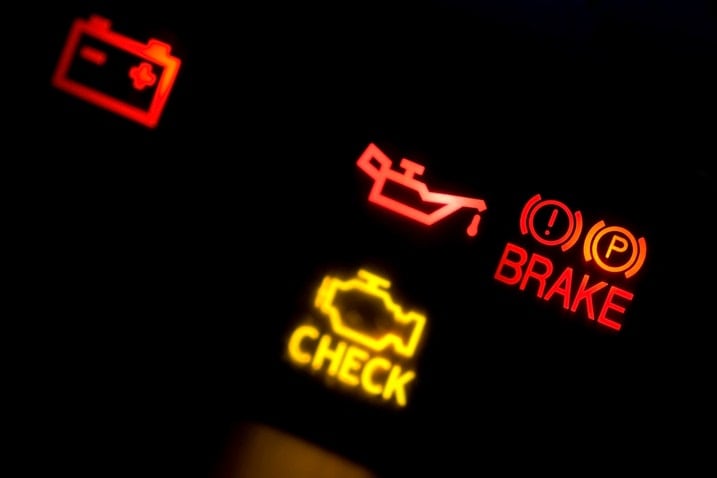
It’s crucial to pay attention to your car’s dashboard and address any warning lights as soon as possible.
“The check engine light is designed to come on when a vehicle’s onboard diagnostic system sees a problem that impacts emissions or drivetrain issues,” said David Rich, CarMD technical vice president. “With uncertainty about how tariffs will impact replacement part prices, it’s particularly important for drivers to address their car’s dashboard warning lights. Catching problems early can reduce the likelihood of a snowball effect from additional repairs.”
In a recent survey of U.S. vehicle owners, CarMD found that nearly half (49%) reported having a dashboard warning light on. Of that group, 20% reported their vehicle’s check engine light was on — nearly double the number from the last time CarMD conducted a similar survey. In the same survey, 22% reported having a tire pressure light on, which CarMD noted was understandable since the survey was conducted in January, when cold temperatures can cause low tire pressure.
One of the simplest fixes for a check engine light is inspecting the gas cap. Forgetting to tighten it after a fuel stop or fastening it incorrectly can flag a problem with the car’s evaporative emissions system, causing a check engine light. If the cap is loose, tighten it and drive for several miles — if that was the problem, the light should go out. Other cheap repairs could include replacing an air filter or cleaning a mass airflow sensor, both of which can be done by just about anyone.
What should you do if the check engine light comes on and it's steady rather than flashing? The most obvious answer is to get the engine checked by a mechanic, but you might be tempted to ignore it, especially if you know that a steady light is less of an immediate concern than a flashing one. Indeed, many people simply do nothing, perhaps fearing an expensive repair bill. Some drivers with older vehicles may want to squeeze out as many remaining miles as possible without visiting a service garage.
This isn’t wise, however. Ignoring the root cause of a check engine light can cause wear and excessive fuel consumption, leading to higher costs down the road. For example, a misfire can not only cause poor engine operation it can also accelerate the wear on a catalytic converter, which can be quite expensive to replace. Even in the case of our gas cap, ignoring the problem would result in increased emissions and reduced engine performance.
How to turn off the check engine light
Your vehicle is not likely to pass a state safety inspection with the check engine light on. This can be a good motivator for dealing with the problem. Ultimately, the engine and the emission control system are so interlinked that the health of the emission control system is a good indication of the general health of the car's engine. Having the issue resolved by a mechanic is the best way to make your check engine light disappear
Still, some people might want to turn off the light temporarily for a number of reasons. Most code readers will allow you to turn off or reset the check engine light, which can be handy for DIYers who want to see if they’ve successfully repaired their cars. But unless you’ve read the code, deciphered its cause, and replaced or cleaned the relevant parts, this action alone does not actually address the problem. In many cases, you're only delaying the inevitable, and the light will come back on later.
Occasionally, the check engine light comes on when nothing is wrong with the car, said Mazor. It could be a temporary problem caused by a change in humidity or other factors. In such cases, the light should go off by itself after a short time.
Brief history of the check engine light
Automakers started standardizing their systems with 1996 model-year vehicles under a protocol called OBD-II, which instituted a list of diagnostic trouble codes and mandated that all cars provide a universal connector to access this information. The connector is usually located under the steering column and is relatively easy to access. Before 1996, carmakers had their own engine diagnostic systems, primarily to ensure their cars were compliant with EPA pollution control requirements. These systems were not standardized, however, and required special tools and know-how to decipher the cause of a check engine light.
FAQs
Is it safe to drive your car with the check engine light on?
It depends on the severity of the issue. If it's a minor issue, such as a loose gas cap, it should be safe to drive. If you notice a difference in the performance of the vehicle, it could be an indication of a more serious problem, and it's best to err on the side of caution. Reduce your speed and take the vehicle to a mechanic as soon as possible. If the check engine light is flashing, exercise particular caution because your car is trying to tell you that there's a major malfunction — it might be time to consider a tow truck.
Is the check engine light serious?
If the culprit is a gas cap or temporary changes in the environment, the light should go away on its own. But if the light stays on or turns amber, there's a good chance the car is releasing excess pollutants or consuming too much fuel. That's not only bad for your gas mileage, but it's also a sign of a more serious issue that may need immediate attention. If the check engine light is flashing, there's almost certainly a serious issue that requires immediate expert attention.
How many miles can you drive with the check engine light on?
Since each fault code has its own level of severity, it is difficult to predict how many miles you can drive with the warning light on. The cause could be anything from a bad sensor to plug wires that need to be replaced. The safest bet is to decipher the code as soon as possible and then plan your strategy accordingly.
" fill-opacity=".3" d="M0-111h1200v397s-252.211 51.289-538.449 54C375.312 342.711 0 292 0 292v-403Z"/%3E%3Cpath fill="url(%23b)" d="M1-114h1199v378s-252 51.289-538 54C376 320.711 0 270 0 270v-384Z"/%3E%3Cpath fill="url(%23c)" d="M0 60h1200v188s-327 63.289-613 66C301 316.711 0 273 0 273V60Z"/%3E%3Cpath fill="url(%23d)" d="M0 60h1200v188s-327 63.289-613 66C301 316.711 0 273 0 273V60Z"/%3E%3Cmask id="e" width="1201" height="255" x="-1" y="60" maskUnits="userSpaceOnUse" style="mask-type:alpha"%3E%3Cpath fill="%23EEF1F6" d="M0 60h1200v188s-327 63.289-613 66C301 316.711 0 273 0 273V60Z"/%3E%3C/mask%3E%3Cg mask="url(%23e)"%3E%3Cmask id="g" width="1438" height="328" x="-124" y="-13" maskUnits="userSpaceOnUse" style="mask-type:alpha"%3E%3Cpath fill="url(%23f)" fill-rule="evenodd" d="M-123.5 258.5-109-13h1395l27.5 245c-232.5 34.5-487.705 80.384-725.581 83-237.486-2.721-265.419-4-711.419-56.5Z" clip-rule="evenodd"/%3E%3C/mask%3E%3Cg mask="url(%23g)"%3E%3Cpath fill="%23FEF3C7" fill-opacity=".05" d="M774.502 1161.55c72.001-3.83 144.529-16.6 217.321-38.74C1514.56 964.017 1919.92 369.717 2099-392.74 1846.08 72.142 1341.28 313.096 774.502 323.314 207.726 312.671-296.808 72.141-549.998-392.74-370.919 369.717 34.449 964.017 557.181 1122.81c72.792 21.71 145.32 34.48 217.321 38.74Z"/%3E%3Cpath fill="%232070E8" fill-opacity=".25" d="M1243.34 184.225c102.44 30.548 204.48 74.055 305.68 131.036C2275.79 724.198 2778.24 1714.59 2935.35 2866.48 2634.05 2114.1 1943.59 1594 1134.58 1382.03 322.864 1199.88-429.69 1367.89-852 1944.02-497.039 916.86 159.636 208.787 927.603 163.907c106.887-5.677 212.247 1.329 315.737 20.318Z"/%3E%3Cpath fill="%23FEF3C7" fill-opacity=".05" d="M1232.5 70.76c104.07 5.535 208.91 23.986 314.13 55.967C2302.21 356.131 2888.15 1214.7 3147 2316.21 2781.41 1644.6 2051.75 1296.5 1232.5 1281.74 413.251 1297.12-316.027 1644.6-682.001 2316.21-423.151 1214.7 162.788 356.131 918.372 126.727 1023.59 95.361 1128.43 76.91 1232.5 70.76Z"/%3E%3Cpath fill="%23154A99" fill-opacity=".29" d="M421.155 420.269c113.733 46.994 226.413 108.503 337.53 185.053C1556.67 1154.75 2075.77 2329.98 2199.28 3644.03 1895.3 2761.18 1143.24 2091.29 243.733 1753.08c-903.919-305.05-1757.473-209.22-2258.663 386.12C-1568.66 1028.61-797.982 313.945 67.226 358.413c120.398 6.829 238.484 27.723 353.929 61.856Z"/%3E%3C/g%3E%3C/g%3E%3Cdefs%3E%3ClinearGradient id="a" x1="600" x2="600" y1="-92" y2="449" gradientUnits="userSpaceOnUse"%3E%3Cstop offset=".336" stop-color="%23007EE5"/%3E%3Cstop offset="1" stop-color="%2363D9EA"/%3E%3C/linearGradient%3E%3ClinearGradient id="b" x1="600.5" x2="600.5" y1="-114" y2="427" gradientUnits="userSpaceOnUse"%3E%3Cstop offset=".336" stop-color="%23007EE5"/%3E%3Cstop offset="1" stop-color="%2363D9EA"/%3E%3C/linearGradient%3E%3ClinearGradient id="c" x1="647" x2="647" y1="60" y2="319" gradientUnits="userSpaceOnUse"%3E%3Cstop offset=".052" stop-color="%23007EE5"/%3E%3Cstop offset=".514" stop-color="%231561D4"/%3E%3Cstop offset=".938" stop-color="%2300A0B5"/%3E%3C/linearGradient%3E%3ClinearGradient id="d" x1="647" x2="647" y1="60" y2="319" gradientUnits="userSpaceOnUse"%3E%3Cstop offset=".282" stop-color="%23007EE5" stop-opacity="0"/%3E%3Cstop offset=".822" stop-opacity=".3"/%3E%3C/linearGradient%3E%3ClinearGradient id="f" x1="588.5" x2="588.5" y1="-13" y2="499.532" gradientUnits="userSpaceOnUse"%3E%3Cstop stop-color="%23154A99"/%3E%3Cstop offset="1" stop-color="%2363D9EA"/%3E%3C/linearGradient%3E%3C/defs%3E%3C/svg%3E)

.jpg)