" fill-opacity=".3" d="M0-111h1200v397s-252.211 51.289-538.449 54C375.312 342.711 0 292 0 292v-403Z"/%3E%3Cpath fill="url(%23b)" d="M1-114h1199v378s-252 51.289-538 54C376 320.711 0 270 0 270v-384Z"/%3E%3Cpath fill="url(%23c)" d="M0 60h1200v188s-327 63.289-613 66C301 316.711 0 273 0 273V60Z"/%3E%3Cpath fill="url(%23d)" d="M0 60h1200v188s-327 63.289-613 66C301 316.711 0 273 0 273V60Z"/%3E%3Cmask id="e" width="1201" height="255" x="-1" y="60" maskUnits="userSpaceOnUse" style="mask-type:alpha"%3E%3Cpath fill="%23EEF1F6" d="M0 60h1200v188s-327 63.289-613 66C301 316.711 0 273 0 273V60Z"/%3E%3C/mask%3E%3Cg mask="url(%23e)"%3E%3Cmask id="g" width="1438" height="328" x="-124" y="-13" maskUnits="userSpaceOnUse" style="mask-type:alpha"%3E%3Cpath fill="url(%23f)" fill-rule="evenodd" d="M-123.5 258.5-109-13h1395l27.5 245c-232.5 34.5-487.705 80.384-725.581 83-237.486-2.721-265.419-4-711.419-56.5Z" clip-rule="evenodd"/%3E%3C/mask%3E%3Cg mask="url(%23g)"%3E%3Cpath fill="%23FEF3C7" fill-opacity=".05" d="M774.502 1161.55c72.001-3.83 144.529-16.6 217.321-38.74C1514.56 964.017 1919.92 369.717 2099-392.74 1846.08 72.142 1341.28 313.096 774.502 323.314 207.726 312.671-296.808 72.141-549.998-392.74-370.919 369.717 34.449 964.017 557.181 1122.81c72.792 21.71 145.32 34.48 217.321 38.74Z"/%3E%3Cpath fill="%232070E8" fill-opacity=".25" d="M1243.34 184.225c102.44 30.548 204.48 74.055 305.68 131.036C2275.79 724.198 2778.24 1714.59 2935.35 2866.48 2634.05 2114.1 1943.59 1594 1134.58 1382.03 322.864 1199.88-429.69 1367.89-852 1944.02-497.039 916.86 159.636 208.787 927.603 163.907c106.887-5.677 212.247 1.329 315.737 20.318Z"/%3E%3Cpath fill="%23FEF3C7" fill-opacity=".05" d="M1232.5 70.76c104.07 5.535 208.91 23.986 314.13 55.967C2302.21 356.131 2888.15 1214.7 3147 2316.21 2781.41 1644.6 2051.75 1296.5 1232.5 1281.74 413.251 1297.12-316.027 1644.6-682.001 2316.21-423.151 1214.7 162.788 356.131 918.372 126.727 1023.59 95.361 1128.43 76.91 1232.5 70.76Z"/%3E%3Cpath fill="%23154A99" fill-opacity=".29" d="M421.155 420.269c113.733 46.994 226.413 108.503 337.53 185.053C1556.67 1154.75 2075.77 2329.98 2199.28 3644.03 1895.3 2761.18 1143.24 2091.29 243.733 1753.08c-903.919-305.05-1757.473-209.22-2258.663 386.12C-1568.66 1028.61-797.982 313.945 67.226 358.413c120.398 6.829 238.484 27.723 353.929 61.856Z"/%3E%3C/g%3E%3C/g%3E%3Cdefs%3E%3ClinearGradient id="a" x1="600" x2="600" y1="-92" y2="449" gradientUnits="userSpaceOnUse"%3E%3Cstop offset=".336" stop-color="%23007EE5"/%3E%3Cstop offset="1" stop-color="%2363D9EA"/%3E%3C/linearGradient%3E%3ClinearGradient id="b" x1="600.5" x2="600.5" y1="-114" y2="427" gradientUnits="userSpaceOnUse"%3E%3Cstop offset=".336" stop-color="%23007EE5"/%3E%3Cstop offset="1" stop-color="%2363D9EA"/%3E%3C/linearGradient%3E%3ClinearGradient id="c" x1="647" x2="647" y1="60" y2="319" gradientUnits="userSpaceOnUse"%3E%3Cstop offset=".052" stop-color="%23007EE5"/%3E%3Cstop offset=".514" stop-color="%231561D4"/%3E%3Cstop offset=".938" stop-color="%2300A0B5"/%3E%3C/linearGradient%3E%3ClinearGradient id="d" x1="647" x2="647" y1="60" y2="319" gradientUnits="userSpaceOnUse"%3E%3Cstop offset=".282" stop-color="%23007EE5" stop-opacity="0"/%3E%3Cstop offset=".822" stop-opacity=".3"/%3E%3C/linearGradient%3E%3ClinearGradient id="f" x1="588.5" x2="588.5" y1="-13" y2="499.532" gradientUnits="userSpaceOnUse"%3E%3Cstop stop-color="%23154A99"/%3E%3Cstop offset="1" stop-color="%2363D9EA"/%3E%3C/linearGradient%3E%3C/defs%3E%3C/svg%3E)
If you ever plan to involve yourself in activities such as boating, camping or some sort of automotive pastime, such as auto crossing or drag racing, then chances are you'll need to do some towing. While it may seem scary, towing an average-sized trailer is really easier than it looks.
Two of the most important things to have when you tow are basic common sense and the ability to adjust your driving. In other words, when towing, everything you do while driving needs to be done at about half the speed when compared to driving without a trailer. When you turn, go much slower. When you accelerate, do it much easier. When you brake, allow yourself a great deal more space to stop. And when you change lanes, allow room for your vehicle and the trailer.
The types of things you are likely going to tow are a boat, a camper of some sort, or a car trailer that's usually home to a race or show car. The following information on towing basics applies to just about any type of towing application whether the trailer is carrying a boat, a car, or any other item that needs a lift from point A to point B. The universal nature of this information is due to the fact that how much you can tow and what you tow with are mainly based on weights and capacities.
See Edmunds pricing data
Has Your Car's Value Changed?
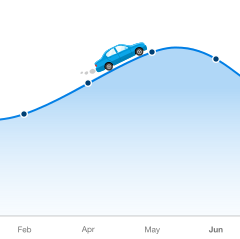
Used car values are constantly changing. Edmunds lets you track your vehicle's value over time so you can decide when to sell or trade in.
For purposes of discussion, let's suppose you bought a boat and want to tow it to a lake. As the photos illustrate, towing a boat with a pickup truck is a very common way to go. As such, the tow vehicle is a major consideration when pulling a trailer, making that vehicle as important as what you're pulling.
As far as cars go, a full-size body-on-frame, rear-wheel-drive car like a Ford Crown Victoria (rated to tow 2,000 pounds) or Chevy Caprice is a basic minimum for towing anything approaching the weight of a 2,000-pound trailer. For smaller trailers, a smaller car can work, but for hauling anything more than 2,000 pounds you're going to need a truly tow-friendly vehicle. Ideally, a truck or an SUV is always a smart choice for towing that boat or camper. Even a compact pickup like a Ford Ranger or Chevy Colorado is going to be better than just about any car. For heavier loads (say more than 4,000 pounds) a half-ton truck like a Ford F-150 or Chevy Silverado will meet the needs of just about any of the trailer-towing basics we're discussing here. But even among half-ton trucks, towing ability can vary. For example, an F-150 with a 5.4-liter V8 will have a much easier time towing a 5,000-pound load than one with a 4.6-liter V8 because it simply has more horsepower and torque. Furthermore, the engine isn't the only thing that can handle a heavier load. The transmission, brakes and rear axle are also upgraded, along with the larger engine. Beyond a typical half-ton truck, a three-quarter (such as an F-250) or one-ton (F-350) can handle loads well beyond 5,000 pounds. For example, an F-250 with a 5.4-liter V8 and 3.73 gears is rated to tow 12,500 pounds. Properly equipped, an F-150 is rated to tow 8,000 pounds with a 5.4-liter V8, an automatic transmission and 3.55 gears. Besides the tow vehicle and the trailer, the other critical element is, of course, the hitch. Trailer hitches are rated according to capacity of the load weight and tongue weight. Load weight is referenced in terms of Gross Trailer Weight (GTW, see chart at the end of article). Tongue weight is the downward force exerted on the hitch ball. This is usually calculated at 10-15 percent of the maximum rated GTW. The tongue is usually formed from the V-shaped merging of the trailer framerails at the front of the trailer. The coupler of the trailer is what accepts the hitch ball.
Once you know how much weight you'll be towing and that the weight doesn't exceed the maximum towing capacity of your tow vehicle, you're ready to determine the proper hitch. Many pickups and SUVs come factory-equipped with a Class III hitch, which is the most popular class of hitch. Most hitches bolt to the vehicle, and while some are welded, a bolt-on installation is the method preferred for attachment. For hauling any load (car, boat, camper, or whatever) a Class III hitch can handle up to 5,000 pounds. For heavier boats or campers, a Class IV hitch (up to 7,500 pounds) would be required, and you might want to consider a three-quarter-ton truck at this point as well. We'd recommend (especially on a compact or half-ton pickup if not already equipped) going straight to a Class III hitch, which is enough to tow most campers, car trailers and small- to medium-sized boats.
All Class III and above hitches are made up of two basic parts. The receiver part of the hitch is what actually attaches to the tow vehicle. It has a framework that's bolted (or welded) to the vehicle chassis. The receiver is a large square tube that accepts a drawbar. The drawbar is a smaller square tube that slides into the receiver and contains the trailer ball. The drawbar is fastened to the receiver with a pin that slides through both pieces and is held in place with a clip. Drawbars come in a variety of heights to allow the trailer to ride at a level plane. For example, with 4x4 pickups, a drawbar can be selected that "drops" the ball to a lower level. The size of the trailer ball also varies. There are 1 7/8-, 2-, 2 ¼-, and 2 5/16-inch sizes, with the 2-inch size being the standard.
With your tow rig, hitch and drawbar ready go, you now need a trailer. Whether it's a boat trailer (as in our photos), a car trailer or a camper of some type, the attachment to the tow vehicle is the same. In general, a dual-axle trailer is also more desirable. Dual axles provide better load distribution and in the event of a tire failure, there's still one good tire on each side of the trailer, which makes the whole package easier to handle if that happens.
As you move to heavier trailers, you'll want to start considering trailer brakes. The most popular type of trailer brakes are surge and electric. Surge brakes work hydraulically using the force of a forward shift in the trailer caused by deceleration to compress a fluid cylinder and apply its brakes. Electric brakes have a controller in the tow vehicle that senses brake pedal pressure using a hydraulic pressure switch plumbed into the tow vehicle's system. Of course the heavier the load, the more you'll want to consider trailer brakes. We'd recommend looking at trailer brakes for any GTW of more than 2,000 pounds.
As we mentioned at the beginning, your driving style when towing a trailer needs to change dramatically. If you've never towed a trailer before and you're nervous about it, we'd strongly recommend seeking out someone who has had experience with towing. In general, you need to remember that when you are towing, you have considerably less room for margin of error. Your vehicle and trailer are much less maneuverable and nimble than your car or truck is without a trailer, and it's critical that you always compensate for the added length the trailer adds when you change lanes so that you don't run anyone off the road.
As far as added costs, besides the item you're towing, there is the fact that your vehicle will use more gas. This is not insurmountable, however. In fact, our experience with towing a boat across the country revealed a smaller increase in fuel consumption than we originally anticipated. Driving from Los Angeles to Chicago in a Ford F-150 standard-cab pickup with a 5.4-liter V8, we averaged 16.5 mpg traveling at 75-80 mph over 2,363 miles. With a new boat purchase in tow, the F-150 managed 13.2 mpg at 55-60 mph from Chicago back to L.A. over 2,051 miles. The overall average for the 4,414-mile jaunt was 14.8 mpg. However, we'll note that boats are usually lighter than travel or camper trailers, and because they are typically lower and more streamlined, don't create nearly as much aerodynamic drag. A good-size travel trailer (5,000 pounds or more) is going to impact fuel economy considerably more than our results.
With heavier loads, the difference in fuel mileage between a gas- and diesel-powered truck can be enough to offset the added purchase price of a diesel. However, you'll also want to factor in that these days, diesel fuel can be notably more expensive than gasoline; up to 40 cents a gallon in some instances.
Finally, you'll want to consider the laws regarding towing. Every state has different rules and regulations for towing a trailer. We recommend checking your state's laws regarding what's cool with towing and what's not. We can tell you that, at a minimum, all trailers need to have working taillights and brake lights and that most states require registration of the trailer with the Department of Motor Vehicles.
Once you've thought about the driving styles, the laws and the costs associated with towing a trailer, take a look at the accompanying photos, captions and Q&A section for more details. With the right tow vehicle, a proper Class III or bigger hitch and a trailer that's in good repair, you'll be on your way to the lake, the campgrounds or the racetrack with your hobbyhorse of choice in short order.
| Trailer Hitch Classification | |
| Class I | 2,000 pounds GTW |
| Class II | 3,500 pounds GTW |
| Class III | 5,000 pounds GTW |
| Class IV | 7,500 pounds GTW |
| Class V | 10,000 pounds GTW |
| GTW=Gross Trailer Weight (including car or boat together, if applicable) |