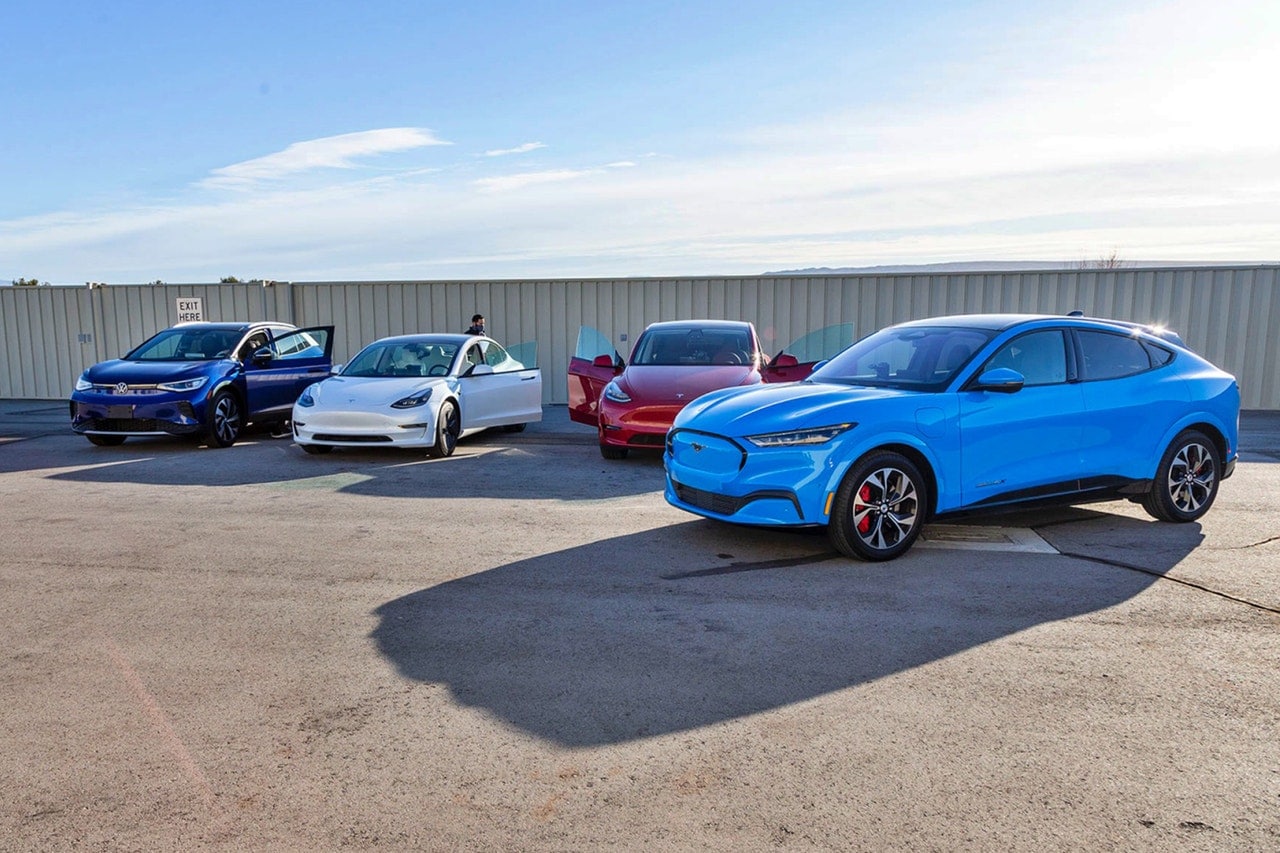
Electric cars are one of the most effective technologies for reducing emissions. This is why nearly every automaker offers an electric car, and with some brands, it is the only type of vehicle they make. The number of choices available leads many shoppers to ask, "What are the top electric car companies?"
The experts at Edmunds have gathered and ranked the top 10 electric car companies, listing the more notable models, highlighting some of their features, and discussing any important partnerships they might have. Our list was ranked using the following variables: the popularity of the brand in the market, sales numbers, the number of EV models, and our expert vehicle rankings. This isn't an exact science, so your choices might differ from ours. But this list should give you a good starting point from where to begin the search for your next EV. If you're curious about the latest EV companies, check out our article, New Electric Car Companies.
" fill-opacity=".3" d="M0-111h1200v397s-252.211 51.289-538.449 54C375.312 342.711 0 292 0 292v-403Z"/%3E%3Cpath fill="url(%23b)" d="M1-114h1199v378s-252 51.289-538 54C376 320.711 0 270 0 270v-384Z"/%3E%3Cpath fill="url(%23c)" d="M0 60h1200v188s-327 63.289-613 66C301 316.711 0 273 0 273V60Z"/%3E%3Cpath fill="url(%23d)" d="M0 60h1200v188s-327 63.289-613 66C301 316.711 0 273 0 273V60Z"/%3E%3Cmask id="e" width="1201" height="255" x="-1" y="60" maskUnits="userSpaceOnUse" style="mask-type:alpha"%3E%3Cpath fill="%23EEF1F6" d="M0 60h1200v188s-327 63.289-613 66C301 316.711 0 273 0 273V60Z"/%3E%3C/mask%3E%3Cg mask="url(%23e)"%3E%3Cmask id="g" width="1438" height="328" x="-124" y="-13" maskUnits="userSpaceOnUse" style="mask-type:alpha"%3E%3Cpath fill="url(%23f)" fill-rule="evenodd" d="M-123.5 258.5-109-13h1395l27.5 245c-232.5 34.5-487.705 80.384-725.581 83-237.486-2.721-265.419-4-711.419-56.5Z" clip-rule="evenodd"/%3E%3C/mask%3E%3Cg mask="url(%23g)"%3E%3Cpath fill="%23FEF3C7" fill-opacity=".05" d="M774.502 1161.55c72.001-3.83 144.529-16.6 217.321-38.74C1514.56 964.017 1919.92 369.717 2099-392.74 1846.08 72.142 1341.28 313.096 774.502 323.314 207.726 312.671-296.808 72.141-549.998-392.74-370.919 369.717 34.449 964.017 557.181 1122.81c72.792 21.71 145.32 34.48 217.321 38.74Z"/%3E%3Cpath fill="%232070E8" fill-opacity=".25" d="M1243.34 184.225c102.44 30.548 204.48 74.055 305.68 131.036C2275.79 724.198 2778.24 1714.59 2935.35 2866.48 2634.05 2114.1 1943.59 1594 1134.58 1382.03 322.864 1199.88-429.69 1367.89-852 1944.02-497.039 916.86 159.636 208.787 927.603 163.907c106.887-5.677 212.247 1.329 315.737 20.318Z"/%3E%3Cpath fill="%23FEF3C7" fill-opacity=".05" d="M1232.5 70.76c104.07 5.535 208.91 23.986 314.13 55.967C2302.21 356.131 2888.15 1214.7 3147 2316.21 2781.41 1644.6 2051.75 1296.5 1232.5 1281.74 413.251 1297.12-316.027 1644.6-682.001 2316.21-423.151 1214.7 162.788 356.131 918.372 126.727 1023.59 95.361 1128.43 76.91 1232.5 70.76Z"/%3E%3Cpath fill="%23154A99" fill-opacity=".29" d="M421.155 420.269c113.733 46.994 226.413 108.503 337.53 185.053C1556.67 1154.75 2075.77 2329.98 2199.28 3644.03 1895.3 2761.18 1143.24 2091.29 243.733 1753.08c-903.919-305.05-1757.473-209.22-2258.663 386.12C-1568.66 1028.61-797.982 313.945 67.226 358.413c120.398 6.829 238.484 27.723 353.929 61.856Z"/%3E%3C/g%3E%3C/g%3E%3Cdefs%3E%3ClinearGradient id="a" x1="600" x2="600" y1="-92" y2="449" gradientUnits="userSpaceOnUse"%3E%3Cstop offset=".336" stop-color="%23007EE5"/%3E%3Cstop offset="1" stop-color="%2363D9EA"/%3E%3C/linearGradient%3E%3ClinearGradient id="b" x1="600.5" x2="600.5" y1="-114" y2="427" gradientUnits="userSpaceOnUse"%3E%3Cstop offset=".336" stop-color="%23007EE5"/%3E%3Cstop offset="1" stop-color="%2363D9EA"/%3E%3C/linearGradient%3E%3ClinearGradient id="c" x1="647" x2="647" y1="60" y2="319" gradientUnits="userSpaceOnUse"%3E%3Cstop offset=".052" stop-color="%23007EE5"/%3E%3Cstop offset=".514" stop-color="%231561D4"/%3E%3Cstop offset=".938" stop-color="%2300A0B5"/%3E%3C/linearGradient%3E%3ClinearGradient id="d" x1="647" x2="647" y1="60" y2="319" gradientUnits="userSpaceOnUse"%3E%3Cstop offset=".282" stop-color="%23007EE5" stop-opacity="0"/%3E%3Cstop offset=".822" stop-opacity=".3"/%3E%3C/linearGradient%3E%3ClinearGradient id="f" x1="588.5" x2="588.5" y1="-13" y2="499.532" gradientUnits="userSpaceOnUse"%3E%3Cstop stop-color="%23154A99"/%3E%3Cstop offset="1" stop-color="%2363D9EA"/%3E%3C/linearGradient%3E%3C/defs%3E%3C/svg%3E)
Top Electric Car Companies of 2024
Your guide to choosing the best EV brands

- 9/25/2024
1. Tesla Motors
Tesla Motors was responsible for opening the EV market to widespread adoption, and it's currently the most popular electric car maker by a healthy margin. While the Tesla Roadster was the first to arrive, the more practical Model S sedan took the automaker to the next level. It established many Tesla hallmarks, from the large infotainment tablet to the long battery range to seat-pinning acceleration.
Next came the Tesla Model X —Tesla's first SUV and still one of the only EVs with seating for up to seven passengers. The signature falcon-wing rear doors looked cool but ended up being problematic because they would sometimes open at odd angles and prevented owners from mounting objects on the roof. Still, the Model X is one of the top-selling Tesla models to date.
The Model 3 sedan was Tesla's attempt at making an inexpensive electric car for the masses. It was the first Tesla to adopt the company's spartan interior philosophy: Use as few buttons as possible and allow the central touchscreen to handle most controls. That screen features a vertical layout, as opposed to the horizontal screens on the S and X. Initially, the Model 3 was advertised with a starting price of $35,000. The first versions, though, not only cost roughly $20,000 more, but the Standard Range Model 3 ended up becoming a rarity. Only a small number were ever produced, and they were fairly difficult to order (as we found out when we added a $35,000 Model 3 to our long-term fleet). These days, a Model 3 starts around $44,000 before federal tax credits. In late 2019, Tesla released a compact SUV called the Model Y. It was based on the Model 3 and looked nearly identical except it had a hatch in the rear and added cargo space.
Tesla is also in the process of manufacturing and delivering the electric Semi Truck for commercial applications, while an all-new Roadster is slated to arrive in the coming years. The sci-fi-inspired Tesla Cybertruck is the automaker's first attempt at an electric pickup; time will tell if its bold styling and features can appeal to the average truck buyer.
Tesla's Supercharger network is perhaps one of the company's biggest accomplishments. The Superchargers are a series of DC fast-charging stations that are easy to use, well maintained, and widely available throughout the U.S., and they allow Tesla owners to take road trips around the country. The Supercharger network was initially exclusive to Tesla owners, but Tesla has since begun opening up the network to non-Tesla EVs. However, the charging process isn't as easy for non-Tesla owners, and it typically costs more for other EVs to use the network.
2. Ford Motor Co.
Ford dipped its toes into the EV world with the Ford Focus Electric, but it had a short range of up to 115 miles in later model years. Ford made a bigger splash with the introduction of the Mustang Mach-E for the 2021 model year. The electric SUV's adoption of the Mustang name initially riled up Mustang purists, but once the dust settled, the Mach-E proved to be one of our favorite EVs. It went on to win the Edmunds Top Rated Luxury EV award for 2021.
Ford followed up the excellent Mach-E with another home run, the F-150 Lightning. Taking a page out of the same playbook, the F-150 Lightning borrowed its name from the gas-powered performance F-150 SVT Lightning pickup of the late 1990s to early 2000s. The all-electric Lightning paired the utility and power of the F-150 truck with a quieter zero-emissions electric motor. Our editors liked the F-150 so much that we gave it the Edmunds Top Rated Best of the Best award for 2023.
In 2020, Ford announced that it partnered with Volkswagen to collaborate on EVs for the European market. Ford's luxury arm, Lincoln, has not yet formally announced a production-bound electric vehicle.
3. Hyundai
Hyundai is a South Korean automaker that has made a splash with the debut of the Hyundai Kona Electric, earning high marks in Edmunds' ratings. The automaker's next electric SUV, the Hyundai Ioniq 5, made another splash with its utility and retro-inspired styling. The Ioniq 5 was recently named the Edmunds Top Rated Electric SUV, and the lineup is growing with the debut of the Ioniq 6 sedan.
Genesis, Hyundai's luxury brand, is also entering the electric car business. It started with the GV60, a small performance-oriented SUV, before launching two electric versions of gas-powered vehicles: the Electrified GV70 compact SUV and the Electrified G80 midsize sedan.
4. Kia
Kia is Hyundai's sister brand and shares many mechanical components with its South Korean counterpart. Its first electric car was the Kia Niro EV, an electric version of an existing gas-powered vehicle. Kia then made a splash with the futuristic-looking EV6 and larger EV9, an electric three-row SUV with a max EPA-estimated range of just over 300 miles. In 2026, the Kia EV3 is expected to debut.
5. Rivian Automotive
Rivian is a California-based automaker with a factory in Illinois. It currently offers two vehicles, the R1T, an all-electric pickup truck, and the R1S, an SUV variant. The R1T was one of the first all-electric pickup trucks available, followed by the larger Ford F-150 Lightning. In 2022, we awarded the R1T the Edmunds Top Rated Editors' Choice award for making a great first impression and exceeding our expectations.
Amazon is a major investor in Rivian, and in 2019, both parties struck a deal for Rivian to produce about 100,000 electric delivery vans for the e-commerce giant. That same year, Ford invested $500 million in Rivian and the automakers announced they would partner to develop an EV for the Lincoln brand. In 2021, Ford announced it was backing out of the deal and would go it alone. In 2024, Volkswagen made a $1 billion investment in Rivian to share technology and work on a joint venture in the future.
6. BMW
BMW's "i" models denote its electrified-only vehicles. The brand first produced electrified cars in the form of the compact i3 hatchback (available as a pure EV or with a two-cylinder gasoline range-extender) and the sleek i8 plug-in hybrid sports car. In BMW's current lineup, however, you'll find the EV-only i4 compact sedan, the i7 executive sedan and the iX midsize SUV. These newer models are loaded with technology, including the latest version of BMW's iDrive operating system.
BMW also offers plug-in hybrid (PHEV) versions of many of its major models. The impressive lineup of so-called electrified vehicles is part of the company's Power of Choice global strategy, which seeks to offer a variety of vehicles to fit customers' needs.
7. Mercedes-Benz
Mercedes-Benz entered the era of modern electric vehicles with the debut of the B-Class Electric in 2014. This van-like hatchback was adapted from the overseas-only B-Class and only offered about 100 miles of range. However, the company's first vehicle designed to be an EV from the ground up was the EQS large sedan. Mercedes uses a naming structure similar to the one for its gas-powered vehicles but with the addition of the letters "EQ" in front, so the EQS is roughly equivalent in size and price to the S-Class, though the two vehicles are highly differentiated. On the low end of the range, you'll find the EQB, a small SUV, which is the only vehicle in the EQ lineup that is essentially an electric version of a gas car (in this case, the GLB). Next, there's the EQE sedan, which serves as the equivalent of an E-Class. The sport-utility version of the EQE is the EQE SUV. Finally, there's the aforementioned EQS, and its crossover variant, the EQS SUV. Mercedes EVs have a wide cruising range, anywhere from about 240 miles to upward of 400 miles, according to the real-life Edmunds EV Range Test.
8. Chevrolet
Chevrolet's parent company, General Motors, got its start making modern EVs in the late 1990s with the infamous EV1. It was a small electric car that was perhaps ahead of its time given that neither the market nor the charging infrastructure existed. It was also too costly for GM to make a profit. Fast-forward to 2017, when the automaker launched the Chevrolet Bolt EV. The Bolt's timing was much better — it came onto the market after the success of the low-cost Nissan Leaf and groundbreaking Tesla Model S, both of which proved consumers were coming around on electric vehicles. The Bolt EV offered over 200 miles of range, a useful cargo area and an affordable price tag. The initial starting price was advertised at $30,000 with the $7,500 federal tax credit factored in. It wasn't the coolest EV on the road, but it was a solid option for those who wanted a long-range EV. Crucially, it beat the Tesla Model 3 to market by several months. The Bolt has been steadily updated over the years, and it has gained more range and a refreshed interior and exterior since its introduction. It even has an SUV spinoff called the Bolt EUV, which gives up a few miles of range in exchange for more room and more up-to-date tech features. Edmunds has recognized the Bolt's value and named it the Edmunds Top Rated Electric Car for 2023. The Bolt stopped production in 2023, but Chevy plans to bring it back soon. Chevy has several other EVs on the horizon, including the compact Equinox EV and midsize Blazer EV sport-utility vehicles, plus the full-size Silverado EV pickup. These vehicles are built on GM's Ultium platform, a modular battery architecture that allows GM to create dedicated EVs of different sizes. GM has even shared the technology with the Honda Prologue.
9. Cadillac
GM's luxury brand, Cadillac, has a pair of noteworthy EVs to keep an eye out for. The Cadillac Lyriq is the brand's first electric vehicle. It is classified as a small SUV, but its elongated proportions give it a wagon-like appearance. In the near future, Cadillac is looking to release a high-end electric sedan called the Celestiq. This built-to-order four-door will split the price between mainstream luxury EVs like the BMW i7 and Mercedes-Benz EQS and the seriously expensive Rolls-Royce Spectre.
10. Nissan
Nissan was one of the first automakers to usher in the new era of modern and affordable electric vehicles. It started back in 2011, with the debut of the Nissan Leaf, a small hatchback with quirky styling and a range of about 100 miles. The current Leaf has an estimated range of 149 miles in the base Leaf S trim and up to 215 miles in the higher Leaf SV Plus trim. The automaker's second electric vehicle, the Nissan Ariya compact SUV, offers more range, room, tech, and performance in exchange for a much higher price tag compared to the Leaf. It competes with vehicles such as the Ford Mustang Mach-E and the Hyundai Ioniq 5.
Honorable mentions
The automakers above aren't the only ones producing electric cars. But not all of them have had the same impact or variety in their lineup. Toyota, for example, is one of the biggest automotive companies in the world, but its first vehicle designed to be a pure EV — the oddly named bZ4X — arrived late to the party and hasn't brought much new to the table. It is a similar story with Lexus and its RZ 450e, which looks, feels and drives nicely but has a range that isn't competitive with other EVs at its price point.
Subaru jointly developed its first EV, the Solterra, with Toyota. And while it offers solid off-road performance for an EV, it suffers from the same issues as its Toyota cousin: mediocre range and a polarizing driving position.
Volvo has offered several plug-in hybrid vehicles in recent years, but its first all-electric vehicle was the XC40 Recharge, a subcompact luxury SUV. Next was the Volvo C40 Recharge, a variant of the XC40 with a sloped rear roofline. These sibling EVs give a great first impression, but the C40 suffers from poor rearward visibility and both have EPA-estimated range figures that are low relative to their competition. Late in 2024, Volvo will launch the EX90, a three-row luxury electric SUV with an estimated range of about 300 miles. In 2025, the compact EX30 is set to debut.
Polestar was once a company that modified and produced high-performance Volvos but has since been spun off into its own electrified company with unique vehicles. The first vehicle produced was the Polestar 1, a handsomely styled plug-in hybrid coupe that had a short two-year lifespan. Polestar's more mainstream model is the Polestar 2, a small liftback sedan that competes with the Tesla Model 3. But a high starting price relative to its competition and a less efficient EV motor hold the Polestar 2 back from making it to our main list. Later in 2023, Polestar will launch its Polestar 3, the brand's first SUV, which looks to compete with the Tesla Model Y.
Mini, part of the BMW Group, began testing its Mini E in 2009. The first all-electric Mini Cooper was available as a lease-only vehicle and sold in small numbers. Roughly a decade later, the British brand launched the Mini Cooper SE, an all-electric version of the third-generation Mini Cooper two-door Hardtop. But while the Mini Cooper SE matched the fun-to-drive nature of the Mini brand, its low range and lack of utility for larger families held it back from reaching a higher tier in our rankings.
Volkswagen designed an electric vehicle from the ground up after a brief experimentation with the e-Golf (an electric version of the Golf compact hatchback). Its new ID sub-brand started with the European-only ID.3, but here in the States, we got the larger ID.4 compact SUV. In 2024, we'll see the debut of the ID. Buzz electric van, with retro styling inspired by the old VW Bus. Soon after, we'll see the ID.7 electric sedan. In addition to having more electric vehicles in its lineup, Volkswagen seeks to have a greater emphasis on software integration, as part of its Accelerate strategy.
Audi, Volkswagen's luxury brand, offers a solid yet somewhat confusing selection of electric vehicles to choose from. Starting from the low end, there's the Q4 E-tron compact SUV and its Sportback variant, which share a platform and powertrains with the VW ID.4. Next is the larger Q8 E-tron SUV, formerly known as the Audi E-tron. It too has a Sportback variant, with a Q8 Sportback on the way soon. Finally, there's the ultra-luxury E-tron GT sedan and its high-performance variant, the RS E-tron GT.
Porsche has one electric vehicle, the Taycan, with several variants under the Taycan name. The standard Taycan is a sleek sedan and, like any Porsche, comes in a multitude of trims — including popular 4S, GTS and Turbo models — with different power levels and performance. The Taycan Cross Turismo is a wagon version with added cargo space. It too is available in 4S and Turbo versions. Finally, there's the Sport Turismo GTS, which offers a lowered ride height and provides a midpoint between the Cross Turismo 4S and Turbo.
Am I Ready for an EV?
- EV ownership works best if you can charge at home (240V outlet)
- Adding a home charging system is estimated to cost $1,616 in
- Edmunds is partnering with Treehouse, an independent provider of home EV installation services. Learn more about the installation services partnership
by Ronald MontoyaRonald Montoya has worked in the automotive industry since 2008. He has written over a thousand car related articles and bought and sold over 100 vehicles over the course of his career. Ronald is a senior consumer advice editor and content strategy at Edmunds and has also contributed to the Associated Press. He has also been featured on ABC, NBC and NPR on a number of car shopping topics. He got his start in the auto industry by taking a part-time job at a car dealership, where he worked in the service and accounting department.