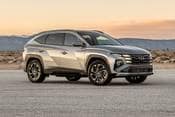
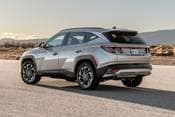
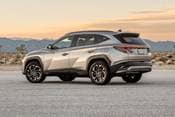
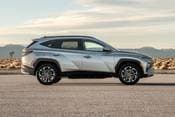
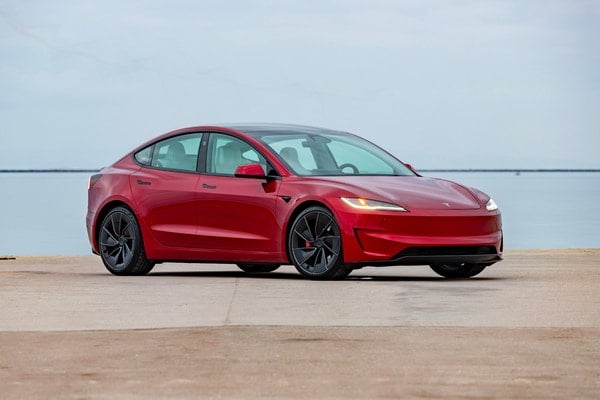
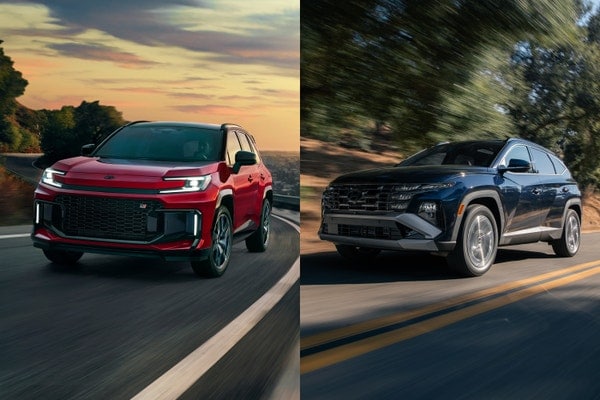
The 2025 Tucson Plug-in Hybrid is just like a regular Tucson but with a plug-in hybrid powertrain. It can drive more than 30 miles on all-electric power, and frequent charging can help you save on gas. It's also comfortable and packed with features. But it does a lot cost more than a regular Tucson.Read full review
Significant price jump compared to the regular Tucson
Less EV range and lower overall fuel efficiency than some competitors
What's new
New infotainment system
Revised interior controls
Mildly updated front and rear styling
Based on the fourth Tucson generation introduced for 2022
Overview
The 2025 Hyundai Tucson Plug-in Hybrid is exactly what it sounds like: a plug-in hybrid version of the automaker's popular small SUV. That means this Tucson has a small chargeable battery that can take you an EPA-estimated 33 miles on a single charge. The Tucson Plug-in Hybrid then switches to driving like a regular gas-powered hybrid after the battery runs out. We dig the Tucson's stylish exterior and its comfortable ride, but the plug-in hybrid is quite a bit more expensive than the regular Tucson and it doesn't offer as much electric-only range as some competitors.
According to GeoTab’s data, if the observed degradation rates are maintained, the vast majority of batteries will outlast the usable life of the vehicle.
EV Tax Credits & Rebates
Maximize savings on your Hyundai Tucson Plug-In Hybrid.
You could save$100
We’ll check your eligibility for:
Vehicle not eligible for federal EV credit
Local rebates
Edmunds does not share any data that you provide through this tool. We make every effort to provide accurate information, but please verify programs and eligibility before purchasing a vehicle. This information is provided subject to our Visitor Agreement.
Cost to Drive
$91/mo
Tucson Plug-In Hybrid
vs
$159/mo
SUV Avg.
Monthly estimates based on costs in Texas
Am I Ready for a Plug-In Hybrid?
EV ownership works best if you can charge at home (240V outlet)
Adding a home charging system is estimated to cost $1,616 in
The Tucson now comes with a 12.3-inch touchscreen and an available 12.3-inch digital instrument panel. The combo can give the impression that you're looking at one panoramic display. In reality, there's a bit of blank space separating the infotainment in the center of the cabin and the digital instrument cluster that sits behind the steering wheel. Still, it looks sharp. A more important upgrade comes underneath the big touchscreen: physical knobs. One of our biggest complaints about the Tucson is its haptic touch buttons, and while there are still too many of those for our liking, you can finally control your air conditioning with a knob.
Competitors to consider
If you're hoping for more all-electric range with your plug-in hybrid SUV, check out the Toyota RAV4 Prime. It gets an EPA-estimated 42 miles on a single charge, beating the Tucson by 9 miles. Happy with the range? Check out the Tucson's corporate cousin, the Kia Sportage Plug-in Hybrid. It's pretty much the same vehicle but with different styling. If you're put off by the plug-in hybrid's high price, getting a regular Tucson Hybrid is a fine alternative as well.
Edmunds Expert Rating
Our Verdict
Great
8.1
out of 10
edmunds TESTED
The 2025 Tucson Plug-in Hybrid is just like a regular Tucson but with a plug-in hybrid powertrain. It can drive more than 30 miles on all-electric power, and frequent charging can help you save on gas. It's also comfortable and packed with features. But it does a lot cost more than a regular Tucson.
How does the Tucson Plug-In Hybrid drive? Much like the hybrid version of the Tucson, the Plug-in Hybrid is superior to the gas version with quicker and smoother acceleration. Our test vehicle accelerated from 0 to 60 mph in 7.6 seconds, which is an average time for a plug-in small SUV. When traveling on solely battery power, the Tucson PHEV's electric motors are strong enough to get it to highway speeds without kicking on the gas engine most of the time. Pressing the accelerator aggressively will fire up the engine, though it quickly shuts off when its added power is no longer needed. The transmission downshifts quickly when called upon.
The Tucson Plug-in Hybrid's suspension is well tuned, offering comfort in most day-to-day situations while keeping body roll mostly under control. There isn't much feedback from the steering wheel, but the crossover is quick to respond to inputs and it's easy to track straight on the highway. The Plug-in Hybrid does have a Sport mode that turns on the gas engine all the time and makes the steering heftier, but the engine drone gets annoying after a while; the less aggressive drive modes are more suitable for most situations. The brakes work smoothly and also provide good emergency stopping power.
Comfort
8.5/10
How comfortable is the Tucson Plug-In Hybrid? The front seats offer good support and enough adjustments to find a comfortable position, though some drivers might prefer more telescoping action from the steering wheel. The back seat offers several recline angles and a long seat bottom cushion, so adults can be comfortable back there even on longer trips. The available front seat ventilation is a welcome feature for hot days.
Also helping to cool you down quickly is a great climate control system. Instead of a single auto setting, there are three (low, medium and high) that make finding a comfortable fan speed and temperature easy. There's also a diffuse mode, which keeps the cabin at a set temperature without blowing air directly on the passengers and lowering the fan noise considerably.
Interior
8/10
How’s the interior? For 2025, Hyundai came to its senses and added a pair of knobs to control the climate system. Some touch-based controls still exist and operating them is more complicated than it should be. Another problem is that the glossy black panel that covers the controls holds onto smudges and fingerprints like it's starting a collection. Keeping a soft cloth to wipe the screen and the panel off is a must in the Tucson.
The Tucson PHEV's interior room is a plus; adults will have no problem sitting in the rear seats. Visibility is pretty good out of the front and to the sides, but the chunky rear roof pillars can block the driver's view out back.
How’s the tech? The Tucson's touchscreen looks sharp and is pretty easy to use. The touch-sensitive controls placed near the screen allow you to get to the media, navigation or home screens quickly, though we've found the volume slider (instead of a traditional knob) can be annoying to use. Apple CarPlay and Android Auto are standard, though there's no wireless connectivity for either. (You need to use a USB cord to connect your phone.) Our test vehicle had the available Bose audio system; it's an upgrade over the standard six-speaker setup, but it's not especially impressive.
The advanced driver assist features in the Tucson Plug-in Hybrid are great. The available lane centering keeps the vehicle centered in the lane without bouncing it between the lines, and the adaptive cruise control works smoothly to accelerate and slow down with the flow of traffic. It doesn't add too much steering effort either, making it easy to override the system when needed. The Limited trim also features a blind-spot warning system that will display a live view of the Tucson PHEV's blind spot on either side when the turn signal is activated.
Storage
8/10
How’s the storage? The Tucson Plug-in Hybrid's larger battery takes up some cargo space. There's 31.9 cubic feet available behind the rear seats compared to 38.7 cubic feet in other Tucson models. But it's enough to be helpful for grocery runs and the like. The 60/40-split rear seats can also be folded down from the cargo area via a convenient pair of latches on either side of the cargo space, and that expands cargo room to 66.3 cubic feet. Up front, the Tucson PHEV has a few useful storage nooks and a small bin below the climate controls that also houses the wireless phone charger. The central bin is pretty large, but there isn't a convenient place to store a purse or bag so those may end up on the seat or the floor.
For those with young children, the Tucson PHEV has easy-to-access lower seat anchors and three upper anchors, one for each rear seat. There is enough room as well to fit any type of car seat without too much trouble, though to fit a rear-facing seat comfortably, the passenger may have to scoot forward slightly, but not so much as to be uncomfortable.
How’s the fuel economy? On our testing route, the Tucson PHEV logged 29.3 miles of range using just battery power. That comes in short of its EPA-estimated 33 miles of electric-only range, but it's still enough range to turn short errands or most commutes into gas-free affairs. Once our Tucson switched over to normal hybrid mode, we averaged 37.2 mpg for the rest of the route, which beat its EPA-estimated 35 mpg combined.
Value
8.5/10
Is the Tucson Plug-In Hybrid a good value? The Tucson Plug-in Hybrid commands a large price premium over the regular Tucson and the Tucson Hybrid as well, a difference that's harder to make up as the PHEV no longer qualifies for a federal tax credit as of this writing. The more you can use the PHEV solely on electric power, the quicker your costs will be recouped but it will take time.
Solid build quality and a strong feature set make the Tucson PHEV feel like it's worth its price on most occasions, and since it's a Hyundai, the robust warranty adds to its value proposition as well. Powertrain and battery components are covered for 10 years/100,000 miles and it comes with three years/36,000 miles of free scheduled maintenance.
Wildcard
7.5/10
The Tucson Plug-in Hybrid goes about its business without fuss and leaves the driver feeling satisfied but not wowed. Its styling will be hit-or-miss depending on who you're talking to — the exterior is covered in angles and creases that give the crossover vehicle a crinkly wrapper. Those grille-integrated daytime running lights give it an interesting visual signature at night, but at its core the Tucson PHEV is exceedingly practical transportation.
Which Tucson PHEV does Edmunds recommend?
Both Tucson Plug-in Hybrid trims have the same performance and fuel efficiency. But we think it's worth spending more to get the top Limited trim. It comes with a lot of worthwhile feature upgrades such as leather upholstery, ventilated front seats and additional driver aids.
The overall sentiment for the 2025 Hyundai Tucson Plug-In Hybrid is mixed. Owners love its smooth ride, good driving features, and ability to run on electricity for city trips, making it fun and cost-effective. However, some find it unreliable, with issues like long repair times and a lack of heat in colder climates. Additionally, the gas mileage isn't great on highways, and some owners mention poor service experiences with dealerships.
This summary is AI-generated from the text of owner reviews
We had our car for 3 months and it was great. We seldom filled it up with gas and as we mainly drive around town that was not too often. I was also very surprised that they hydro actually went down compared to the year before so it was not too hard on the hydro bill. But then one day I was dropping my wife off at a friend's place and when I went to reverse the car it went into neutral … and would not leave. I had to have it towed to the dealership and that was over 2 months ago and they are still telling me it might be another month before I get it back. I have been told that it is a 300 amp fuse that needs replaced but first it needs to be built in South Korea. Hyundai Canada has provided me with a rental car in the meantime, but I do miss my Tucson.
We have a limited number of reviews for the 2025 Hyundai Tucson Plug-In Hybrid, so we've included review for other years of the Tucson Plug-In Hybrid since its last redesign.
Key safety features on the Tucson Plug-In Hybrid include:
Back-up camera
Blind Spot Monitoring
Lane Departure Warning
Alarm
Tire Pressure Warning
Stability Control
Pre-collision safety system
Post-collision safety system
IIHS Rating
The Insurance Institute of Highway Safety uses extensive crash tests to determine car safety.
Small Overlap Front Driver-Side Test
Good
Small Overlap Front Passenger-Side Test
Good
Moderate Overlap Front Test – Original
Good
Moderate Overlap Front Test – Updated
Not Tested
Side Impact Test – Original
Good
Side Impact Test – Updated
Not Tested
Roof Strength Test
Not Tested
Rear Crash Protection / Head Restraint
Not Tested
FAQ
Is the Hyundai Tucson Plug-In Hybrid a good car?
The Edmunds experts tested the 2025 Tucson Plug-In Hybrid both on the road and at the track, giving it a 8.1 out of 10. Edmunds’ consumer reviews show that the 2025 Tucson Plug-In Hybrid gets an average rating of 4 stars out of 5 (based on 22 reviews) What about cargo capacity? When you're thinking about carrying stuff in your new car, keep in mind that the Tucson Plug-In Hybrid has 31.9 cubic feet of trunk space. And then there's safety and reliability. Edmunds has all the latest NHTSA and IIHS crash-test scores, plus industry-leading expert and consumer reviews to help you understand what it's like to own and maintain a Hyundai Tucson Plug-In Hybrid. Learn more
What's new in the 2025 Hyundai Tucson Plug-In Hybrid?
According to Edmunds’ car experts, here’s what’s new for the 2025 Hyundai Tucson Plug-In Hybrid:
New infotainment system
Revised interior controls
Mildly updated front and rear styling
Based on the fourth Tucson generation introduced for 2022
To determine whether the Hyundai Tucson Plug-In Hybrid is reliable, read Edmunds' authentic consumer reviews, which come from real owners and reveal what it's like to live with the Tucson Plug-In Hybrid. Look for specific complaints that keep popping up in the reviews, and be sure to compare the Tucson Plug-In Hybrid's 4-star average consumer rating to that of competing vehicles. Learn more
Is the 2025 Hyundai Tucson Plug-In Hybrid a good car?
There's a lot to consider if you're wondering whether the 2025 Hyundai Tucson Plug-In Hybrid is a good car. Edmunds' expert testing team reviewed the 2025 Tucson Plug-In Hybrid and gave it a 8.1 out of 10. Our consumer reviews show that the 2025 Tucson Plug-In Hybrid gets an average rating of 4 stars out of 5 (based on 22 reviews). Safety scores, fuel economy, cargo capacity and feature availability should all be factors in determining whether the 2025 Tucson Plug-In Hybrid is a good car for you. Learn more
How much should I pay for a 2025 Hyundai Tucson Plug-In Hybrid?
The least-expensive 2025 Hyundai Tucson Plug-In Hybrid is the 2025 Hyundai Tucson Plug-In Hybrid SEL 4dr SUV AWD (1.6L 4cyl Turbo gas/electric plug-in hybrid 6A). Including destination charge, it arrives with a Manufacturer's Suggested Retail Price (MSRP) of about $39,730.
Other versions include:
SEL 4dr SUV AWD (1.6L 4cyl Turbo gas/electric plug-in hybrid 6A) which starts at $39,730
Limited 4dr SUV AWD (1.6L 4cyl Turbo gas/electric plug-in hybrid 6A) which starts at $47,440
What are the different models of Hyundai Tucson Plug-In Hybrid?
If you're interested in the Hyundai Tucson Plug-In Hybrid, the next question is, which Tucson Plug-In Hybrid model is right for you? Tucson Plug-In Hybrid variants include SEL 4dr SUV AWD (1.6L 4cyl Turbo gas/electric plug-in hybrid 6A), and Limited 4dr SUV AWD (1.6L 4cyl Turbo gas/electric plug-in hybrid 6A). For a full list of Tucson Plug-In Hybrid models, check out Edmunds’ Features & Specs page. Learn more
" d="M896 513c116 45.015 222 64 304 75V0H0v501c40 36.024 154 76 340 76s344-146.269 556-64Z"/%3E%3C/mask%3E%3Cg mask="url(%23b)"%3E%3Cpath fill="url(%23c)" d="M896 513c116 45.015 222 64 304 75V0H0v501c40 36.024 154 76 340 76s344-146.269 556-64Z"/%3E%3Cpath fill="url(%23d)" fill-opacity=".15" d="M581.718 62.893c42.993 1.53 86.281 5.888 129.704 13.204 311.828 52.485 552.538 242.016 657.698 483.656-149.97-147.971-450.891-226.33-789.375-232.079-338.534.839-640.434 74.572-792.746 220.292 108.75-240.047 352.255-425.97 664.832-473.803a1041.548 1041.548 0 0 1 129.887-11.27Z"/%3E%3Cpath fill="url(%23e)" fill-opacity=".5" d="M611.247 209.93a1458.84 1458.84 0 0 1 139.573 27.692c333.61 83.239 577.16 267.208 668.67 475.188-148.93-138.63-468.279-241.218-835.209-290.421-367.6-43.915-702.265-24.445-881.281 72.561 140.567-178.524 422.355-295.817 766.181-293.074 47.867.484 95.274 3.212 142.066 8.054Z"/%3E%3Cpath fill="url(%23f)" d="M735.039 879.394c48.524-6.62 97.023-16.967 145.3-31.2C1227.03 746.059 1475.76 472.327 1564.28 145c-151.17 209.633-482.23 344.436-865.05 388.31C315.515 568.571-35.93 504.564-227 330.342-73.333 632.61 226.169 849.617 586.429 878.604c50.15 3.871 99.74 4.07 148.61.79Z" opacity=".3"/%3E%3Cpath fill="url(%23g)" d="M694.222 783.712c50.956 12 103.317 20.27 156.946 24.578 385.102 31.013 738.232-146.76 952.062-439.434-231.22 151.216-613.24 158.795-1012.047 55.796C394.784 312.716 68.643 114.101-55.211-133c37.44 360.528 253.087 691.895 601.449 858.946 48.557 23.091 97.963 42.302 147.984 57.766Z" opacity=".9"/%3E%3Cpath fill="url(%23h)" fill-opacity=".5" d="M896 513c116 45.015 222 64 304 75V0H0v501c40 36.024 154 76 340 76s344-146.269 556-64Z"/%3E%3C/g%3E%3Cdefs%3E%3ClinearGradient id="a" x1="1005" x2="989.087" y1="23" y2="552.522" gradientUnits="userSpaceOnUse"%3E%3Cstop stop-color="%23007EE5"/%3E%3Cstop offset=".333" stop-color="%231561D4"/%3E%3Cstop offset="1" stop-color="%230A4AAB"/%3E%3C/linearGradient%3E%3ClinearGradient id="c" x1="1005" x2="989.087" y1="23" y2="552.522" gradientUnits="userSpaceOnUse"%3E%3Cstop stop-color="%23007EE5"/%3E%3Cstop offset=".334" stop-color="%231561D4"/%3E%3C/linearGradient%3E%3ClinearGradient id="d" x1="675.999" x2="879.999" y1="648.999" y2="120.999" gradientUnits="userSpaceOnUse"%3E%3Cstop stop-color="%23fff"/%3E%3Cstop offset="1" stop-color="%23fff" stop-opacity="0"/%3E%3C/linearGradient%3E%3ClinearGradient id="e" x1="656.5" x2="637.602" y1="213" y2="622.259" gradientUnits="userSpaceOnUse"%3E%3Cstop offset=".115" stop-color="%23fff" stop-opacity="0"/%3E%3Cstop offset=".944" stop-color="%23017D8D"/%3E%3C/linearGradient%3E%3ClinearGradient id="f" x1="398" x2="737" y1="599" y2="387" gradientUnits="userSpaceOnUse"%3E%3Cstop stop-color="%2300ABB5"/%3E%3Cstop offset="1" stop-color="%2300A0B5" stop-opacity="0"/%3E%3C/linearGradient%3E%3ClinearGradient id="g" x1="1051.5" x2="271" y1="567" y2="575" gradientUnits="userSpaceOnUse"%3E%3Cstop stop-color="%230098C2"/%3E%3Cstop offset="1" stop-color="%23033E96" stop-opacity="0"/%3E%3C/linearGradient%3E%3ClinearGradient id="h" x1="1005" x2="986.038" y1="23" y2="587.43" gradientUnits="userSpaceOnUse"%3E%3Cstop offset=".813" stop-opacity="0"/%3E%3Cstop offset=".972"/%3E%3C/linearGradient%3E%3C/defs%3E%3C/svg%3E)