" d="M896 513c116 45.015 222 64 304 75V0H0v501c40 36.024 154 76 340 76s344-146.269 556-64Z"/%3E%3C/mask%3E%3Cg mask="url(%23b)"%3E%3Cpath fill="url(%23c)" d="M896 513c116 45.015 222 64 304 75V0H0v501c40 36.024 154 76 340 76s344-146.269 556-64Z"/%3E%3Cpath fill="url(%23d)" fill-opacity=".15" d="M581.718 62.893c42.993 1.53 86.281 5.888 129.704 13.204 311.828 52.485 552.538 242.016 657.698 483.656-149.97-147.971-450.891-226.33-789.375-232.079-338.534.839-640.434 74.572-792.746 220.292 108.75-240.047 352.255-425.97 664.832-473.803a1041.548 1041.548 0 0 1 129.887-11.27Z"/%3E%3Cpath fill="url(%23e)" fill-opacity=".5" d="M611.247 209.93a1458.84 1458.84 0 0 1 139.573 27.692c333.61 83.239 577.16 267.208 668.67 475.188-148.93-138.63-468.279-241.218-835.209-290.421-367.6-43.915-702.265-24.445-881.281 72.561 140.567-178.524 422.355-295.817 766.181-293.074 47.867.484 95.274 3.212 142.066 8.054Z"/%3E%3Cpath fill="url(%23f)" d="M735.039 879.394c48.524-6.62 97.023-16.967 145.3-31.2C1227.03 746.059 1475.76 472.327 1564.28 145c-151.17 209.633-482.23 344.436-865.05 388.31C315.515 568.571-35.93 504.564-227 330.342-73.333 632.61 226.169 849.617 586.429 878.604c50.15 3.871 99.74 4.07 148.61.79Z" opacity=".3"/%3E%3Cpath fill="url(%23g)" d="M694.222 783.712c50.956 12 103.317 20.27 156.946 24.578 385.102 31.013 738.232-146.76 952.062-439.434-231.22 151.216-613.24 158.795-1012.047 55.796C394.784 312.716 68.643 114.101-55.211-133c37.44 360.528 253.087 691.895 601.449 858.946 48.557 23.091 97.963 42.302 147.984 57.766Z" opacity=".9"/%3E%3Cpath fill="url(%23h)" fill-opacity=".5" d="M896 513c116 45.015 222 64 304 75V0H0v501c40 36.024 154 76 340 76s344-146.269 556-64Z"/%3E%3C/g%3E%3Cdefs%3E%3ClinearGradient id="a" x1="1005" x2="989.087" y1="23" y2="552.522" gradientUnits="userSpaceOnUse"%3E%3Cstop stop-color="%23007EE5"/%3E%3Cstop offset=".333" stop-color="%231561D4"/%3E%3Cstop offset="1" stop-color="%230A4AAB"/%3E%3C/linearGradient%3E%3ClinearGradient id="c" x1="1005" x2="989.087" y1="23" y2="552.522" gradientUnits="userSpaceOnUse"%3E%3Cstop stop-color="%23007EE5"/%3E%3Cstop offset=".334" stop-color="%231561D4"/%3E%3C/linearGradient%3E%3ClinearGradient id="d" x1="675.999" x2="879.999" y1="648.999" y2="120.999" gradientUnits="userSpaceOnUse"%3E%3Cstop stop-color="%23fff"/%3E%3Cstop offset="1" stop-color="%23fff" stop-opacity="0"/%3E%3C/linearGradient%3E%3ClinearGradient id="e" x1="656.5" x2="637.602" y1="213" y2="622.259" gradientUnits="userSpaceOnUse"%3E%3Cstop offset=".115" stop-color="%23fff" stop-opacity="0"/%3E%3Cstop offset=".944" stop-color="%23017D8D"/%3E%3C/linearGradient%3E%3ClinearGradient id="f" x1="398" x2="737" y1="599" y2="387" gradientUnits="userSpaceOnUse"%3E%3Cstop stop-color="%2300ABB5"/%3E%3Cstop offset="1" stop-color="%2300A0B5" stop-opacity="0"/%3E%3C/linearGradient%3E%3ClinearGradient id="g" x1="1051.5" x2="271" y1="567" y2="575" gradientUnits="userSpaceOnUse"%3E%3Cstop stop-color="%230098C2"/%3E%3Cstop offset="1" stop-color="%23033E96" stop-opacity="0"/%3E%3C/linearGradient%3E%3ClinearGradient id="h" x1="1005" x2="986.038" y1="23" y2="587.43" gradientUnits="userSpaceOnUse"%3E%3Cstop offset=".813" stop-opacity="0"/%3E%3Cstop offset=".972"/%3E%3C/linearGradient%3E%3C/defs%3E%3C/svg%3E)
2010 Honda Insight Review
Price Estimate: $1,243 - $3,700




Price & Payment
Changing year will take you to a new page
Average price: $6,984
$
to$
Price
Edmunds' Expert Review
Pros
- Affordable price, excellent fuel economy, seamless hybrid powertrain, pleasant driving experience.
Cons
- Tight backseat, invasive road noise.
What’s new
The Honda Insight hybrid is back. This time, however, it's been reincarnated as a four-door sedan that serves as Honda's answer to the iconic Toyota Prius.
Edmunds says
The 2010 Honda Insight largely improves upon the tried-and-true formula of the rival Prius, and it costs thousands less.
For sale near Cupertino, CA
57 listings
- New Listing$7,500fair price$705 below market
- 86,000 miles
- 40 City / 43 Hwy MPG
- 101 mi away
Close
Located in North Highlands, CA
- Features and Specs:
- 41 Combined MPG (40 City/43 Highway)
- Listing Information:
- VIN:
- JHMZE2H55AS042866
- Stock:
- 2222
- Certified Pre-Owned:
- No
- Listed since:
- 09-15-2026
- $5,997good price$951 below market
- 132,070 miles
- 40 City / 43 Hwy MPG
- 292 mi away
Close
Located in Los Angeles, CA
2010 Honda Insight EXCLEAN TITLE AND CLEAN CARFAXThis California-owned 2010 Honda Insight EX is in super clean condition, runs and drives great, and h...
- Features and Specs:
- 41 Combined MPG (40 City/43 Highway)
- Listing Information:
- VIN:
- JHMZE2H79AS024582
- Stock:
- 024582
- Certified Pre-Owned:
- No
- Listed since:
- 07-30-2026


Vehicle overview
For most of this decade, Toyota's 46-mpg Prius has enjoyed a virtual monopoly in the extreme fuel-miser segment. Only Honda's 42-mpg Civic Hybrid comes close, and its sales have been hampered by lethargic acceleration and a not-hybrid-looking-enough sedan body design. Enter the four-door 2010 Honda Insight, which takes dead aim at Toyota's green machine by offering comparable fuel economy and a look-alike hatchback layout at a considerably lower price. Of course, those with a longer memory might recall the first-generation Honda Insight, too, but its futuristic look was too impractical for most people despite stellar fuel efficiency. Not so version 2.0.
Under the new Insight's hood is Honda's familiar Integrated Motor Assist (IMA) hybrid system. IMA starts with a 1.3-liter four-cylinder gasoline engine that produces 88 horsepower and 88 pound-feet of torque, and it adds an electric motor that generates another 13 hp and 58 lb-ft, enough to propel the Insight up to 30 mph without the gas engine's help. A nickel-metal hydride battery pack keeps the electric motor whirring, and the electric motor returns the favor via regenerative braking, becoming a battery-charging generator when the brakes are activated. Notably, the gas engine's crankshaft never stops spinning, even when the Insight is operating solely on electric power, so there's no unseemly coughing or rumbling as the gas engine comes online.
In addition to seamless and adequately perky performance, the payoff is an EPA-estimated 40 mpg city/43 highway and 41 combined, according to Honda. That's a bit off the Toyota's pace, but the deficit shouldn't be a significant factor for most buyers. Over the course of a 15,000-mile year of driving, the Insight will run you an extra 40 gallons of gas, which accounts for a tiny fraction of the money you'll save by choosing the Insight in the first place. With a starting price in the high teens, the Insight handily undercuts its crosstown rival's $22,000 base price, not to mention the Civic Hybrid's $23,550 cost of entry. In fact, the loaded Insight EX with the navigation system won't cost too much more than a bare-bones Prius.
The Insight has two significant warts: Its backseat is considerably tighter than the Toyota's family-sedan-grade rear quarters, and there's plenty of Honda's trademark road noise at higher speeds. On the flip side, though, it has sensible gauges and a superior driving position. Given its impressive talents and attractive price, it's hard to fault the 2010 Honda Insight. Until the next Prius arrives, at least, the Insight is the new ruler of the hybrid-hatchback roost.
Performance & mpg
The 2010 Honda Insight's hybrid system consists of a 1.3-liter four-cylinder gasoline engine and an electric motor paired with a nickel-metal hydride battery pack. The gas engine is good for 88 hp and 88 lb-ft of torque, while the electric motor chips in 13 hp and 58 lb-ft. Due to varying power peaks, the maximum combined output is 98 hp and 123 lb-ft of torque. At our test track, the Insight zipped from zero to 60 mph in 10.9 seconds -- a few tenths slower than the Prius, but a substantial 2.6 seconds quicker than the Civic Hybrid.
According to Honda, EPA fuel economy ratings are 40 mpg city/43 highway and 41 combined.
Safety
All Insights come standard with antilock brakes (front disc/rear drum), front-seat side airbags and side curtain airbags. However, the base Insight LX lacks stability control and traction control, which come standard on the EX.
Driving
The words "hybrid" and "sporty" remain mutually exclusive at this modest price point, but the 2010 Honda Insight is by far the most enjoyable hybrid hatchback to drive. The ride is firm, the steering is relatively responsive and the crankshaft's constant rotation makes for seamless transitions between electric-only and full hybrid power. Braking, too, feels refreshingly normal relative to the wonky regenerative systems found in some other hybrids. No one would call the Insight quick, but its acceleration should prove adequate for shoppers in this segment. On the downside, there's bothersome road noise at highway speeds, and the gas engine gets buzzy under heavy acceleration.
Interior
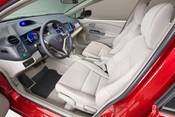
Inside, the 2010 Honda Insight is a distinctive mix of familiar Honda design elements and edgy hybrid-themed flourishes. Taller drivers will appreciate the telescoping steering column, while shorter ones will enjoy the height-adjustable driver seat. Most major controls are intuitive in operation, including the standard automatic climate control system -- a nice perk at this price. Thankfully, the gauges are mounted directly forward of the steering wheel, as opposed to the Prius' wonky center-mounted readout.
Charmingly or annoyingly, depending on your disposition, the background color of the Civic-style digital speedometer switches from blue to green when you're being judicious with your right foot. An "ECON" button to the left of the steering wheel makes the powertrain even more efficient, albeit at a tangible cost in straight-line performance. Unfortunately, the rear quarters are uncomfortably tight for adults. Toyota's roomy hybrid still trumps the Insight in this regard. The convenient hatchback lifts up to reveal 15.4 cubic feet of luggage space -- 31.5 cubes with the 60/40-split rear seats folded down.
2010 Honda Insight models
The 2010 Honda Insight is a four-door hatchback available in base LX and uplevel EX trims. The LX comes standard with 15-inch steel wheels, full power accessories, automatic climate control, a tilt/telescoping steering column, a height-adjustable driver seat and a four-speaker CD audio system with an auxiliary audio jack. The EX adds alloy wheels, side-mirror-mounted turn signal indicators, stability control, cruise control, variable intermittent wipers, steering-wheel-mounted paddle shifters and a six-speaker audio system with a USB port and a fully integrated iPod connection. The lone option is a navigation system (EX only) that includes voice-activated controls and Bluetooth connectivity.

2027 Honda Civic Type R: Costs Nearly $50,000, Gets Tiny Updates
Shopping for a Toyota Sienna? Consider These 3 Alternatives
2027 Nissan Rogue Hybrid vs. Honda CR-V Hybrid and Toyota RAV4: Nissan Re-Enters a Crowded Segment

2026 Honda Prelude: What's It Like to Live With?
Owners' Opinions
What Owners Like
Owners consistently praise the 2010 Honda Insight for delivering hybrid savings without turning daily driving into a science project. Many report 40-45 mpg in mixed use, with highway numbers that climb higher on steady commutes and city numbers that hold up when the car is driven lightly. The Insight also earns repeat credit for long-term durability, with multiple owners logging well past 100,000 miles and describing little more than tires, wiper blades, fluids, or other routine wear items. That kind of track record matters because it keeps ownership costs down after the sticker shock fades, and it matches our view that the Insight’s strongest selling point is its low-drama efficiency. Owners also like the way the cabin is laid out, especially the controls that sit close at hand and the clear, directly ahead instrument display that makes it easy to monitor driving behavior. The hatchback shape gets strong approval for cargo flexibility, since folded rear seats and the wide opening make the car useful for errands, commuting gear, and the occasional bulky haul. Driving manners are another recurring bright spot, even from people who admit the Insight is not fast. The steering and suspension get credit for feeling composed in city traffic and on curving roads, and the brake response is described as more natural than what many buyers expect from a hybrid. Several owners also value the way the car teaches smoother habits through its dash feedback and eco guidance, since that makes it easy to see how small changes affect fuel use. Front-seat comfort and visibility draw positive comments often enough to matter, especially from drivers who spend long stretches on the highway or in stop-and-go traffic. We also keep seeing appreciation for the Insight’s value equation: it costs less than a Prius, still delivers hybrid mileage, and gives buyers a simple, reliable commuter that can rack up years of service with little fuss.
Common Issues
The 2010 Honda Insight’s most common complaints center on space, power, noise, and durability. Rear-seat room comes up again and again as a problem, with adults finding the back seat tight on anything beyond short trips and the low roofline making ingress and visibility more awkward than it should be. Acceleration is another frequent frustration, especially on hills, in mountain driving, or when merging onto faster highways, where the Insight can feel short on reserve power and slow to respond. Several owners note that ECON mode can make the car feel even more sluggish by cutting performance and, in some cases, limiting climate-system output in hot or cold weather. Road and engine noise also draw regular criticism, particularly when the car is pushed hard or driven at highway speeds, where the small gas engine can get buzzy and the cabin can pick up a lot of pavement noise. Visibility issues show up too, with rearward sightlines, the split rear window, and hatch design making backing up and lane changes less confidence-inspiring than in some rivals. A number of owners also report finish and hardware problems that go beyond normal wear, including paint chipping on the hood, rust around rear wheel wells or along the frame, dried-out window seals, and weather stripping that comes loose. Interior materials take a beating in some cars, with hard plastics, cheap-looking trim, and pieces that seem to age faster than the mileage would suggest. The navigation system and audio setup are another sore spot for some buyers, who describe the nav interface as clumsy, the maps as outdated, and the stereo or phone integration as more limited than they expected. A few owners also mention recurring electrical or hybrid-related issues, including warning lights, window switch glitches, ABS or stability-control faults, and repairs tied to the A/C compressor or hybrid cooling system.
Final Takeaways from Everyday Drivers
The 2010 Honda Insight proves that a low-cost hybrid can work as a daily driver without demanding much in return. Owners who use it for long commutes, short urban hops, and high-mileage errands repeatedly describe a car that starts every day, sips fuel, and keeps running with little more than scheduled maintenance and consumables. That reliability shows up in the mileage figures, too, because many drivers report the low-40s mpg with mixed use and even better results when they stay off hills, keep speeds modest, and skip heavy use of ECON in cold weather. The Insight’s cabin also holds up as a practical place to live, with controls that are easy to reach, a driving position that works well for many front-seat occupants, and a hatch that swallows more than its small footprint suggests. The tradeoffs are just as consistent in daily life: rear passengers sit in a tight space, highway passes take planning, and winter weather can pull the mileage down while making the drivetrain feel less eager. Some owners have also seen paint, trim, window, and seal issues that don’t match Honda’s reputation for durability, which makes inspection important on used examples. Still, the overall pattern is hard to miss, because the Insight keeps earning loyalty from people who bought it to save money, cut fuel bills, and avoid repairs, and it keeps doing that job long after the novelty of the hybrid badges wears off. Even after years of commuting, grocery runs, and road trips, many owners still talk about the car as the one they instinctively reach for when they want to get in, drive, and not think about much else.
Cost to Drive
Monthly estimates based on costs in California
$193/mo for Insight LX
vs
$334/mo
Avg. Compact Car
Reliability
The 2010 Honda Insight has a 3 years / 36,000 miles basic warranty and 10 recalls. RepairPal gives it a reliability rating of 4.5 out of 5, ranks it #5 out of 6 among Alternative Fuel Vehicles. Below you’ll find our owner reviews.
Reliability Rating by RepairPal
/5Excellent
#5 out of 6 among Alternative Fuel Vehicles
powered by RepairPal
Recalls
10 recalls foundWarranty
3 years / 36,000 miles Basic WarrantyHonda Insight Reviews
Owner Reviews
5(76%)
4(17%)
3(6%)
2(1%)
1(0%)
Most Helpful Owner Reviews
Great little car, not up to brutal winters
Johannes Smith, 01/17/2016
2010 Honda Insight EX 4dr Hatchback (1.3L 4cyl gas/electric hybrid CVT)
Year 2 update - still solid, no major mechanical issues after 3 years, up to about 90k miles. Winter performance is still only OK for both drive quality and fuel economy, but overall performance is a solid 4/5 stars. No major mechnical issues make this a ludicrously cheap car to drive.
Year 1 Update - still a solid little car. I need to preface everything I say next with this, the … Insight is the cheapest hybrid out there. If you're going for MPGs and utility at bottom dollar, and don't mind a few quirks, it's an awesome car.
Driving quality is... weird. Car rolls backwards on hills very readily. Hybrid drive is the slightest bit balky when it triggers. Pedals feel loose and floaty, in a minor way. I call this car "The Gadget" because a few elements of the drive train feel like they're still just prototypes. The flip side is, strangely, car has plenty of pickup. Gets on the highway very comfortably, can accelerate into small gaps in traffic no problem. All that combines with an average of about 40-41MPGs in good weather, 30-31MPGs in very cold weather.
No major mechanicals after one year. I hear Honda's are famously reliable, and I believe it. I replaced the tires, the OEM tires were shot after 75K miles. Replacement tires have some issues, not sure if that is the wheels or the tires. My fault if it's the tires, Honda's if it's the wheels.
---
So, I should start with the positive - bought a 2010 Insight EX in 2015. On the used market, they're going for sub 10K, and that means that entry level combustion engine cars are the same price as entry level hybrids. I had to give the hybrid a shot!
In all the classic measurements of a car, the Insight excels. Acceleration is solid, it gets on the highway comfortably and can speed up to avoid hazards. Food for thought here, this car does 0-60 in 11.9 seconds. That compares to the gasoline Lancer of the same year at 11.4 seconds. The difference in fuel economy is a staggering 26MPG vs 43MPG. I'll leave you to do the cost/benefit analysis there.
The interior is very comfortable, I love the seats. Safety features are cool (I'm upgrading from a cromagnon car with 1 airbag, so I'm excited to see 5 obvious airbags). The headlights on the EX are dazzlingly bright.
For issues, there are 2 minor design flaws. Cabin view is not great - rearward visibility could be better with better pylon placement. The hatchback could also be roomier, it gets pretty tight back there. These are minor flaws - the view is most of the way there, and the hatchback is a great feature decently executed.
The most perplexing issue with this overall great car is the winter performance. I am a Chicagoan. Sometimes, Chicago winter is colder than the dark side of the moon (and that is factual truth, google it). This winter has been average. The Insight's electric engine does not engage below a given temperature, usually below 20-30. The gasoline engine provides decent to good driving performance, but a much lower fuel efficiency. I'm averaging 31MPG in January.
Also, the A/C unit is relatively weak, so it takes a significant amount of time to get the car hot. Maybe it's attempting to route heat to the hybrid drive's battery, I'm not sure - in either case, winter performance is out of line with general performance.
I love my 2010 Honda Insight
msajm41, 05/17/2014
2010 Honda Insight LX 4dr Hatchback (1.3L 4cyl gas/electric hybrid CVT)
I had my 2010 Honda Insight for 5 years.
The gas mileage was around 40 mpg, and about 45 mpg on long trips.
I used synthetic oil in it since I bought it.
I never had any major repairs on it.
It was a great car.
It wasn't the most comfortable on long trips.
I never sat in the back seat so I'm not sure if they were comfortable.
My older friends had trouble getting in and out of the back … seat.
But it was a nice car for the price, reliable, nice looking, and had great gas mileage.
133,081 miles, $3,000 warranty refunded, no probs
Doc, 10/20/2015
2010 Honda Insight EX 4dr Hatchback (1.3L 4cyl gas/electric hybrid CVT)
This was the most undervalued vehicle from 2010. Bought new. Get 41mpg still with Eco on. Driven all over US. Highway excellent. Safe. Still have original rotors. No problems except when 1st bought recall on a rubber trim. Just bought a Pioneer radio with Carplay. Amazing vehicle. I expect will see 200,000 miles plus. Got $3,000 back from extended warrantee because I never … used it. Mine made in Japan before tsunami. Best investment. Replaced a crappy BMW convertible that nickled and dimed me. UPDATE 2017: 170,000 miles and counting. Repaired tire pressure sensor and brake lights. 1st major repairs. $500.
after 25k miles: the facts plus a few comments
rickinseagrove, 01/12/2011
2010 Honda Insight EX 4dr Hatchback (1.3L 4cyl gas/electric hybrid CVT)
The car is very econmical to operate and gets way better mileage than EPA estimate. Lifetime average fuel economy to date is 51 MPG (measured). Best tank average to date is 60 MPG (measured). The car computer over estimates mileage by 2 or 3 MPG. It gets significantly better mileage in the summer than in the winter. The 60 MPG tank average was during Aug. in Florida with slightly … overinflated (40 PSI) tires on my daily 25 mile commute. I've change the oil 3 times in 25k miles. No other maintenance cost or issues to date. Honda replaced the IMA battery for free after a warning light came on when it was 2 months old. Really like the styling but they should use better interior materials. iLuvIt