If there's an ever-changing segment of the automotive industry, it's the family-friendly world of minivans. In the 29 months since our last hard look at the segment, it has completely turned itself over. The Kia Sedona and Honda Odyssey have been overhauled, while the Nissan Quest and Chrysler Town & Country have been given thorough once-overs. To see which is the king of the modern mommy-mobiles, we brought the four together, along with the winner of the 2004 comparison test, the Toyota Sienna.
Each of the five vans packs a V6 engine, an automatic transmission and two power-sliding doors. Since the Sienna is the only one of the five available with all-wheel drive, we asked for one so equipped. The other four vans are front-wheel drive.
As tested, prices ranged from $31,595 for the Kia to $43,523 for the Toyota. Both the Nissan and the Honda showed up with the expensive run-flat-tire option which didn't do their sticker prices any favors. At $38,125, the Chrysler was cheaper than both.
The wringer
Despite their accommodating intent, these vehicles are the products of ruthless competition for loyalty and dollars, each manufacturer vying for dominance by trying to out-convenience, out-versatility, out-feature, and lately, out-coddle one another.
So in addition to our usual test battery of acceleration, handling and braking, we lived with all five minivans for three weeks, filling them with the screaming kids and screaming adults of our daily lives. We crept in L.A. traffic to and from the office, and exercised them on hours-long trips through the mountains. Last, we evaluated their composure in swallowing and hauling a load of cargo and five passengers over a driving route consisting of freeway travel, rough surface streets and urban city roads.
Here's how they finished.
Originator of the breed
To get a flavor of the unique "Stow 'n Go" fold-flat second row seating, a feature introduced in 2005, we tested a long-wheelbase Chrysler Town & Country dressed in the top-tier Limited trim level.
Twin to the Dodge Caravan, the Town & Country is the elder statesman of the pack. With the explosive growth of the segment it created, the Town & Country has seen incremental revisions in an attempt to keep pace with its younger rivals. Despite riding on the same fundamental platform that debuted nearly 10 years ago, the Chrysler has enjoyed tremendous popularity over the years. Stow 'n Go in particular is an ingenious system, allowing a flat floor without the hassle of removing the second-row seats. Doubling as storage, Stow 'n Go can ingest more cargo than any other minivan we tested. A heart transplant wouldn't hurt, as the Town & Country's four-speed automatic transmission and 215-horsepower engine turned in the weakest performance of all.
Ultimately, the Town & Country's ongoing updates and innovative seating aren't enough to hide the fact that it's a relic from a bygone era. It is simply outclassed by the rest.
Livin' in style
/The Quest's nontraditional approach to the world of minivans has historically polarized opinions. For 2007, Nissan revamped the Quest with a new interior and an updated features list.
Screw the minivan stereotype. Nissan wants to change the long-standing notion that minivans are bland appliances for bland people. This approach is obvious from its daring exterior styling, and the Quest's new interior offers a unique blend of ambience and elbow room. Driving enthusiasts in particular will appreciate the Quest's behavior at the helm, strong performance numbers from its 235-hp power plant notwithstanding.
Although the 2007 Quest 3.5 SE we tested is dynamically strong and has a sharp style, it still needs to function as a minivan. A few shortcomings like a one-piece third-row seat, limited cargo capacity and crummy seats were dings it couldn't quite recover from. As such, the better versatility of its stiff competition at the front of our rankings left the Quest fighting for scraps.
Looking down the barrel of four guns
Toyota's Sienna is left to do battle with these upstarts armed with the same basic platform that topped our finishing order in 2004. It was all-new back then, and the second-generation Toyota Sienna enters 2006 with a face-lift and revisions to its standard equipment.
More than just a basic minivan, the 215-hp Sienna excels at mixing practicality and feature content. Long trips bring out the best in the Sienna, providing high levels of comfort in all three rows, a spacious standard cargo area, and a fluid, accommodating ride. The Sienna is the only minivan offered with all-wheel drive, and although it didn't help its scoring in our dry, warm Southern California climate, it offers snowbirds an extra degree of security.
Our Sienna XLE AWD Limited tester has a lot to offer and continues to play a strong role as the do-gooder of the bunch, but its high price kept it out of 1st place. The standard of the segment is an ever-moving target.
New kid, familiar name
Kia's Sedona arrived this year as an all-new model, available in LX or EX trims. For this comparison test we included our long-term EX model, which offers more standard equipment and options than the LX model but is otherwise similar.
Full of surprises, acceleration from the 244-hp 3.8-liter V6 was tops in this crowd, and the Sedona's stopping power was equally reassuring, requiring the shortest length of road. The Sedona doesn't trade practicality for performance either, and its feature content is comprehensive.
What really tipped the scoring scales in the Sedona's favor, though, was its low sticker price. Combined with consistently good, if not chart-topping, evaluation scores, the Sedona was armed with a recipe for a competitive result.
With its stout value, strong performance and impressive warranty, the larger and better-equipped 2006 Sedona pulled out a 2nd-place finish.
The other new kid with an even more familiar name
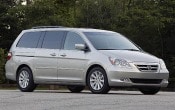
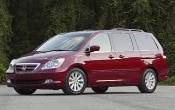
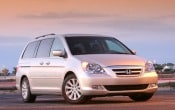
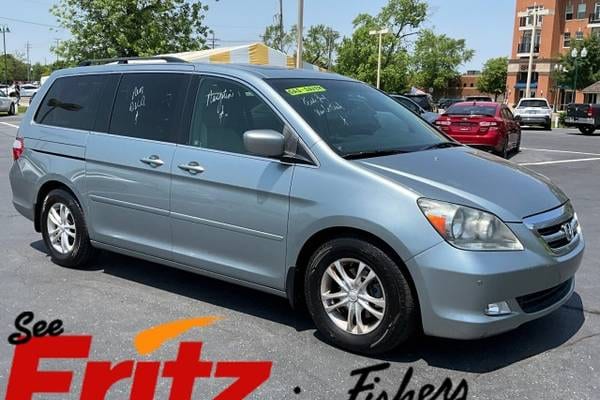
Honda introduced a fresh Odyssey in 2005, replacing the outgoing model we ranked in 2nd place in our 2004 comparison test. Our test Odyssey was a top-of-the-line Touring with navigation, which is, like the other minivans here, the most deluxe model available.
The price of doing business in the minivan segment is to be all things to all people, and no other minivan came close to the Odyssey in meeting that challenge. Viewed from any perspective, be it ease of use, comfort, performance or utility, the Odyssey was at or near the top of the rankings. Plenty of cargo space, clever touches and the reassurance of 244 hp don't hurt either. Honda nailed it with this one.
The Odyssey has been a strong contender in the past, and based on our experience with a 2005 long-term tester, our expectations were high. The 2006 model delivered. With an interior that would make a Bentley blush and road manners not found in many sedans, the Odyssey claims the top spot.
The manufacturers provided Edmunds these vehicles for the purposes of evaluation.
First Place: 2006 Honda Odyssey
Once the driving and photo shoots are done and it's time to pack up and head home, the comparison test begins. At that point, the vehicles are disseminated to the editors on hand and each one jockeys for position, vying for the one vehicle they'd most like to keep for themselves for the evening. For this test, it was the Odyssey that had grown men and women elbowing one another to get their selfish paws on its keys. Can't blame them, really. It's just that the Honda does everything so damned well.
A juicy center
Today, making a splash means sweating the details, and the Honda sweats them like Richard Simmons to the oldies. Just a few short years ago, dual power-sliding doors and a power liftgate bordered on wretched excess; now they're practically commonplace. In fact, all five minivans in our test sported those items. Sliding second-row windows — found only on the Odyssey, Sedona and Sienna — are destined to be the next must-have minivan items. The bar is always moving.
What makes our leather-equipped Touring model stand out from the crowd begins with its limousinelike interior and class-leading seat comfort. It just oozes class inside, coddling its occupants with rich textures. Thoughtful touches and bins, cubbies and nooks are everywhere. In back, the third-row seats literally stow themselves, and the rear cargo area is second only to the Sienna in its ability to gulp down gear.
Cupholders? The Odyssey's got 17 of them. There's even a lazy Susan between the first and second rows, a reconfigurable and easily accessible space perfect for the detritus that inevitably accumulates when transporting children.
Behind the wheel, the Odyssey presents its driver with exceptionally comfortable captain's chairs and an almost intimidating number of controls. Fortunately, the dash is logically laid out, though the audio controls are mounted pretty low and we'd prefer knobs instead of rocker levers for the HVAC. At 7.9 inches diagonally, the Odyssey's nav screen is simply huge, and its operation doesn't require a Ph.D.
Refined sweets
What's more, it's not a stretch to say that the Odyssey drives like no other minivan here. Test notes from its slalom-topping performance of 61.0 mph gushed: "Wow, this one is remarkably better than the rest. There's nothing to remind you you're driving a minivan. It just shrinks up around you as you begin tossing it from cone to cone.
You can even pedal it a little to coax some rotation. Steady and balanced."
On the road, this prowess has a fairly supple ride quality with just a hint of that "heavy wheel" sensation over small bumps that some drivers are tuned into. This is at least partly attributable to the Michelin PAX run-flat wheel and tire combos, part of the Odyssey's Touring package, which are also found on our Nissan Quest tester. At first blush, run-flats appear to be a no-brainer until considerations like wear and replacement are taken into account. For a deep dive on the subject, see our run-flat piece.
If there's anything average about the Odyssey, it's the brakes. Stopping from 60 mph required 136 feet, beating out only the Chrysler. Despite the underwhelming result, the Odyssey's brake pedal offers up decent modulation and effort.
Motivating all Odysseys is a 3.5-liter SOHC V6 pumping out 244 horsepower and 240 pound-feet of torque. What's most unique about it in this group is its cylinder deactivation feature, known as VCM in Honda-speak. VCM transparently boosts the Odyssey's fuel economy to 20/28 mpg city/highway, the highest in this test, without sacrificing full-throttle performance.
Honda's V6 is a tractable and smooth operator, having little difficulty hauling around the Odyssey's hefty 4703-pound curb weight. In fact, the Odyssey was bested only by the Sedona in quarter-mile acceleration, tying the Quest with a 17.0-second elapsed time.
The aperitif
There's a depth to the Odyssey lacking in the other minivans, a sense that no detail was given short shrift just to meet a deadline. From the seat-folding mechanisms to the navigation interface, every lever and latch operates intuitively and with low effort. It's like Honda deployed a whole battalion of engineers on each device.
When deciding on which of those devices you'd like, don't be thrown by Honda's model strategy. They tend to bundle options in chunks and then try to convince you it's a separate trim level, with all those options included as "standard equipment." For example there's a base Odyssey, an Odyssey with leather, an Odyssey with leather and entertainment and so on. Just know that an Odyssey Touring with nav and entertainment is fully loaded, yet has "no options."
We did spot a few blemishes on the Honda's gleaming armor. One of our editors of shorter stature had some difficulty finding the ideal driving position, suggesting that a telescoping wheel would help. And while the fit and finish was impeccable, our tester had some unusual issues like a faint whistle from the front end at around 30 mph and an occasional creak from one of the sliding doors.
Those quibbles weren't nearly enough to dislodge the Odyssey from 1st place, a position it strode to very early in our test. The Odyssey hits the minivan sweet spot, offering something for everyone. It's got Quest dynamics blended with Sienna practicality, and offers an ease of use untouched by any of the others. With its $39,380 as-tested price, it's not as affordable as the Sedona, but it still manages to undercut two rivals. Even without factoring in price, the Odyssey clinches the top spot as the most accomplished minivan on the market.
Second Place: 2006 Kia Sedona EX
Kia's all-new 2006 Sedona is the Clark Kent of minivans, getting the job done well without attracting undue attention to itself. With solidly midpack evaluation scores, it never quite turns into a superhero, instead using the weapon of super-low price to subdue most of its villains. The dust has settled and the Sedona's strong 2nd-place finish, like all good superhero stories, still leaves you primed for a sequel.
And if the Sedona looks familiar, maybe you've seen its badge-engineered clone, the Hyundai Entourage. It's really tempting to continue the superhero analogy here and refer to it as the evil twin, but that would just be mean.
Doing it well
Just because the Sedona is less expensive than its competition doesn't mean it is bare-bones. Equipped with standard stability control, five-speed autobox, a full complement of airbags and sliding second-row windows, the Sedona's feature list gives away very little to the others.
With power second- and third-row windows, DVD player, power-sliding doors and liftgate, and premium audio, this Kia is pimpin'. One glaring omission is the lack of a navigation system, which is not available in any Sedona.
Most of the good stuff is optional, though, but not to worry — those items won't break the bank either. Go ahead, load it up with all the options. Our fully optioned range-topping EX rang in at $31,595, which is $6,530 less than the next thriftiest Town & Country we tested. This is serious savings, and it played a huge role in propelling the Sedona into 2nd place.
Hot rod of the bunch
Another factor in the Sedona's strong showing is its performance. In one of the most unexpected outcomes in our test, the Sedona swept our acceleration tests and out-braked all comers, stopping from 60 mph in 128 feet, 5 feet shorter than the Quest. Providing a broader spread of power throughout the rev range than any other minivan we tested, the 244-horsepower 3.8-liter DOHC V6 was unfazed by the Sedona's portly 4729-pound curb weight. Sixty came and went in 9.3 seconds, making its presence known with a clearly audible intake honk which may or may not be your cup of wheatgrass juice.
At part-throttle, though, the Sedona felt strangely lacking in suds, leaving us wondering where all the urge went. Part of the reason is that, like the Sienna, its transmission tends to upshift into high gear and is less than eager to downshift. When it does, it slurs downshifts smoothly, if not rapidly. The engine braking available in the transmission's manual mode, a feature not found in the other minivans here, makes bumper-to-bumper traffic easier to deal with.
Loaded, and it shows
Behind the wheel, the Kia's heaviest-in-test mass is noticeable when bending into a turn or braking, feeling as if it's on tiptoes. It's an impression magnified by its relaxed, if linear, steering. The Sedona's ride and handling are not unduly compromised as a result of its girth, but once in motion, the driver always has the impression that this is one substantial minivan.
Thanks to multizone auto climate control and a heated power seat, the front-seat passenger is given equal consideration as the driver. Power controls for both front seats are located on the doors in plain view, a nice touch we wish was more common in vehicles of all types. Operation of a few of the Sedona's secondary and climate control functions, like the rear temperature control and sliding-door lock function, are not immediately intuitive so it is recommended that new owners get acquainted with the owner's manual.
Our beefs with the Sedona are primarily of the execution variety. For instance, the DVD player is a stand-alone device, meaning there are no redundant controls at the driver's disposal, and the lack of a navigation screen also means no backup camera is available. Inside, the switchgear lacks the well-oiled refinement of the Toyota or Honda, and the Kia's interior plastics are a half-step behind in fit and tactile appeal.
While the third row stows easily, removing the second-row seats requires serious muscle, since each one weighs more than 75 pounds. Fortunately, those seats also pack very good comfort. Most curious of all, the temperature of the air pumped out by the climate control system cycles up and down noticeably, even at a fixed setting during a steady cruise.
Weapon of choice
Still, the Sedona represents tremendous value for the money. With each generation, the Korean manufacturers have stepped up their game considerably, and the Sedona is an excellent example. It may not yet be perfect, but buyers willing to look past its minor idiosyncrasies will be rewarded with a well-equipped and practical beast of burden. Top it off with a five-year/60,000-mile basic warranty and a 10-year/100,000-mile powertrain warranty, the strongest of the bunch, and Kia's latest minivan makes for a compelling choice.
Third Place: 2006 Toyota Sienna XLE AWD Limited
Taking top honors in our last minivan comparison test, the Sienna won us over with its cosseting ride and comprehensive feature availability. Today's Sienna is much the same smooth and eminently practical offering as when we last visited it, with immense cargo capacity behind the third row and all kinds of storage bins, cubbies and compartments throughout the cabin.
It's not all nuts-and-bolts practicality, either. The Sienna offers an array of niceties and options, and our tester, an XLE AWD Limited model, was lavishly equipped. Sunshades for both second- and third-row passengers, power-folding heated driver's mirror with integrated signals, adaptive cruise control, JBL premium audio, cockpit-adjustable-height HID headlights and all-wheel drive are all present on our tester. There simply isn't a feature the Sienna doesn't offer.
All Siennas are equipped with a 3.3-liter DOHC V6 generating 215 horsepower and 222 pound-feet of torque through a five-speed automatic transmission. Since the AWD hardware eats up the space normally reserved for the spare tire, all AWD Siennas come equipped with Bridgestone run-flat tires. Run-flats involve a lot of decision-making, so bone up by reading our summary of the technology's pros and cons.
High price
With high evaluation scores and feature content, the Sienna was poised for a strong overall finish, until we factored in price. Our Sienna rang in at a knee-weakening $43,863, just 40 nickels shy of $3 grand more expensive than the next dearest Quest. This rich blood is the single biggest factor hauling the Sienna into 3rd place.
One way to defray some costs is by paring off the all-wheel drive, which will save $2,200 and boost fuel economy on the sticker from 17/23 mpg to 19/26 mpg. Also, you can pocket more than a grand by skipping the $485 spoiler and intrusive $599 running boards on our tester. Even with these three deletions, our Sienna tester would only undercut the Quest's as-tested price by less than $300, which still wouldn't be enough to change the Sienna's final ranking.
Not an Olympian
Most of our gripes leveled at the Sienna are in the dynamic category. In an attempt to boost fuel economy, the five-speed transmission would upshift to high gear in rapid succession, leaving drivers to curse the Sienna's sluggish around-town thrust. Full throttle produces adequate if not stellar results relative to the competition, and when hauling it back down, the Sienna's brake pedal feel is wooden, especially if you've just exited a Quest.
While the steering is responsive, it is devoid of feedback and the weighting is a shade light. The Sienna's suspension will swallow large bumps with ease and the ride quality is compliant, though 0.70g skid pad grip and a 56.5-mph slalom speed are both near the back of the pack. It's competent, but not chart-topping.
Driving the Sienna is like piloting an appliance, which is not a condemnation considering a minivan's mission statement. Rather, as the Quest and Odyssey demonstrate, practicality and driver enjoyment do not have to be mutually exclusive. Besides, the sense of driver confidence attendant in a feedback-laden vehicle that responds willingly to inputs is arguably a form of real-world passive safety. At least that's what we keep telling our insurance agent.
Doing it well
Long freeway trips are perfect for the Sienna. It rides like a mobile living room, complete with plush seats and a killer sound system. One item in the Sienna not found in any living room, or any of the other minivans in our test for that matter, is a telescoping steering wheel, allowing the Sienna the most versatile range of driving positions in our test.
Seats are consistently comfortable no matter which row your backside graces. Even the third row is a pleasant place to sit for extended trips. Up front, those HID headlamps make a big difference at night, drawing positive comments from several night owl editors for their even, bright illumination.
From the tilting navigation screen to the slick-shifting gear selector, the Toyota's controls all work with an understated adroitness. Interior fit and finish is held to a high standard, though a darker color than the light gray and blue of our tester would impart a classier ambience. Plus, we wish they'd lose the fake wood. It simply looks mismatched.
The rear cargo area is cavernous with the third-row seats in place, topping our gear-swallowing test. Integrated seatbelts on the second-row seats are a double-edged sword — they aid ingress and egress since they move with the seat, but they make the seats bulkier and heavier. This, in turn, makes removing the seats awkward. Once removed, the Sienna is second only to the Town & Country in cargo-hauling capability. While we were converting the Sienna to a two-seater, we discovered that the console in the first row is also removable. And surprisingly lightweight. Perfect for those inevitable Home Depot runs to fetch lengths of PVC plumbing and angle iron.
Like the kid in the front row of class
Versatile, smartly packaged and comfortable, the Sienna is a decathlete with a bland personality and expensive tastes. Think of it as the polar opposite of the stylish, driver-biased Quest. Hearts won't go a-flutter behind the wheel of the Sienna, but your left brain will reassure you that it's a smart choice, and so will your passengers. If you've got the bucks, it remains an outstanding choice.
Fourth Place: 2007 Nissan Quest 3.5 SE
One look at its unconventional flanks and squat stance and it's obvious that Nissan intends the Quest 3.5 SE to appeal to the most slap-your-forehead-obvious buyer in all of minivandom: the one whose skin crawls at the mention of the word "minivan." Say what you will about the Quest's polarizing styling, this is one minivan that stands out in a crowd.
The yin
It doesn't end at the sheet metal. Inside the Quest's new-for-'07 interior, dramatic detailing and upmarket touches abound, further clues that Nissan is attempting to woo those style-conscious members of society burdened with additional spatial needs. Indeed, the interior looks fully contemporary, our tester adorned with tastefully contrasting charcoal and cinnamon hues.
Nissan also came to its senses and relocated the instrument cluster to the conventional location right smack in front of the driver. Build quality of the interior is also said to be improved, though we had two minor issues with our test Quest. On the positive side, the Quest is positively voluminous for its occupants, thanks to an arching roof line and gargantuan 124-inch wheelbase — nearly 5 inches longer than the next longest competitor. Overhead skylights standard on the SE enhance the sense of cabin airiness.
For its next trick, the Nissan Quest 3.5 SE speaks the language of the enthusiast driver. No one will mistake it for a sport sedan, yet the Quest's dynamic control interfaces better conjure the cohesive nature of those four-door steeds than its peers. The Quest cleaves corners willingly, has a pleasingly firm brake pedal and clung to our skid pad at an almost inspiring 0.75g, tying the Odyssey for best skid pad grip. True, the price paid is a firmer-legged ride quality than the rest, but none of our editors lodged any complaints.
Ample engine power from Nissan's ubiquitous 3.5-liter V6 paired with an alert five-speed autobox delivers solid thrust. Best of all, the Quest's steering is pin-sharp and linear right off-center, and its admirably reined-in body movements make its strong performance numbers more easily accessible. Behind the wheel, the tall Quest shrinks, feeling much more nimble than its dimensions suggest. Even at 7/10ths, the Quest is a minivan that is actually
fun to drive.
The fun continues in the rows aft of the driver, each row receiving a dedicated DVD screen as part of an optional entertainment package. Passengers in the second row are also treated to the Quest's best seats in terms of comfort, but the levers to fold them down to allow third-row access proved more cumbersome than in other minivans in our test.
The yang
With its artful appointments and enthusiast bent, the Quest was off to a great start. And yet here it is, languishing in 4th place. During the early stages of our test, this finish would have come as a surprise. Keep in mind that the gap between 3rd and 4th place was the closest in this comparison.
Where the Quest lost ground was with its consistently midpack scores coupled with its second steepest price tag. Part of this result is attributable to the Quest's versatility, which doesn't quite stack up to the top three finishers.
Our equipment accommodation test, an impressive way of saying we crammed the same load of crap into each minivan and tried closing the liftgate, revealed a relative lack of cargo capacity behind the Quest's third row. Blame the plunging roof line at the rear and that long wheelbase.
The second-row seats fold down, which is a plus, but they form a lumpy floor rather than a truly flat loading surface like all the others. In addition, the Quest is the only minivan in our test equipped with a single-piece folding third-row seat, whereas all other players are equipped with 60/40-split-folding seats.
To the strapping meatheads on staff, the only apparent compromise of the single-piece third-row seat is reduced seating flexibility. But there's more to it than that — less burly colleagues pointed out that the Quest's single-piece seat is inherently heavy compared to a partitioned seat. As such, it proved cumbersome to fold for a few of our editors, particularly since the instructional pictograms in the cargo area of our tester were flat-out wrong. Worse yet, the correct folding technique places one's forearm in peril of being squashed as the seat heaves into stowage.
Also drawing criticism from nearly all editors was the Quest's ill-shaped driver seat. By far the worst seat of all the minivans in the test, calling it uncomfortable is putting it mildly. It's as if the seat was accidentally shaped for the body contours of a simian rather than a human.
Inner peace
Go easy on the options and the Quest makes a stronger case for itself. Only one problem with that: If you want your Quest 3.5 SE with navigation, it'll cost you dearly. Nav is only available as part of a $2,650 package including PAX run-flat tires, a package that requires that you also pony up an additional $800 for the satellite radio technology package plus $2,000 for the rear-seat entertainment package...which itself requires the $750 Fold-Away Seat Package. Cha-ching! That'll be $6,200, please.
Less of an all-arounder than the others, the Quest excels at being a stylish means of transporting full-grown passengers and drivers with a yen for keener-than-average driving dynamics.
Fifth Place: 2006 Chrysler Town & Country
Call it resting on its laurels, but Chrysler is getting beaten at its own game. To be fair, the Town & Country Limited is quite long in the tooth, its basic platform dating back to the then all-new 1996 model. Remaining competitive in the ruthlessly cutthroat minivan segment with a 10-year-old vehicle is an uphill battle, to put it mildly. Nevertheless, the iconic Chrysler minivan serves as a barometer in this segment, a historical yardstick by which to measure the competition — as such we would be remiss to exclude it from this comparison.
Keeping up with the Joneses
During the lifecycle of its people mover, Chrysler raised the bar by introducing segment firsts like dual sliding doors and in-floor "Stow 'n Go" storage in the second row. Other features have been added in the ensuing years in an attempt to remain competitive, but it's clear that Chrysler engineers have had to accommodate them around the limitations of an aging platform.
Stack our Town & Country tester's feature list next to the others and it appears to check many of the right boxes, but where it is lacking is in their execution. For example, although park assist is available, a backup camera is not, which would probably be a moot point anyway given the Town & Country's miniscule navigation screen. Not only is the 4.2-inch (as measured on the diagonal) screen the smallest in this test by a long shot, but it is maddeningly cumbersome to use.
When used for cargo, the huge Stow 'n Go compartments are far less convenient to access than Town & Country's smallest-in-test cargo area aft of the third row. Stow 'n Go compartments are best suited for storage of gear that will be accessed infrequently, since items in low-mounted, enclosed cargo areas will be secure and have the least impact on handling. On the plus side, the Stow 'n Go compartments allow a perfectly flat floor when the seats are stowed away. And when both the aft cargo area and Stow 'n Go compartments are filled, the Town & Country will swallow vast amounts of stuff.
Stow 'n Go's unique second-row seats prove less comfortable than those of its peers and impede "toe room" for third-row occupants — their feet cannot skootch under the seats. Still, it's impressive to watch those second-row seats neatly origami themselves into the floor, and for certain buyers Stow 'n Go is a feature that makes all the difference.
Acting its age
There are other niggles, too. Side curtain airbags for all three rows are standard only on Limited models. We could locate no button to operate the power liftgate from the back of the vehicle — if you want power closing, you must use the key fob or the button on the dash. Inside, an ocean of whale-gray plastics straight out of a Rubbermaid catalog instantly make our essentially brand-new tester feel like an old car. Folding the third-row seats required more steps than the other minivans, and then one of the folded seats would get jammed in the folded position. Further, its small center console is fixed in place, and the console's bulbous top and odd shape further limit its usefulness.
True, these are minor gripes at an individual level, but the heightened competition in the minivan segment does not suffer missteps lightly. These complaints collectively conspire to further chip away at the Town & Country.
Our testing showed that the Town & Country's handling and braking lags the bunch, scoring last in all categories, requiring 153 feet to stop from 60 mph — a whopping 17 feet longer than the next closest distance of the Odyssey. Now, no one will be buying a minivan solely for its performance. But there's a strong argument to be made that higher capabilities and predictable manners can help prevent accidents from happening in the first place, provided the driver skill is present to exploit the vehicle's potential.
More than just numbers
Perhaps even more illuminating than the hard numbers themselves are our test notes describing the unruly manner in which the Town & Country behaved during test maneuvers. During braking, "...the ABS system makes a racket and the pulses are so far apart and ridiculously abrupt that the Town & Country sounds like a pack of seals barking. Various tires skip and slip, then the rear end hikes up in the air and I needed to steer to keep the line straight."
Likewise, in the slalom, "while the steering is fairly reactive, the rest of the chassis is about a step and a half behind." Its skid pad composure was similarly lacking: "wobbly, bouncing and losing its cool with every imperfection on the ground." On the road this translated into a soft ride that was bouncy and underdamped, particularly when loaded. Editors in the third row became nauseated. Whining ensued.
Powered by a 215-horsepower pushrod 3.8-liter V6, the Town & Country was also the least sprightly entry in our fivesome, despite its second-highest 245 pound-feet of torque and relatively lean 4,452-pound curb weight. Blame its narrow power band and the tall gearing of its outclassed four-speed transmission, which hunted on grades more than the rest and left the engine weak-kneed in top gear.
In with the new
With an as-tested price of $38,125, the Town & Country gained some ground by undercutting three other competitors. Yet $38 grand is a tough sell when the higher-placing Kia outshines the Chrysler's price tag by a considerable margin. Considering that the current Chrysler minivan twins were class leaders at their introduction, it goes to show how far the game has moved on in a relatively short period.
Chrysler has demonstrated in the past that it has the know-how to turn the segment on its ear. We're very curious to see what tricks it has up its sleeve for the next all-new version.