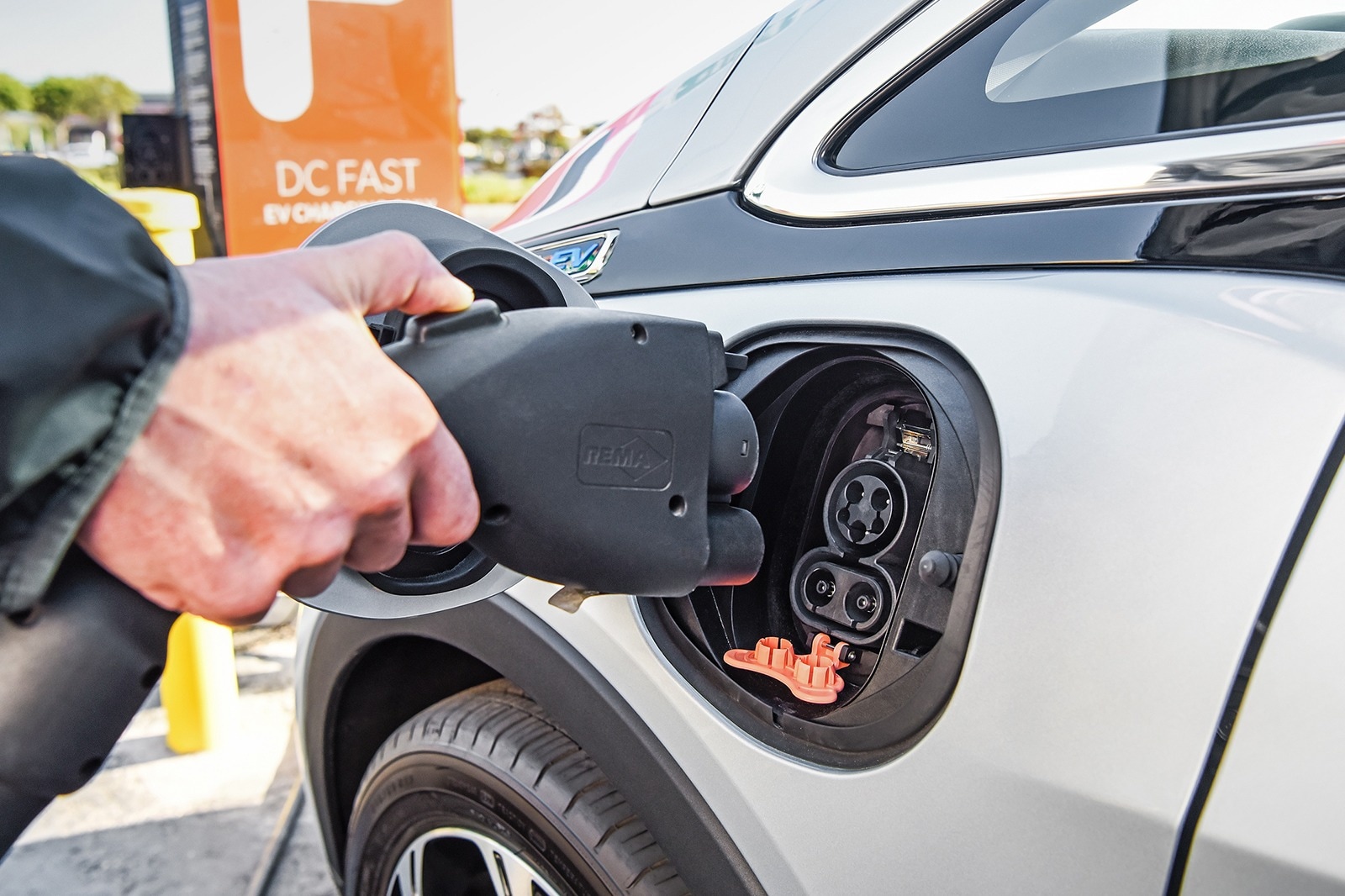
With the debut of the Tesla Model S, the company eschewed the industry standard plugs and developed its own. The Tesla North American Charging Standard (NACS) is the smallest EV plug and features a squarish oval connector with five holes. The advantage of Tesla's NACS is that it can accommodate all forms of charging in one plug. The CCS plug does the same now, but Tesla was the first to do it at scale.
Every model in Tesla's lineup, except for the original Roadster, uses the NACS connector. As such, all charge stations in Tesla's Supercharger network use this connector. Notably, in Europe, the Tesla Model 3 and Model Y come with a CCS Type 2 power outlet. The Model S and Model X still use the NACS but will include an adapter to ensure CCS Type 2 compatibility in Europe. As of this article's publication, Tesla's NACS standard currently has a maximum power delivery upward of 250 kW. It is possible for Tesla vehicles to use J1772, CHAdeMO or CCS Type 1 connectors provided the owner has purchased the appropriate adapter.
In late 2022, Tesla announced that it would open its plug standard for charging network operators and other automakers. And in 2023, like dominos falling, one automaker after another began to announce support for Tesla's NACS standard. So far, Ford, General Motors, Mercedes-Benz, Nissan, Polestar, Rivian and Volvo have rallied around the NACS, with Volkswagen having discussions to also adopt it and Hyundai considering it as well. Starting in spring 2024, electric vehicles from these companies will be able to charge at most of Tesla's Superchargers provided they have the necessary adapter. The first new vehicles from each of these manufacturers to feature built-in NACS chargers will debut in 2025. Due to the engineering complexities of changing a power port, there will likely be some overlap between EV models currently available with CCS in the coming years. You're likely to see the change in vehicles receiving a midcycle refresh or on all-new models. Given the significant market share of these brands, the defections to Tesla's NACS standard mean that in just a few years, the vast majority of new electric vehicles will be able to charge at Tesla's Superchargers.
Other non-Tesla vehicles with a CCS Type 1 plug can charge at certain Supercharger stations outfitted with a Magic Dock adapter. EV owners with CHAdeMO and J1772 plugs will not be able to use the Magic Dock at this time. Owners will need to download and create an account in the Tesla app, then visit a designated Tesla Supercharger. Non-Tesla owners will pay higher charging rates than Tesla customers unless they spring for a monthly membership that puts the cost on par with Tesla vehicles. There are only a handful of compatible stations at this time, but the company plans to open more in the near future. The federal government announced in 2022 that Tesla would begin production of new Supercharger equipment later this year to allow non-Tesla EVs in North America to use Tesla Superchargers. And going forward, Tesla must make its Superchargers compatible with CCS plugs in order to qualify for government subsidies.