
- What's new: Kia's latest extra-small electric SUV boasts a $31,385 starting price and standout styling.
- Why it matters: The EV3 is more well rounded than the old Niro EV; it's a better rival for affordable electric cars like the Chevy Bolt and Nissan Leaf.
- Edmunds says: This is a compelling entry into a crowded market that unfortunately materialized after federal subsidies went away.
" fill-opacity=".3" d="M0-111h1200v397s-252.211 51.289-538.449 54C375.312 342.711 0 292 0 292v-403Z"/%3E%3Cpath fill="url(%23b)" d="M1-114h1199v378s-252 51.289-538 54C376 320.711 0 270 0 270v-384Z"/%3E%3Cpath fill="url(%23c)" d="M0 60h1200v188s-327 63.289-613 66C301 316.711 0 273 0 273V60Z"/%3E%3Cpath fill="url(%23d)" d="M0 60h1200v188s-327 63.289-613 66C301 316.711 0 273 0 273V60Z"/%3E%3Cmask id="e" width="1201" height="255" x="-1" y="60" maskUnits="userSpaceOnUse" style="mask-type:alpha"%3E%3Cpath fill="%23EEF1F6" d="M0 60h1200v188s-327 63.289-613 66C301 316.711 0 273 0 273V60Z"/%3E%3C/mask%3E%3Cg mask="url(%23e)"%3E%3Cmask id="g" width="1438" height="328" x="-124" y="-13" maskUnits="userSpaceOnUse" style="mask-type:alpha"%3E%3Cpath fill="url(%23f)" fill-rule="evenodd" d="M-123.5 258.5-109-13h1395l27.5 245c-232.5 34.5-487.705 80.384-725.581 83-237.486-2.721-265.419-4-711.419-56.5Z" clip-rule="evenodd"/%3E%3C/mask%3E%3Cg mask="url(%23g)"%3E%3Cpath fill="%23FEF3C7" fill-opacity=".05" d="M774.502 1161.55c72.001-3.83 144.529-16.6 217.321-38.74C1514.56 964.017 1919.92 369.717 2099-392.74 1846.08 72.142 1341.28 313.096 774.502 323.314 207.726 312.671-296.808 72.141-549.998-392.74-370.919 369.717 34.449 964.017 557.181 1122.81c72.792 21.71 145.32 34.48 217.321 38.74Z"/%3E%3Cpath fill="%232070E8" fill-opacity=".25" d="M1243.34 184.225c102.44 30.548 204.48 74.055 305.68 131.036C2275.79 724.198 2778.24 1714.59 2935.35 2866.48 2634.05 2114.1 1943.59 1594 1134.58 1382.03 322.864 1199.88-429.69 1367.89-852 1944.02-497.039 916.86 159.636 208.787 927.603 163.907c106.887-5.677 212.247 1.329 315.737 20.318Z"/%3E%3Cpath fill="%23FEF3C7" fill-opacity=".05" d="M1232.5 70.76c104.07 5.535 208.91 23.986 314.13 55.967C2302.21 356.131 2888.15 1214.7 3147 2316.21 2781.41 1644.6 2051.75 1296.5 1232.5 1281.74 413.251 1297.12-316.027 1644.6-682.001 2316.21-423.151 1214.7 162.788 356.131 918.372 126.727 1023.59 95.361 1128.43 76.91 1232.5 70.76Z"/%3E%3Cpath fill="%23154A99" fill-opacity=".29" d="M421.155 420.269c113.733 46.994 226.413 108.503 337.53 185.053C1556.67 1154.75 2075.77 2329.98 2199.28 3644.03 1895.3 2761.18 1143.24 2091.29 243.733 1753.08c-903.919-305.05-1757.473-209.22-2258.663 386.12C-1568.66 1028.61-797.982 313.945 67.226 358.413c120.398 6.829 238.484 27.723 353.929 61.856Z"/%3E%3C/g%3E%3C/g%3E%3Cdefs%3E%3ClinearGradient id="a" x1="600" x2="600" y1="-92" y2="449" gradientUnits="userSpaceOnUse"%3E%3Cstop offset=".336" stop-color="%23007EE5"/%3E%3Cstop offset="1" stop-color="%2363D9EA"/%3E%3C/linearGradient%3E%3ClinearGradient id="b" x1="600.5" x2="600.5" y1="-114" y2="427" gradientUnits="userSpaceOnUse"%3E%3Cstop offset=".336" stop-color="%23007EE5"/%3E%3Cstop offset="1" stop-color="%2363D9EA"/%3E%3C/linearGradient%3E%3ClinearGradient id="c" x1="647" x2="647" y1="60" y2="319" gradientUnits="userSpaceOnUse"%3E%3Cstop offset=".052" stop-color="%23007EE5"/%3E%3Cstop offset=".514" stop-color="%231561D4"/%3E%3Cstop offset=".938" stop-color="%2300A0B5"/%3E%3C/linearGradient%3E%3ClinearGradient id="d" x1="647" x2="647" y1="60" y2="319" gradientUnits="userSpaceOnUse"%3E%3Cstop offset=".282" stop-color="%23007EE5" stop-opacity="0"/%3E%3Cstop offset=".822" stop-opacity=".3"/%3E%3C/linearGradient%3E%3ClinearGradient id="f" x1="588.5" x2="588.5" y1="-13" y2="499.532" gradientUnits="userSpaceOnUse"%3E%3Cstop stop-color="%23154A99"/%3E%3Cstop offset="1" stop-color="%2363D9EA"/%3E%3C/linearGradient%3E%3C/defs%3E%3C/svg%3E)
2027 Kia EV3 First Drive Review: Getting a Lot for Relatively Little
Kia's latest take on an extra-small EV stands out from the competition in some important ways


- 10/6/2026
— Victoria, British Columbia, Canada
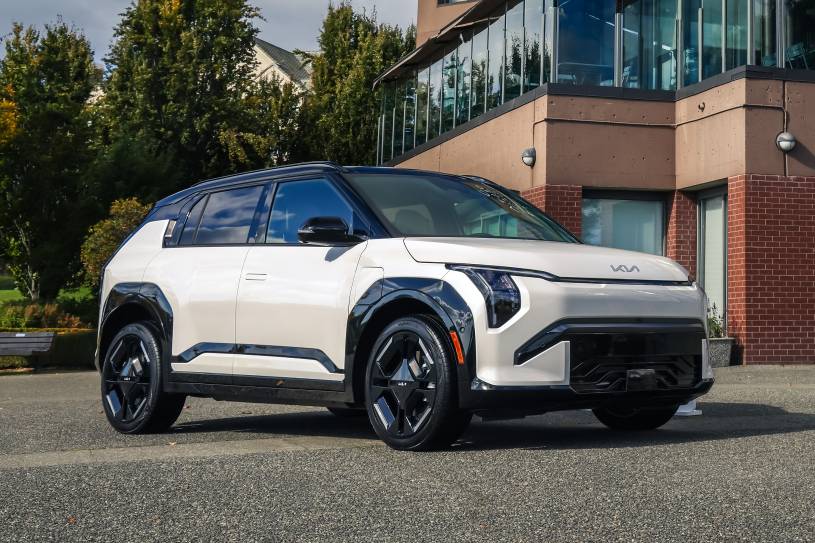
With its $31,385 starting price and funky looks, the 2027 Kia EV3 is a compelling extra-small electric SUV. It's better priced and positioned than the outgoing Niro EV, giving Kia a better player in the affordable EV space. Just look at it — you'd definitely rather have one of these than a Chevy Bolt or Nissan Leaf, right?
See 14 2027 Kia EV3 vehicles for sale near you
See All for Sale
Bold styling and lots of interior space
Having EV at the beginning of its name makes this model's powertrain a bit more obvious, but it's the bold Kia styling that should attract eyeballs. The design hews toward that of the three-row EV9 but also incorporates some details from the compact EV6. The looks are also consistent with the latest Seltos, and the EV3 won't seem out of place on a dealer's lot next to a Telluride.
Though the EV3 is much shorter in length than the EV6, it's a bit taller, making the most of its small footprint. The little Kia beats its main rivals, the Chevy Bolt and the Nissan Leaf, in terms of cargo volume, both with the second row in place and folded. And unlike those two, the EV3 has a front trunk, albeit a small one, that adds some extra storage.
The EV3's interior design fits in with the rest of the Kia lineup's, but the material quality isn't as good. That's to be expected for something at the low end of the price spectrum. There are hard plastic panels on the doors, but they at least get a matte finish and avoid the low-rent shiny look. A fabric band on the dashboard helps break up the hard surfaces and provides some texture.

Grown-up looks in an affordable package
All EV3s use the same screen setup: 12.3-inch displays for the driver and center touchscreen, separated by a panel for climate controls. (There are also hard controls for the temperature, fan speed and mode lower on the center stack.) The touch interface is easy enough to figure out, with a simple menu structure, and it has a modern look to match the other new Kias. Sadly, you have to choose a more expensive trim level to get a wireless phone charger.
One thing I'm personally not in love with is Kia's shifter stalk that also incorporates the power button. It's relatively short and set low on the steering column, making it hard to see without moving your head to the right of the wheel. Owners will get used to this, but it just feels like something different for the sake of being different and doesn't solve any obvious issue.
On the subject of controls, the EV3 uses the latest iteration of Kia's regenerative braking system, called i-Pedal 3.0, where the car slows itself and uses its electric motor as a generator to send energy back into the battery. Paddles behind the steering wheel let you select from three levels of regen, or none at all. With i-Pedal active, you get the same three levels of regeneration, but the vehicle will also slow itself to a complete stop, enabling true one-pedal driving. The many choices can be a little confusing at first, but the good news is that when an owner finds a setting they like, it will stay active through restarts, something Kia's other EVs don't yet do. i-Pedal also now applies to reverse, so you get the same calibration regardless of which direction you're heading.

Three powertrains right from the get-go
Kia will sell the EV3 in three power levels. Front-wheel-drive versions use a 201-horsepower motor, while all-wheel drive, available on midtier trims and standard on the GT-Line, ups the total to 261 hp. On the hot-rod GT, its dual motors combine for 288 hp and 345 lb-ft of torque. Kia brought the two less powerful options to its media test drive in Victoria, British Columbia, for me to sample.
There are also two battery pack sizes to choose from. The Light trim gets a 58.3-kWh battery and comes with front-wheel drive, giving it an estimated range of 221 miles. It seems like that spec exists mostly to advertise a lower starting price; more buyers are likely to end up with the front-wheel-drive Wind or Land versions, which get an 81.4-kWh pack good for an estimated 321 miles, the best of the bunch. Choosing all-wheel drive on the Wind or Land, or opting for the GT-Line or GT where it's standard, drops the range estimate to 280 miles.
The EV3 uses a 400-volt electrical architecture, likely to keep costs down; the company's other EVs use a more sophisticated 800-volt setup that allows for faster charging. Because of its relatively small batteries, that's not much of a hindrance, and Kia says either pack can be charged from 10% to 80% in about 30 minutes.

Little EVs have advantages and disadvantages
I first drove a front-wheel-drive EV3 Land and found the powertrain to be more than adequate, especially as a car for in-town use. There's enough power to merge onto the highway, and it's delivered smoothly, so I think I'd be satisfied with this mileage-maximizing configuration. The route I took didn't really stress-test range, so any insights there will have to wait until the EV3 is put through the Edmunds EV Range Test.
The other version I tried was a GT-Line, meaning it had the regular-strength all-wheel-drive powertrain. Its extra output was nice but ultimately felt unnecessary in a little vehicle like this. And while I'm sure the 288-hp GT will be good fun, I don't know that I could justify the added cost.
The EV3's suspension tuning proved comfortable in all but one specific scenario. Like other Kias, the EV3 rides a little on the firmer side without being punishing on suburban streets. But it was Kia's choice of roads, a coastal highway along the southwest tip of Vancouver Island, that highlighted a shortcoming. Traversing numerous relatively shallow frost heaves caused the rear axle to compress and then sharply spring up. When a heave corresponded with a curve in the road, this would easily unsettle the EV3 and knock it off course, making it feel surprisingly sketchy mid-corner. This is likely a result of compliance to filter out little bumps coupled with a lot of rebound to deal with an EV's extra weight. This could be a real annoyance if you frequently drive on choppy, undulating roads.

Also in the Kia vein is the EV3's steering, which is somewhat heavily weighted but light on feedback. I found the car's Sport mode added too much heft to the steering wheel without any real benefit and preferred Normal and Eco for that reason. Note that the GT gets unique suspension and steering tuning, so it's possible that version would behave more favorably.
A relative value
Pricing starts at $31,385, including destination, for the EV3 Light and its smaller battery, placing it just below the least expensive Leaf but almost two grand more than the base Bolt. The Light's range doesn't quite match the estimates of its main rivals, but opting for the $36,485 front-wheel-drive Wind and its larger battery net the best figure in the category.
One thing the Bolt and Leaf don't offer is all-wheel drive, but like the front-wheel-drive EV3, they'd do just fine in winter with the right tires. That said, if you simply want more power and are willing to take a small range hit, the EV3's two all-wheel-drive powertrains set it apart from the others. Range is less of an issue for someone looking for a city car, but recharging may be a challenge unless you have a dedicated garage.
The EV3 offers similar range and more modern styling than the old Niro EV for nearly $10,000 less. There are still trade-offs with EVs, but even with the end of federal incentives, you can get a lot for your money in this segment. Kia has done what it can to convince buyers that a small EV is worth having, and high gas prices certainly help its case. The EV3 should be a good test of whether Americans actually want the inexpensive, competitive EVs that have been promised for so long.

Consider These RecommendationsAdvertisement

 by David Gluckman
David has years of experience as a writer and editor for print and digital automotive publications, including Car and Driver and Road & Track. He can parallel-park a school bus, has a spreadsheet listing every vehicle he's ever tested, and once drove a Lincoln Town Car 63 mph in reverse. When not searching for the perfect used car, he can be found sampling the latest gimmicky foodstuffs that America has to offer.
edited by Steven EwingSteven Ewing is Edmunds' director of editorial content. An automotive journalist for more than half of his life, Ewing's been on staff at Winding Road magazine, Autoblog, Motor1.com, CNET, and he was the U.S. correspondent for Top Gear magazine. He's also contributed to publications like Automobile magazine, Car and Driver, The Drive, Jalopnik, Porsche Panorama, and more. Ewing has worked in the automotive industry since 2003. From testing prototype cars in the Arctic Circle to spilling a beer on a Formula 1 driver at the 24 Hours of Le Mans (oops), he's always got an interesting story to tell.