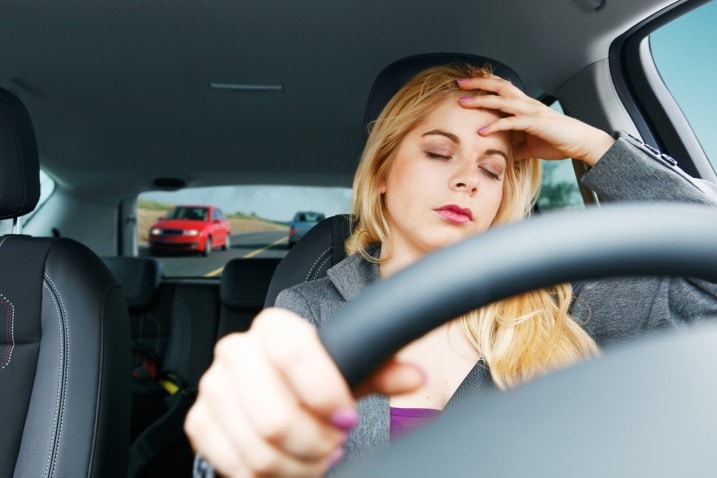
Time, Age and Work Schedules Are Factors
Surprisingly, the study showed that the majority of crashes and near-crashes occur during daytime hours, when roads are more crowded, rather than at night. But sleep-related accidents at night tend to be more serious because they are more likely to occur on high-speed highways and rural roads, when the driver is alone.
Among the groups studied, all the age groups had the same percentage of drowsy-driving crashes and near-crashes, except for one. "The 18-20 age group was involved in five times more fatigue-related accidents and near-accidents than any other group," due to their inexperience behind the wheel and irregular sleep habits, Klauer said.
Teens and young adults are also more likely to get behind the wheel tired. A recent AAA Foundation for Traffic Safety survey found that one in seven licensed drivers ages 16-24 admitted to having dozed off at least once while driving in the past year, compared to one in 10 of all licensed drivers who confessed to falling asleep during the same period.
A National Sleep Foundation poll found that one in five teens and adults in their 20s could be rated as "sleepy" by a standard clinical assessment tool that determines whether sleepiness impairs daily activities.
"A big factor for youth driving drowsy is high school starting times across the country. Many have start times between 7:20 and 7:30 in the morning," says Dr. Helene Emsellem, director of The Center for Sleep & Wake Disorders in Chevy Chase, Maryland. Several studies have associated early start times with increased teenage car crash rates.
To be safer drivers, teens need their rest. "Typical high-schoolers need between 8.5 and 9.5 hours of sleep each night. Many are getting even less than seven hours, which is the minimum threshold for adults," says Emsellem, author of Snooze...or Lose! 10 "No-War" Ways to Improve Your Teen's Sleep Habits.
Work schedules also are a factor in drowsy driving. An AAA Foundation for Traffic Safety study, based on interviews with drivers after crashes, indicated that drowsy drivers were nearly twice as likely to work at more than one job and their primary job was much more likely to involve non-standard hours. Working the night shift increased the odds of a sleep-related accident by nearly six times.
Additionally, Klauer said, many people are commuting much longer distances now, increasing the number of drowsy-driving incidents.
The Role of Sleep Apnea and Other Sleep Disorders
Drowsy driving is particularly common among drivers who say they get fewer than six hours of sleep a night or who have sleep disorders, according to a new report by the U.S. Centers for Disease Control. Of the 150,000 drivers surveyed in 19 states and the District of Columbia, 4.2 percent said they had fallen asleep at the wheel in the last 30 days.
An estimated 50 million to 70 million Americans chronically suffer from sleep disorders and sleepiness, according to the Institute of Medicine. Some have sleep disorders that contribute to drowsy driving and they may not even know it.
Obstructive sleep apnea is one of those. The chronic disorder causes repeated pauses in breathing and shallow breath while sleeping. Signs of sleep apnea include loud, irregular snoring or choking and gasping sounds and extreme daytime sleepiness and fatigue.
Obesity is one of the highest risk factors for developing sleep apnea. Studies have found that people with sleep apnea are at twice the risk of being in a car crash, and three to five times more likely to be in a serious crash resulting in personal injury.
New research from University Hospital in Leeds, England, finds that drivers with untreated sleep apnea are more likely to fail driving simulation tests and to report nodding off at the wheel.
"Driving simulators can be a good way of checking the effects that a condition like sleep apnea can have on driving ability," said Dr. Mark Elliott, the study's chief investigator. "Our research suggests that people with the condition are more likely to fail the test."
Exercise can help people who have trouble getting a good night's sleep, according to the National Sleep Foundation's most recent "Sleep in America" poll. "If you are inactive, adding a 10-minute walk every day could improve your likelihood of a good night's sleep," said Max Hirshkowitz, Ph.D., chairman of the poll's task force.
More Factors: Allergy, Cold and Flu Medicines
Dr. Joel Zive, an independent pharmacist in New York and a spokesman for the American Pharmacists Association, cautions consumers to read their medication labels or talk to their pharmacist for warnings about ingredients that cause drowsiness. Many drivers still don't realize that legal, over-the-counter treatments for allergies, cold and flu can cause significant sleepiness at the wheel.
For example, the antihistamines dipenhydramine (in Benadryl), clorpheniramine (in Chlor-Trimeton) and brompheniramine (in Dimetane) can cause drowsiness.
The so-called second-generation antihistamines fexofenadine (in Allegra), loratadine (in Claritin and Alavert) and cetirizine (in Zyrtec) are non-sedating and do not cause impairment under normal circumstances, Zive said.
Danger for New Users of Sleeping Pills
If you've recently started taking prescription sleeping pills, your risk of a car crash increases, according to research from the University of Washington. Researchers there evaluated the medical records of adults in a health care system who were given new prescriptions for sleeping pills, then looked at drivers' license and collision records.
"People with prescriptions for zolpidem (Ambien/Ambien CR) had more than double the crash risk compared to those who did not receive zolpidem," says Ryan Hansen, a pharmacist and assistant research professor. Those on trazodone (Desyrel) had a 91 percent increased risk of crashes and those on temazepam (Restoril) had a 27 percent increased risk of crash, compared to those not on those sleeping pills, he found. Those risks, he says, are equivalent to those of drivers with blood alcohol levels around and above the legal limits, from 0.06 to 0 .11 percent.
Anyone taking sleeping pills should discuss the risk with their doctor and pharmacist, he says.
How To Avoid Falling Asleep at the Wheel
Here are the top 10 things to do to avoid falling asleep at the wheel, according to the AAA Foundation for Traffic Safety and the University of Iowa:
1. Stop driving if you feel sleepy. Stop and drink a caffeinated beverage.
2. Since it takes about 30 minutes for caffeine to enter the bloodstream and take effect, use that time to take a nap.
3. Get plenty of sleep the night before taking a long trip. Get at least six hours, though more is better.
4. Don't plan to work all day and then drive all night.
5. Drive at times when you are normally awake and stay overnight in a hotel or motel rather than driving straight through.
6. Avoid driving at so-called sleepy times of day. Take a midafternoon break for a short nap and find a place to sleep between midnight and dawn. If you can't nap, at least stop your drive and rest for awhile.
7. Avoid carbohydrate-laden foods that can make you sleepy. Eat some protein instead.
8. Avoid allergy and cold or flu medications containing diphenhydramine, such as Benadryl, which can contribute to drowsiness. And don't take prescribed sleep aids such as Ambien until you are finished driving for the day.
9. On long trips, keep a passenger who's awake in the front seat. Increasing the volume on the car stereo is not a substitute for somebody you can talk to.
10. Take a break every two hours or every 100-120 miles, even if you don't need a pit stop or gas. Get out of the car, take some deep breaths and do some stretching exercises, especially for the neck and shoulders, to relieve cramping and stress. And try to set a limit of 300-400 miles of driving per day.
When To Take a Break
The AAA Foundation for Traffic Safety found that nine out of every 10 North American police officers had stopped a driver who they believed was drunk, but turned out to be drowsy instead. Johns Hopkins Medical Center says drivers should be aware of these warning signs:
- You can't remember the last few miles driven.
- You hit a rumble strip or drift from your lane.
- You keep pulling your vehicle back into the lane.
- Your thoughts are wandering and disconnected.
- You yawn repeatedly.
- You have difficulty focusing or keeping your eyes open and your head up.
- You tailgate or miss traffic signs.
- You have barely avoided being in an accident.
" fill-opacity=".3" d="M0-111h1200v397s-252.211 51.289-538.449 54C375.312 342.711 0 292 0 292v-403Z"/%3E%3Cpath fill="url(%23b)" d="M1-114h1199v378s-252 51.289-538 54C376 320.711 0 270 0 270v-384Z"/%3E%3Cpath fill="url(%23c)" d="M0 60h1200v188s-327 63.289-613 66C301 316.711 0 273 0 273V60Z"/%3E%3Cpath fill="url(%23d)" d="M0 60h1200v188s-327 63.289-613 66C301 316.711 0 273 0 273V60Z"/%3E%3Cmask id="e" width="1201" height="255" x="-1" y="60" maskUnits="userSpaceOnUse" style="mask-type:alpha"%3E%3Cpath fill="%23EEF1F6" d="M0 60h1200v188s-327 63.289-613 66C301 316.711 0 273 0 273V60Z"/%3E%3C/mask%3E%3Cg mask="url(%23e)"%3E%3Cmask id="g" width="1438" height="328" x="-124" y="-13" maskUnits="userSpaceOnUse" style="mask-type:alpha"%3E%3Cpath fill="url(%23f)" fill-rule="evenodd" d="M-123.5 258.5-109-13h1395l27.5 245c-232.5 34.5-487.705 80.384-725.581 83-237.486-2.721-265.419-4-711.419-56.5Z" clip-rule="evenodd"/%3E%3C/mask%3E%3Cg mask="url(%23g)"%3E%3Cpath fill="%23FEF3C7" fill-opacity=".05" d="M774.502 1161.55c72.001-3.83 144.529-16.6 217.321-38.74C1514.56 964.017 1919.92 369.717 2099-392.74 1846.08 72.142 1341.28 313.096 774.502 323.314 207.726 312.671-296.808 72.141-549.998-392.74-370.919 369.717 34.449 964.017 557.181 1122.81c72.792 21.71 145.32 34.48 217.321 38.74Z"/%3E%3Cpath fill="%232070E8" fill-opacity=".25" d="M1243.34 184.225c102.44 30.548 204.48 74.055 305.68 131.036C2275.79 724.198 2778.24 1714.59 2935.35 2866.48 2634.05 2114.1 1943.59 1594 1134.58 1382.03 322.864 1199.88-429.69 1367.89-852 1944.02-497.039 916.86 159.636 208.787 927.603 163.907c106.887-5.677 212.247 1.329 315.737 20.318Z"/%3E%3Cpath fill="%23FEF3C7" fill-opacity=".05" d="M1232.5 70.76c104.07 5.535 208.91 23.986 314.13 55.967C2302.21 356.131 2888.15 1214.7 3147 2316.21 2781.41 1644.6 2051.75 1296.5 1232.5 1281.74 413.251 1297.12-316.027 1644.6-682.001 2316.21-423.151 1214.7 162.788 356.131 918.372 126.727 1023.59 95.361 1128.43 76.91 1232.5 70.76Z"/%3E%3Cpath fill="%23154A99" fill-opacity=".29" d="M421.155 420.269c113.733 46.994 226.413 108.503 337.53 185.053C1556.67 1154.75 2075.77 2329.98 2199.28 3644.03 1895.3 2761.18 1143.24 2091.29 243.733 1753.08c-903.919-305.05-1757.473-209.22-2258.663 386.12C-1568.66 1028.61-797.982 313.945 67.226 358.413c120.398 6.829 238.484 27.723 353.929 61.856Z"/%3E%3C/g%3E%3C/g%3E%3Cdefs%3E%3ClinearGradient id="a" x1="600" x2="600" y1="-92" y2="449" gradientUnits="userSpaceOnUse"%3E%3Cstop offset=".336" stop-color="%23007EE5"/%3E%3Cstop offset="1" stop-color="%2363D9EA"/%3E%3C/linearGradient%3E%3ClinearGradient id="b" x1="600.5" x2="600.5" y1="-114" y2="427" gradientUnits="userSpaceOnUse"%3E%3Cstop offset=".336" stop-color="%23007EE5"/%3E%3Cstop offset="1" stop-color="%2363D9EA"/%3E%3C/linearGradient%3E%3ClinearGradient id="c" x1="647" x2="647" y1="60" y2="319" gradientUnits="userSpaceOnUse"%3E%3Cstop offset=".052" stop-color="%23007EE5"/%3E%3Cstop offset=".514" stop-color="%231561D4"/%3E%3Cstop offset=".938" stop-color="%2300A0B5"/%3E%3C/linearGradient%3E%3ClinearGradient id="d" x1="647" x2="647" y1="60" y2="319" gradientUnits="userSpaceOnUse"%3E%3Cstop offset=".282" stop-color="%23007EE5" stop-opacity="0"/%3E%3Cstop offset=".822" stop-opacity=".3"/%3E%3C/linearGradient%3E%3ClinearGradient id="f" x1="588.5" x2="588.5" y1="-13" y2="499.532" gradientUnits="userSpaceOnUse"%3E%3Cstop stop-color="%23154A99"/%3E%3Cstop offset="1" stop-color="%2363D9EA"/%3E%3C/linearGradient%3E%3C/defs%3E%3C/svg%3E)