|
(Enlarge photo)
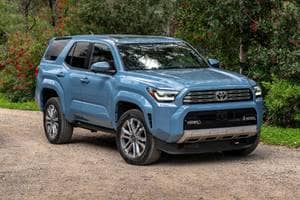
Top-of-the-line Limited models wear body-colored fender flares and bumpers for a more polished look.
(Photo courtesy of Toyota Motor Sales, U.S.A., Inc.)
|
|
|
|
(Enlarge photo)
A clean, uncluttered design and plenty of top-quality materials give the 4Runner's cabin an inviting look. A DVD-based navigation system is available on all trim levels.
(Photo courtesy of Toyota Motor Sales, U.S.A., Inc.)
|
|
|
|
(Enlarge photo)
The rear hatch retains the popular power roll-down window feature as well as incorporating an electric release for the liftgate.
(Photo courtesy of Toyota Motor Sales, U.S.A., Inc.)
|
|
|
See All Photos
|
|
|
|
Road Test: First Drive Test
|
|
First Drive: 2003 Toyota 4Runner
Can the Fourth Time Be a Charm?
By
Ed Hellwig, Lead Senior Editor
Date posted: 09-23-2002
The fact that the 2003 4Runner represents the fourth generation of the nameplate
says a lot about the popularity of Toyota's midsize SUV. With rugged good looks
and true off-road capability, the 4Runner has earned a reputation as a stout no-nonsense
sport-ute. While other SUVs in its class have evolved into kinder, gentler versions
of their originals, the 4Runner has retained much of its truckish character.
This might seem like a misguided philosophy when you consider that few SUV owners
actually go off-road, but Toyota looks at the situation a bit differently. It
sees the 4Runner's all-terrain capability as a selling point over its rivals.
If you want a "soft roader," there are plenty to choose from (the Toyota Highlander
being a convenient suggestion). But if you want a real sport-utility, the 4Runner
is still the real deal.
So when it came time to revamp its bread-and-butter sport-ute, Toyota stuck to
the same game plan that has served it well since the 4Runner's introduction way
back in '84 keep it off-road-worthy, good-looking and built to last. After
our brief introductory test drive, we would consider it "mission accomplished."
It still tackles trails with ease, has plenty of eye-catching lines and looks
to be put together as sturdily as any 4Runner before it. Factor in the larger
interior, more powerful engines and numerous passenger amenities, and it looks
as though the 4Runner's popularity will be secure for many years to come.
Previous-generation 4Runners gained a strong reputation for their stout V6s and
durable four-cylinders. But increased competition within the ranks of midsize
SUVs and dwindling sales of four-cylinder models forced Toyota to rethink the
4Runner's drivetrain options. For 2003, the weak 183-horsepower 3.4-liter V6 has
been replaced by a new 4.0-liter V6, while an optional 4.7-liter V8 has been added.
The 4.0-liter V6 is an all-new engine design that incorporates some firsts for
a Toyota truck. It's the company's first all-aluminum truck engine, the first
truck engine to make use of Toyota's Variable Valve Timing with intelligence (VVT-i)
and the first Toyota truck engine to employ a variable intake manifold. The results
are impressive: 245 horsepower at 5,200 rpm and 283 pound-feet of torque at 3,400
rpm. The engine is also LEV-certified and boasts significantly reduced amounts
of lead to make it more recyclable in the future.
The optional 4.7-liter V8 is not quite as new, but it is no less deserving of
mention. Debuting in the Tundra pickup in 2000, the iForce V8 has gained a reputation
as one of the smoothest, most refined eight-cylinders ever to grace the engine
bay of a pickup. Generating 235 horsepower at 4,800 rpm and 320 lb-ft of torque
at 3,400 rpm, the iForce engine offers slightly less horsepower but significantly
more torque for those who need the extra grunt for towing.
The biggest news for V8 buyers is the introduction of an all-new five-speed automatic
transmission another first for a Toyota truck. It features slightly lower
gearing overall than the previous four-speed, but a taller overdrive gear for
better highway mileage. All V6-equipped models retain the same four-speed automatic
used on the previous model.
Both engines move the truck out quickly, with the differences in their torque
production barely apparent. The new V6 is as smooth as the buttery V8, with the
slightly higher pitch of its exhaust the only hint of its smaller displacement.
We expect most buyers will be perfectly happy with the power and performance of
the six-cylinder, but for those who would like the added punch of the V8, the
iForce is a gem of an engine that performs flawlessly.
Building on the 4Runner's reputation as a capable off-road machine, all 2003 4WD
4Runners get redesigned transfer cases and a new Torsen limited-slip center differential
the first of its kind used in a midsize SUV. This differential can alter
the bias of the available engine power between three different settings depending
on which wheels have the most traction. Four-wheel-drive models with the V6 engine
come equipped with a shift-on-the-fly multimode system that offers both two- and
four-wheel drive, while all V8-equipped models feature a full-time four-wheel-drive
system. Both systems use dash-mounted switches for activation and both offer a
fully "locked" mode that locks the center differential for maximum traction in
difficult terrain.
Also new for 2003 is the addition of a standard Downhill Assist Control (DAC)
system on all 4WD models and a Hill-start Assist Control (HAC) system on both
two- and four-wheel-drive models. The DAC system integrates the brakes, electronic
throttle control and active wheel speed sensors to maintain a slow and steady
descent on tricky downhill sections. The HAC system uses control of the brakes
to keep the vehicle from sliding backward on an ascent between the time you let
off the brakes and apply the throttle.
We sampled variably equipped 4Runners on moderately challenging logging roads
as well as a few steep, muddy pitches to test all the new hardware. Not surprisingly,
the higher-speed logging roads were tackled without much drama. We never sensed
the workings of the torsen differential but we did instigate a couple beeper warnings
from the standard stability and traction control systems. The steeper, more difficult
sections required the full capabilities of the new sport-ute, but after multiple
passes of the same gnarly terrain, we were duly impressed with the 4Runner's adept
hill climbing ability as well as its slow, well-controlled pace down the same
treacherous route. Hard core off-roaders should take note, however, that the maximum
ground clearance is now just 9.1-inches, slightly less than the previous model.
Back on more civilized terrain, we were able to appreciate some of the 4Runner's
other notable improvements. The frame now employs fully boxed side rails that
significantly increase torsional rigidity. This has eliminated much of the body
flex that gave the previous version such a sloppy ride on the highway. Also new
are optional X-REAS (Diagonally Linked Relative Absorber System) shocks and a
rear air suspension. The X-REAS system connects diagonally opposed shocks to help
quell body roll in turns, while the air suspension (only available on V8 Limited
models) uses air bladders instead of traditional coil springs to maintain proper
ride height when towing heavy loads (maximum towing capacity is 5,000 pounds).
The air system can also raise the rear end an extra one and half inches for a
better departure angle and lower three quarters of an inch for easier trailer
hookup.
Pushing a sport-utility hard through the turns on public roads isn't exactly our
preferred test method regardless of what new fangled suspension it has, but our
less taxing maneuvers indicated that the X-REAS shocks kept the substantial sport-ute
well under control. The lack of an unhitched ski boat lying around also prevented
us from properly addressing the merits of the air suspension, but our experiences
with similar systems in the past have proven them to be quite helpful when it
comes to maintaining a safe ride height when towing.
With all the mechanicals out of the way, we turned our attention to what probably
matters the most in the grand scheme of things the interior. The 2003 4Runner
features a much improved cabin that benefits immensely from the vehicle's larger
overall size. The longer wheelbase (up 4 1/2 inches) and increased width (2 1/2
inches) result in more interior room in nearly every dimension. Front and rear
legroom are up by 2 and 1 1/2 inches respectively, while shoulder and hiproom
have increased between 4 and 5 inches front and rear. The effect will be quite
noticeable for anyone used to the cramped feeling of the previous version, as
4Runner's cabin now feels like the more spacious interiors of its newer competitors.
The overall design of the interior is both aesthetically pleasing and seriously
functional. The large analog gauges are easy to read at a glance and the center
stack controls have been kept neat and well within reach. The console features
numerous storage bins of varying sizes and well-placed cupholders right at your
side. Our only major complaint concerns the climate controls. Although they look
like traditional dial controls, they work more like joysticks, requiring you to
press the pad in the direction of your preferred vent location or temperature.
They felt cheap on our preproduction prototype and weren't exactly the easiest
things to work we would much prefer plain old dials any day.
Another aspect of the interior that might be cause for concern for some buyers is rear cargo room. With a maximum cargo capacity of just 75.1 cubic feet, the 4Runner still lags behind the Ford Explorer, Nissan Pathfinder and Dodge Durango which offer 88, 85 and 88 cubic feet respectively. Toyota isn't completely oblivious to this fact as the company offers a foldable cargo shelf that allows for two-tiered loading, but it hardly makes up for the deficiency.
Oh, and to those hoping for a third-row seat, it doesn't have one of those either.
According to Toyota representatives, the typical 4Runner buyer isn't looking for
a family vehicle as much as he is a capable sport-utility, so the third-row seat
option was nixed. With the limited space available we hardly blame them, but considering
that nearly every new midsize sport-ute on the market is finding a way to offer
this option, the 4Runner might suffer in head-to-head comparisons without it.
There are three distinct trim levels depending on your appetite for gadgetry and/or
larger monthly payments. All trim levels offer both two- or four-wheel drive and
either the V6 or V8 power plants. The SR5 continues as the entry-level model,
and the Limited remains the top-of-the-line version. A new Sport Edition slots
between the two.
Standard features on the SR5 include gray metallic fender flares and body cladding,
ABS brakes with Electronic Brakeforce Distribution (EBD), automatic climate control
with rear vents, remote keyless entry, a tilt and telescoping steering wheel,
cruise control, a trip computer and full skid plate protection, among other things.
Stepping up to the Sport Edition adds larger 17-inch wheels and tires; the X-REAS
shocks; a hood scoop; a leather-wrapped steering wheel with satellite stereo and
cruise controls; high-contrast seat fabrics and color-keyed exterior mirrors.
High-dollar Limited models ditch the gray body cladding in favor of more subtle
color-keyed panels along with illuminated running boards, dual-zone automatic
climate control, a leather-trimmed interior, rear-seat audio controls, an auto-dimming
rearview mirror with compass and special Granite or Silver interior trim.
Additional options for all models include JBL sound systems with up to 10 speakers,
an in-dash six-disc CD changer, a DVD-based navigation system, a power sunroof,
front and rear side curtain airbags, a color-keyed spoiler and a V6 towing package
with auxiliary transmission and oil coolers.
Needless to say, the '03 4Runner stacks up favorably against just about any other
midsize sport-ute on the market when it comes to creature comforts and standard
equipment. Add in the powerful new engines, advanced vehicle control systems and
stout underpinnings, and there's little doubt this 4Runner will uphold the legacy
of the numerous 4Runners before it.
|
|
|