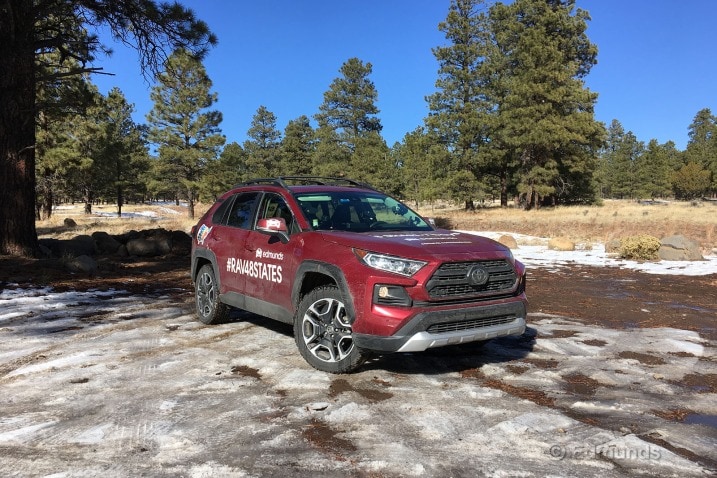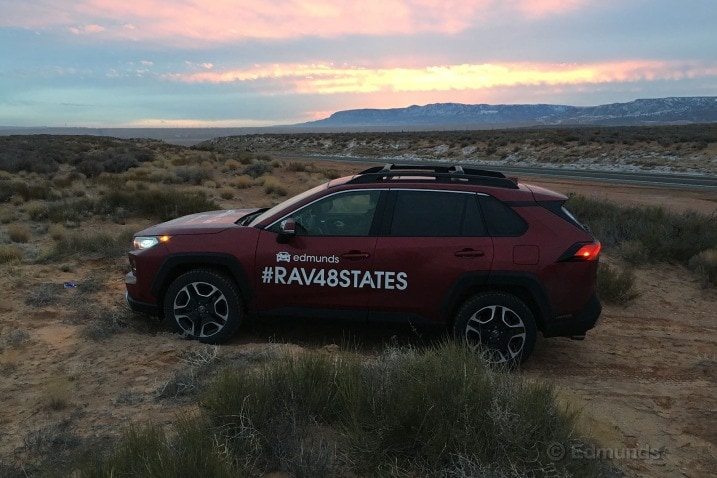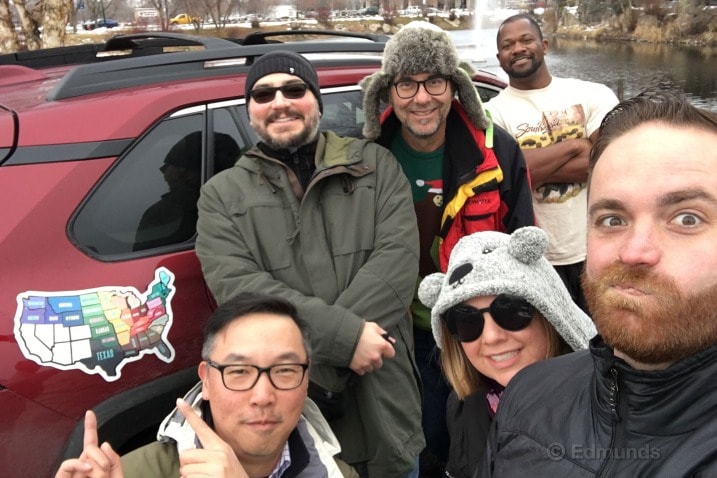
#RAV48States: We Made It!
Map powered by Garmin: See full route details
" fill-opacity=".3" d="M0-111h1200v397s-252.211 51.289-538.449 54C375.312 342.711 0 292 0 292v-403Z"/%3E%3Cpath fill="url(%23b)" d="M1-114h1199v378s-252 51.289-538 54C376 320.711 0 270 0 270v-384Z"/%3E%3Cpath fill="url(%23c)" d="M0 60h1200v188s-327 63.289-613 66C301 316.711 0 273 0 273V60Z"/%3E%3Cpath fill="url(%23d)" d="M0 60h1200v188s-327 63.289-613 66C301 316.711 0 273 0 273V60Z"/%3E%3Cmask id="e" width="1201" height="255" x="-1" y="60" maskUnits="userSpaceOnUse" style="mask-type:alpha"%3E%3Cpath fill="%23EEF1F6" d="M0 60h1200v188s-327 63.289-613 66C301 316.711 0 273 0 273V60Z"/%3E%3C/mask%3E%3Cg mask="url(%23e)"%3E%3Cmask id="g" width="1438" height="328" x="-124" y="-13" maskUnits="userSpaceOnUse" style="mask-type:alpha"%3E%3Cpath fill="url(%23f)" fill-rule="evenodd" d="M-123.5 258.5-109-13h1395l27.5 245c-232.5 34.5-487.705 80.384-725.581 83-237.486-2.721-265.419-4-711.419-56.5Z" clip-rule="evenodd"/%3E%3C/mask%3E%3Cg mask="url(%23g)"%3E%3Cpath fill="%23FEF3C7" fill-opacity=".05" d="M774.502 1161.55c72.001-3.83 144.529-16.6 217.321-38.74C1514.56 964.017 1919.92 369.717 2099-392.74 1846.08 72.142 1341.28 313.096 774.502 323.314 207.726 312.671-296.808 72.141-549.998-392.74-370.919 369.717 34.449 964.017 557.181 1122.81c72.792 21.71 145.32 34.48 217.321 38.74Z"/%3E%3Cpath fill="%232070E8" fill-opacity=".25" d="M1243.34 184.225c102.44 30.548 204.48 74.055 305.68 131.036C2275.79 724.198 2778.24 1714.59 2935.35 2866.48 2634.05 2114.1 1943.59 1594 1134.58 1382.03 322.864 1199.88-429.69 1367.89-852 1944.02-497.039 916.86 159.636 208.787 927.603 163.907c106.887-5.677 212.247 1.329 315.737 20.318Z"/%3E%3Cpath fill="%23FEF3C7" fill-opacity=".05" d="M1232.5 70.76c104.07 5.535 208.91 23.986 314.13 55.967C2302.21 356.131 2888.15 1214.7 3147 2316.21 2781.41 1644.6 2051.75 1296.5 1232.5 1281.74 413.251 1297.12-316.027 1644.6-682.001 2316.21-423.151 1214.7 162.788 356.131 918.372 126.727 1023.59 95.361 1128.43 76.91 1232.5 70.76Z"/%3E%3Cpath fill="%23154A99" fill-opacity=".29" d="M421.155 420.269c113.733 46.994 226.413 108.503 337.53 185.053C1556.67 1154.75 2075.77 2329.98 2199.28 3644.03 1895.3 2761.18 1143.24 2091.29 243.733 1753.08c-903.919-305.05-1757.473-209.22-2258.663 386.12C-1568.66 1028.61-797.982 313.945 67.226 358.413c120.398 6.829 238.484 27.723 353.929 61.856Z"/%3E%3C/g%3E%3C/g%3E%3Cdefs%3E%3ClinearGradient id="a" x1="600" x2="600" y1="-92" y2="449" gradientUnits="userSpaceOnUse"%3E%3Cstop offset=".336" stop-color="%23007EE5"/%3E%3Cstop offset="1" stop-color="%2363D9EA"/%3E%3C/linearGradient%3E%3ClinearGradient id="b" x1="600.5" x2="600.5" y1="-114" y2="427" gradientUnits="userSpaceOnUse"%3E%3Cstop offset=".336" stop-color="%23007EE5"/%3E%3Cstop offset="1" stop-color="%2363D9EA"/%3E%3C/linearGradient%3E%3ClinearGradient id="c" x1="647" x2="647" y1="60" y2="319" gradientUnits="userSpaceOnUse"%3E%3Cstop offset=".052" stop-color="%23007EE5"/%3E%3Cstop offset=".514" stop-color="%231561D4"/%3E%3Cstop offset=".938" stop-color="%2300A0B5"/%3E%3C/linearGradient%3E%3ClinearGradient id="d" x1="647" x2="647" y1="60" y2="319" gradientUnits="userSpaceOnUse"%3E%3Cstop offset=".282" stop-color="%23007EE5" stop-opacity="0"/%3E%3Cstop offset=".822" stop-opacity=".3"/%3E%3C/linearGradient%3E%3ClinearGradient id="f" x1="588.5" x2="588.5" y1="-13" y2="499.532" gradientUnits="userSpaceOnUse"%3E%3Cstop stop-color="%23154A99"/%3E%3Cstop offset="1" stop-color="%2363D9EA"/%3E%3C/linearGradient%3E%3C/defs%3E%3C/svg%3E)

Map powered by Garmin: See full route details
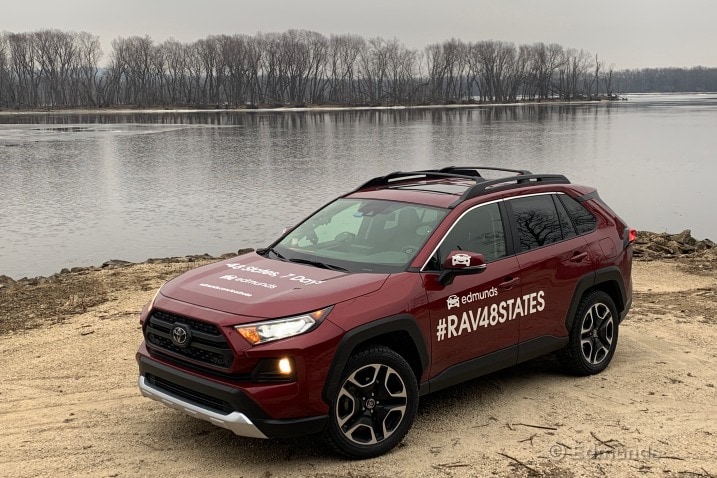
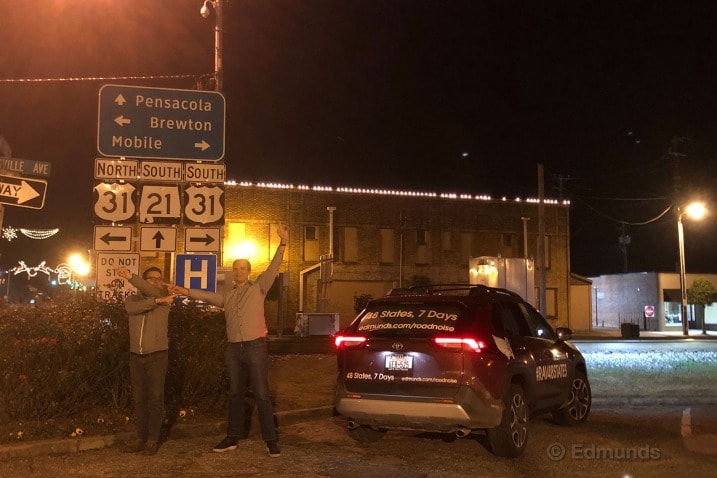
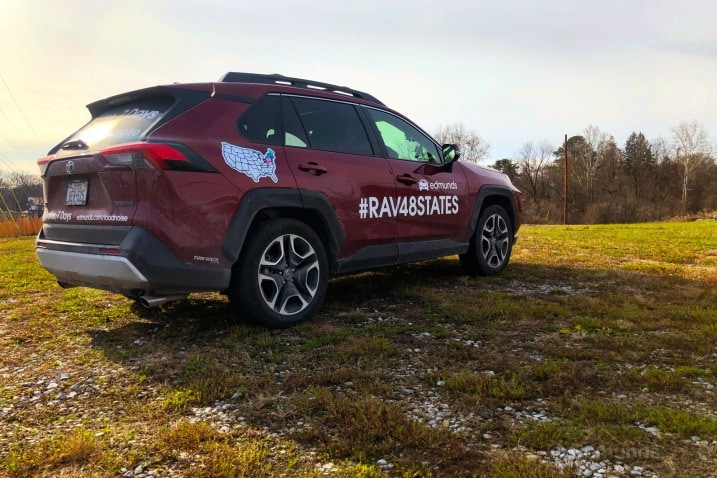
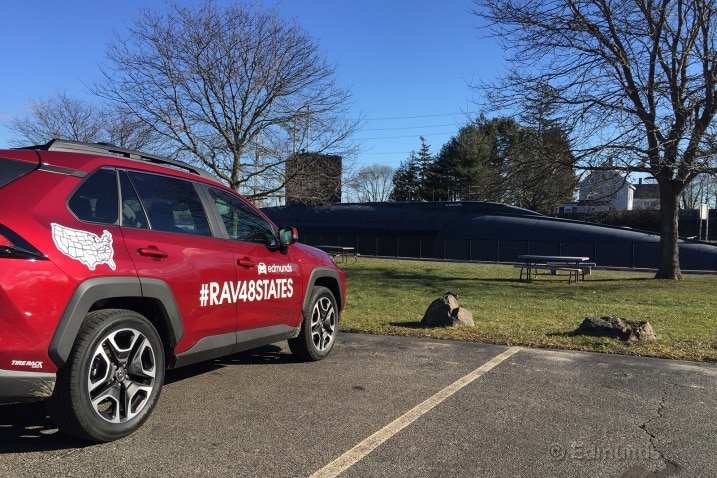
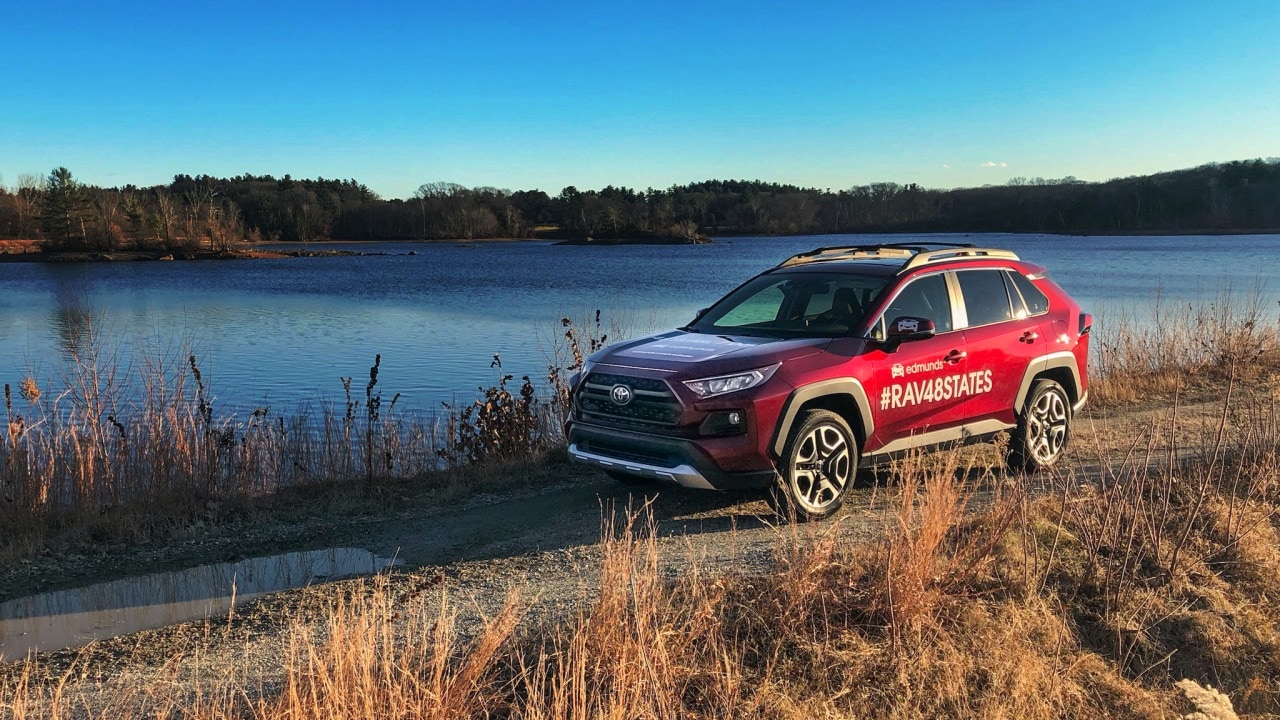
Our mission was to put the redesigned 2019 Toyota RAV4 to the ultimate test. We set out to drive it through each of the 48 contiguous states (sorry, Hawaii and Alaska) in seven days, starting in Kittery, Maine, and ending in Needles, California. Our 7,000-mile route included just about every traffic and road condition, from the heat of the desert to the freezing heights of the Rockies. For each 30-hour leg of the trip, three testers split the driving duties, stopping only for food and fuel before passing the baton to the next trio. It would be a grueling week for both America's best-selling SUV and our expert editorial team.
Now that we're back at Edmunds HQ, we invite you to read through all of our daily updates below. You'll also find plenty of exclusive content on our Facebook, Instagram and Twitter channels under the hashtag #RAV48States.
What's Been Happening?
We made it! We crossed the finish line with daylight to spare, coming in to San Bernardino County — the single largest county in the United States by area. We'd driven more than 7,100 miles in total over the course of 149 hours, from Kittery, Maine, to Needles, California, touching the soil of every contiguous state in the Union in that time.
This last leg only accounted for less than 24 hours of total driving time, but that was more than enough for yours truly. We can't imagine how our compatriots who handled 30 hours or more managed the feat.
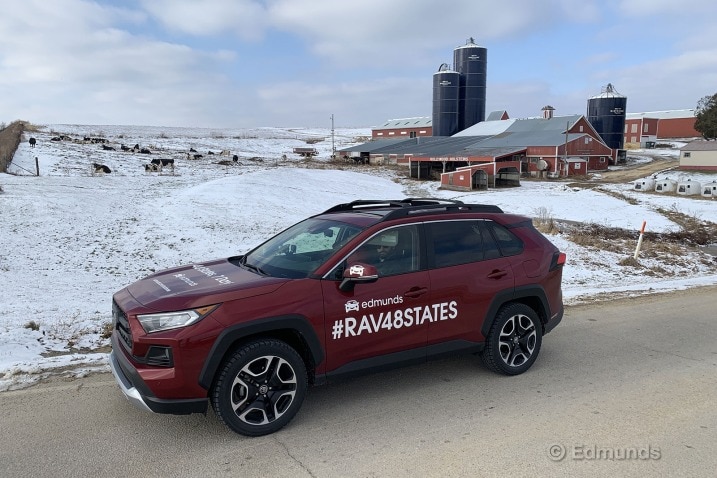
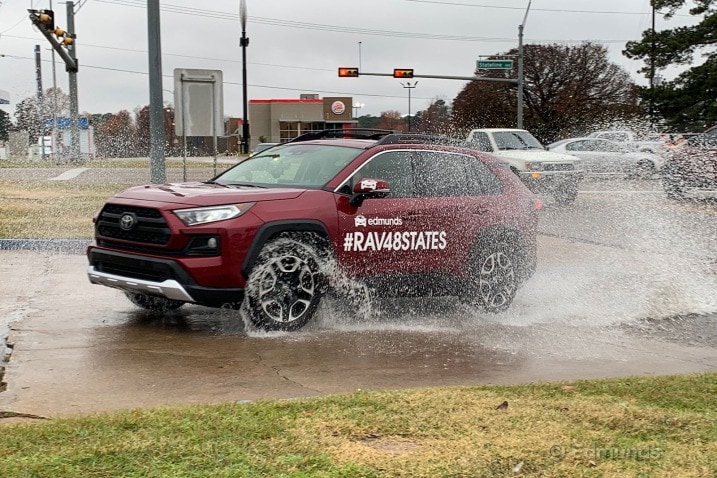
In the end, the car had no trouble with the journey. It handled snow, rain, mud, gravel, dirt, and endless miles of subfreezing temperatures with zero hint of trouble. More than that, it made us feel safe and secure. We may have complaints about the car's power, but there's no doubting that the RAV4 feels as stable as a rock.
Our work isn't done, though. You can look forward to more video content from the trip, a more extensive written review of the vehicle itself, and more in the coming weeks. So stay tuned to Edmunds for a final verdict from this ambitious test.
In the meantime, we're going to shower, eat a real meal and fall fast asleep. — Will Kaufman
What's Been Happening?
We haven't made it to California yet, but we're close! We're seeing snow in northern Arizona and drawing ever nearer to Nevada and then California. We're behind where we'd like to be — for a brief, shining moment we thought we had a chance of finishing the trip in just six days — but we're still ahead of schedule for the seven-day challenge.
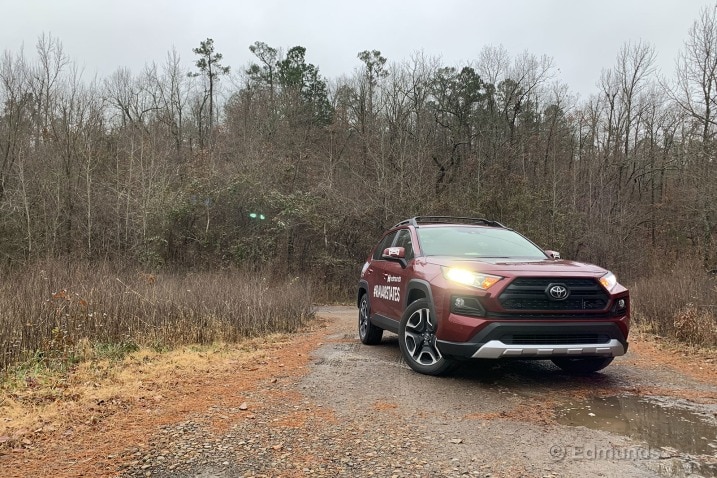
The curse of the front passenger seat continues, with a crick in my neck. Meanwhile, Laurel enjoyed a thorough and refreshing rest in the roomy and comfortable back seat. Otherwise, how do we feel about new RAV4? Based on our impressions, we don't expect this to upset our current 1-2 ranking of the Honda CR-V and Mazda CX-5. However, our few, brief forays into mud, soft earth, rocks and dirt have made us feel like this Adventure trim would be our pick of the three for ... an adventure.
Or even the appearance of adventure! There's no denying the new RAV4's personality. The old car just didn't set itself apart in any meaningful way, but this generation feels like a distinct offering in the class. Something that can provide an alternative for buyers looking for more attitude than the CR-V offers while going up against mainstay lifestyle offerings like the Jeep Cherokee.
Also, Travis and Laurel have apparently become a unicorn and a tiger. ¯\_(ツ)_/¯
— Will Kaufman
What's Been Happening?
We survived the final night of #RAV48States! Mother Nature only troubled us with fluffy, white frozen stuff early on in the evening, and we saw nothing more adverse than light mist the rest of the night. In fact, we didn't see anything. We drove past some of the country's most breathtaking vistas, but, well ...
Sadly, the Four Corners Monument was closed to visitors at 4 a.m., but we still covered Utah, Colorado and New Mexico before dawn.
Then morning broke, and we were treated to a spectacular sunrise. We're all a bit loopy, running on anywhere from three hours of sleep to zero hours of sleep, but with the end in sight, spirits are high. Now we just need to cross all of Arizona.
We're all agreed that the front passenger seat is our least favorite seat in the RAV4, with its high seating position and lack of adjustable lumbar. The vote is split on whether the driver's seat or the back seat is a better place to spend time.
This new RAV4 may be dressed up with a bit more attitude than the outgoing model, but it's still a steadfast road companion, keeping us feeling secure no matter what the road has thrown at us. The headlights are a bit disappointing: They're much too white in color, so oncoming traffic always thinks they're high beams, and they don't offer the best projection down the road.
Lane centering and adaptive cruise have been great aids to have, even if the lane-keeping assist system beeps every time it loses track of a lane and then beeps every time it finds the lane again. That's annoying.
OK, too many words. Nap time instead. The next update may very well be from the finish line! — Will Kaufman
What's Been Happening?
Team 5 (or as we like to be called, team sur5or) just took possession of the RAV4 in Boise, Idaho. Travis has already noted a lack of low-down power, and that the car doesn't sound very happy when you push it up into the powerband. BUT, he does like the driver's seat. The same cannot be said for your faithful correspondent, who is less than thrilled with the front passenger accommodations. The rather narrow and firm bolsters are causing a bit of kidney-area discomfort for me, and the lumbar bump is not in the right place.
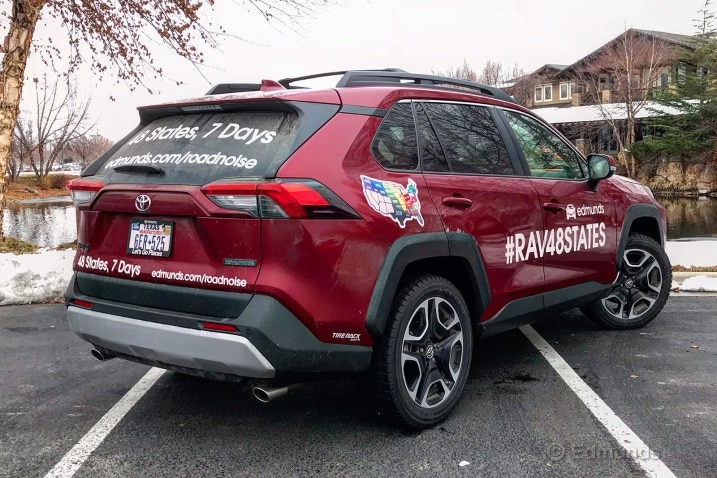
Our third member, Laurel, is too distracted doing her job posting to social media to form an opinion. "It's fine," she says, not looking up from her phone. "Does Wet Ones have a Instagram account?" She does appreciate how easy it is to reach over the back seat and reach stuff in the trunk. We'll try to get more out of her later.
We're about five hours behind schedule right now, and we have a lot of ground to cover before the finish line. The good news is that the speed limit is 80 mph where we are right now. The bad news? It's starting to snow.
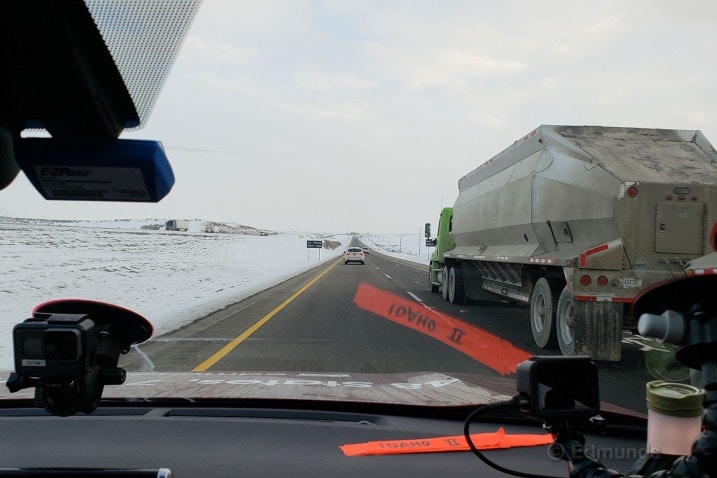
Sadly, we'll pass the prettiest parts of Utah in the dark, but neither sleet nor snow nor gloom of night will stay these testers from their route. Although Travis blasting Adele at full volume might. Hey, the stereo's not bad! — Will Kaufman
What's Been Happening?
Captain's Log: Leg 4, Team 4, Entry 4. Monday, December 10, 2018. 12:45 p.m. Day 6.
We are about two hours from completing our portion of the 2019 RAV4 drive across the country. As we wrap up our part of the adventure, we thought it fitting we leave you with some thoughts and opinions about this new RAV4. If you are just tuning in, Team 4 is a three-person group made up of Dan Edmunds, director of vehicle testing; Calvin Kim, road test engineer; and Matt Jones, a senior consumer advice adviser.
By the time you read this post, our team will have driven approximately 1,700 miles in about about 26 hours. We've taken meal and bathroom breaks and short stops to stretch our legs and take pictures. Besides these stops, the three of us have alternated shifts of driving, sleeping or writing in the car. Spending more than 24 hours in a vehicle will certainly provide some opinions. So here we go ...
Dan
The good: A huge step forward in AWD sophistication compared to the previous RAV4. Spacious, comfortable interior, good cargo space. The transmission is great.
The bad: The engine sounds a little rough around the edges when accelerating.The RAV4 doesn't need to be rocket fast, and it does fine as power is concerned. Not in love with the menus within the infotainment system and the lack of control of options when it comes to the trip computer. It could use a digital speedometer that displays nothing but speed on the cluster. If there is one, we haven't found it.
Calvin
The good: I like how the doors overlap the rockers, which keeps the rockers clean. That stops you from getting your legs all messed up when getting in and out of the RAV's cabin. This stands out when driving in slush, snow and muck. I also like the usable cargo space's little nooks and crannies.
The bad: Not in love with the top half of the seatbacks. They push my shoulders and head too far forward. I kind of feel like I'm being folded like a taco. I can fix that as a driver, but it's hard to get the steering wheel to the right position. As a passenger, it's fine because I can just recline my seat. Speaking of the passenger seat, I wish I could lower the seat height.
Matt
The good: I like that the RAV4, at least in this package, doesn't seem like it wants to feel like a car. That seems to be a common theme in this segment. This RAV4 feels substantial, like it has heft about it. I get a truck vibe from this, and I like it. I'm also impressed with the passenger space. After 24-plus hours in this thing, I never felt cramped.
The bad: Yesterday in the early afternoon, the sun shone on the instrument cluster. The resulting glare made the electronic speedometer close to unreadable, and it was nearly impossible to see my speed. This isn't going to happen often, but when it does, I know it would drive me nuts. And the ding ding ding every time I do something the RAV4 doesn't like gets on my absolute last nerve.
As a whole, we are really happy with this vehicle. It isn't perfect, but all three of us have a positive opinion. I'm very curious to see how the youngsters on Team 5 feel about the RAV4 when they are done. — Matt Jones
What's Been Happening?
Captain's Log: Leg 4, Team 4, Entry 3. Monday, December 10, 2018. 5:00 a.m.
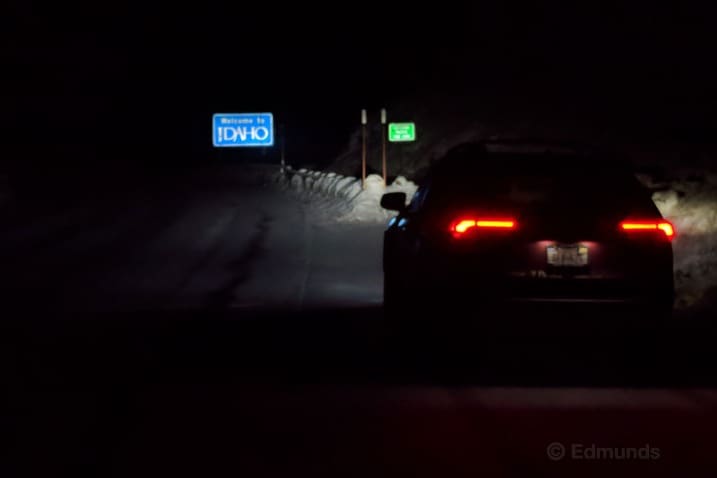
Since you last heard from us, we've made our way through Montana, crossed the Continental Divide, said hello to snowy Idaho, and now our feet are firmly planted in less snowy but more slushy Eastern Washington.
If all goes according to plan, we will hand off the keys to the Team 5, who's driving the final leg of our cross-country trip, right around noon. Although we are all eager for a break, I think it is safe to say this trio has thoroughly enjoyed our time.
Let's talk about driving in the snow. Specifically, about our winter tires, the RAV4's all-wheel-drive system, and Dan's thoughts on the two:
"These winter tires are outstanding. We were driving through all sorts of stuff — slush, fresh snow, packed snow, icy patches ... and the tires were the last thing I was concerned with. It felt like they had us bolted to the ground."
While on the road, Dan pointed out how timid other drivers — even those driving trucks with local plates — seemed to be driving. It suggested to him that those drivers may not have felt as planted as we did. He suspects tires are the culprit.
His take on the all-wheel-drive system in this Adventure package: (btw, Toyota has a fancy name for this system that is about 30 words long).
"When we were in the rest area driving on that fresh snow, I got the chance to see and feel the torque vectoring system making all sorts of decisions. It felt very organized and all four wheels were working together."
As a passenger, the RAV felt solid. And to me, that's important. Because when you're in the mountains at 3 in the morning and snow is coming down, feeling solid is a very, very good thing. — Matt Jones
What's Been Happening?
Captain's Log: Leg 4, Team 4, Entry 2. Sunday, December 09, 2018. Suppertime
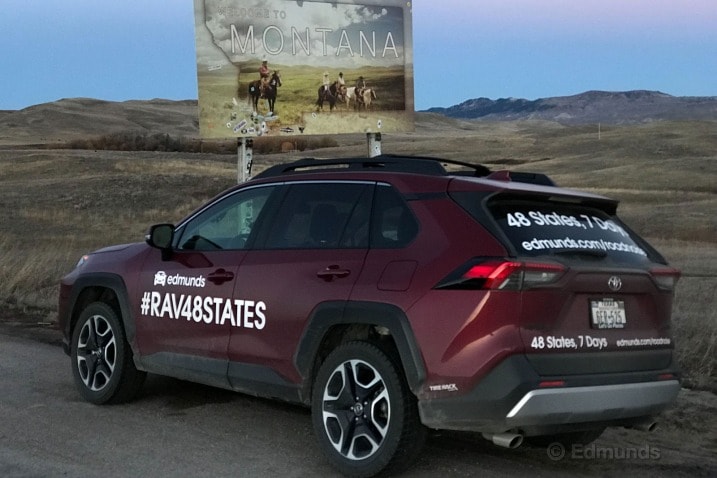
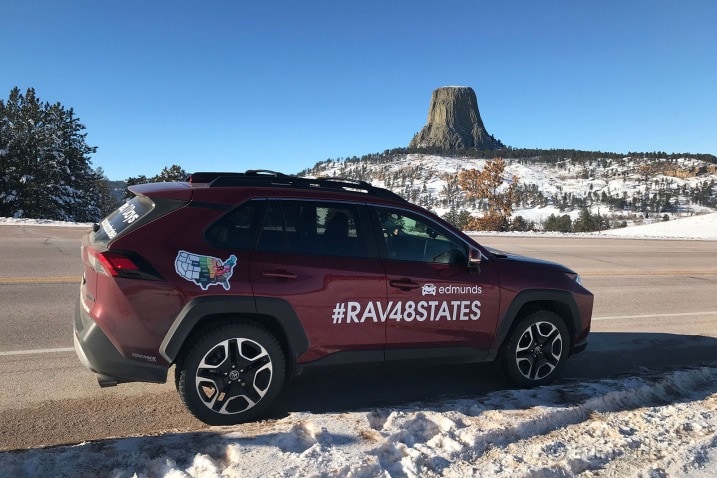
So far, our team has touched three states — South Dakota, Wyoming and now Montana. Up next is Idaho. Followed by Washington, Oregon, and a loop back into Idaho. But for now? Dinner.
Dan, Calvin and I stopped for supper in Billings, Montana. Calvin used the googles and found a place called Walkers. Pro tip: If you've ever in Billings, stop by Walkers. Thank me later.
After appetizers, the three of us shared some thoughts about the RAV4. In an effort to stay short and sweet, I'm only going to touch on two: gas mileage and the heated seats.
Turns out the heated seats work better than an update from leg 3 would lead you to believe. One of our drivers mentioned the heated seats didn't seem to heat too well. Well, we found the problem. It wasn't the seats; it was the layering of the driver that caused the problem. As luck would have it, that same driver from leg 3 is also a member of leg 4. This leg, he took off some of his many layers, and once his 6-inch-thick parka was removed, he was able to feel the heated seats do their thing. So yeah. Our bad.
Gas mileage. Our onboard meter reads 27.9 mpg, and the RAV4 is rated at 28 mpg combined. As a whole, we're pleased with the reported mileage. While our numbers are a little lower than other tanks, we are still happy.
Consider our trip: Most of the drive has been in areas with 75 to 80 mph speed limits. Driving these speeds has likely had a negative effect on our mpg. There is also a good chance the winter tires are reducing our efficiency. Combine those factors with the more-than-occasional hill climb and the weight of three guys and their gear, and we think 27.9 mpg is pretty respectable. — Matt Jones
What's Been Happening?
Captain's Log: Leg 4, Team 4, Entry 1. Sunday, December 09, 2018 noon-ish
Team 3 just handed us the keys, and we are about to begin our stint behind the wheel.
One concern we had prior to beginning our leg was space. While we had no doubt all three of us 6-footers (and our gear) would be able to fit in the RAV4, we wondered how comfortable we'd be. Turns out, all three of us are pretty darn comfy. In fact, I'm sitting behind Calvin Kim in the back seat of the RAV4 as I type this update, snug as a bug in a rug while we are doing 80 miles per hour on a Wyoming highway. And I've got legroom to spare.
Speaking of room, the storage area behind the rear seat is pretty substantial.
For example, the previous team picked up a Hyundai Tucson when they arrived in Illinois. The Tucson was almost overloaded with the gear and luggage. In the RAV4, our gear doesn't even break the sight line. Score.
Because I forced the team to make an unplanned stop, we are slightly behind schedule. Dan is concerned we might meet some weather on the western side of the Rockies, so we want to move our tires. At this point, we think we may be able to miss it. But we will be mindful of our breaks so we can stay ahead of the storm and on schedule. Until next time. — Matt Jones
What's Been Happening?
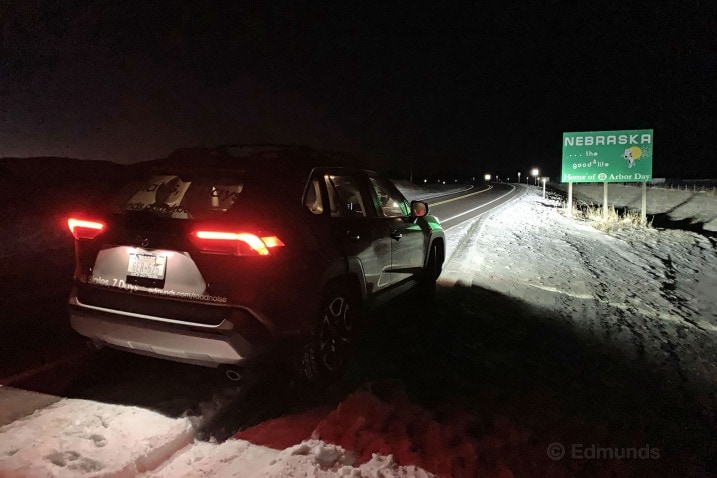
We might have been premature in signing off the last update. We still had the tail end of Minnesota to drive through and passing through the Dakotas took up the entire night. I'm happy to report, however, that we have hit all our states and are driving through Nebraska for a stretch before heading back into South Dakota to meet Team 4.
We've driven in sub-freezing temperatures for the entire journey. The highest temperature we saw was about 28 degrees Fahrenheit. The locals say it is "unseasonably cold." And while our winter tires never saw snowfall, they held up well in these freezing conditions and the RAV4 always felt composed on the road.
Dan says that the transmission shift logic felt good when we passed over the rolling hills. It never felt like it was hunting for gears and shifted smoothly on the downgrades.
We started this journey at night and it feels like we've only had a few hours of daylight. We're tired, hungry and not our freshest, but we're in good spirits overall. The plan, for now, is to get some breakfast in Gordon, Nebraska, to give us some energy, then head over to meet Team 4. The sun is starting to rise again and we're feeling positive about the road ahead. Until next time. — Ron Montoya
What's Been Happening?
We've now been on the road for about 16 hours, and we've crossed the Mississippi River and passed through Iowa and Minnesota. Things have slowed down now as the distances between states have grown farther.
We still need another 10 hours to meet the next team. This will take us to the long, flat stretches of North and South Dakota in total darkness and frigid temperatures.
Despite a late start, we are still on track to meet Team 4. The flight home that Rex and I are on, however, is a bit more nebulous. We have a same-day flight and the airport is about an hour's drive from the meeting point, plus we have to return the rental car. We might be cutting it close.
The RAV4 continues to be a solid companion for the journey. We set a team range record of 402.3 miles on one tank of gas. This averaged about 30.1 mpg. However, we can't verify if this is the best overall since we don't have the other teams' numbers at the moment.
We're skipping a sit-down dinner and eating protein bars instead, with the goal of making up some lost time. This will be the last update from our team as we focus our efforts on the road ahead. Wish us well as we head toward our rendezvous with Team 4. — Ron Montoya
What's Been Happening?
After the tire swap, we ventured into New Buffalo, Michigan, to check the state off our list and have breakfast. We ate at a tiny café that offered us samples of the fudge it sells. From there we needed to backtrack a bit to reach a couple of states. So far, we've set foot in Illinois, Indiana, Michigan, Wisconsin and Iowa.
We've made one fuel stop so far in which we drove about 376 miles and averaged 28.8 mpg. That is a solid improvement over the last tank from Team 2, which averaged 26.8 mpg. This was our best tank yet, but we have a feeling our next fill-up will yield a better result. We're now venturing onto local roads far from the highway and the speed limits have slowed us down quite a bit.
It's been cold but we've yet to encounter any snow. Temperatures have been in the high 20s for most of the day, so we're grateful to have the winter tires, which have a reformulated compound to perform better in this subfreezing climate.
So far Dan and I have taken a turn at the helm and we both felt that this RAV4 is a definite improvement over the prior model. As we approach the Northern Plains, we've encountered an increasing amount of frost heaves. It's made the ride much bumpier than normal, but it's too early to tell if the RAV or the roads are to blame. It's hard to imagine any vehicle making it through without a few jostles.
We're taking a lunch break now and will report back in a few hours. — Ron Montoya
What's Been Happening?
Team 3, consisting of Dan Edmunds, director of vehicle testing, Rex Torres, vehicle testing technician, and Ron Montoya, senior consumer advice editor, arrived in Springfield, Illinois, on December 7. We rented a late-model Hyundai Tucson at the airport to use for the day before our swap with Team 2.
The Tucson was nice to have as a basis for comparison before the RAV4's arrival. We found it to have plenty of headroom and comfortable seats. And, despite it being a lower trim model, it supported Apple CarPlay, which meant we could use our phone for navigation.
We headed to our hotel after an indulgent deep-dish pizza lunch to grab a few hours of rest before showering and heading out to meet Team 2.
The team change occurred at about 2:15 a.m. on December 8. Team 2 arrived bleary-eyed but in good spirits. We were officially on the road after a few handshakes and hugs. However, we soon noticed the gas gauge was on "E" and had to stop off for fuel.
We've been in the RAV4 for about 200 miles and our initial impressions are positive. The RAV4 packs a considerable amount of cargo space, much more than the Tucson. There seems to be a bit more wind noise than expected, but overall the vehicle is comfortable and roomy.
We made arrangements to meet Tire Rack in Michigan City, Indiana, a small town near the Michigan border. The Tire Rack team was waiting for us with a set of Yokohama Ice Guard winter tires. We felt it necessary to swap tires as we're heading toward the coldest stretch of the trip and might see some single-digit temperatures and potential snowfall.
We'll have more to report soon as we continue our journey. Stay tuned. — Ron Montoya
What's Been Happening?
As I'm typing this, Scott is at the helm of the RAV4 once more, transporting the RAV4 and its precious cargo with dogged determination toward our final destination of Springfield, Illinois. There we'll part with our trusty red steed and hand the keys over to Team 3. We hope Dan, Rex and Ron enjoy the Christmas lights and assorted energy bars that Team 1 left, plus the surprises we've packed.
We will have traveled over 1,500 miles by the time our leg ends (we're currently sitting at around 1,200 outside Springfield, Missouri, which made Scott very excited after he misread a sign). The RAV4 has been a great companion, never giving us a moment of unexpected trouble. The seats weren't the most comfortable for long trips — though it's difficult to imagine rivals with superior 32-hour support — and we would have liked warmer seat heaters.
But the rest of the RAV4 deserves praise. The numerous small-item storage pockets and sizable cargo area make it an ideal road-trip companion. Its sprightly acceleration carried us through the Ozarks with ease, and indicated fuel economy in the low 30s is impressive, too. We even figured out how to turn down the Apple CarPlay navigation command volume! (You have to adjust it in the Setup > Voice menu.)
Although our leg was longest in terms of distance, the good eats along the way helped the journey feel like no time at all. We want to give special shoutouts to Elizabeth, our bartender at the Hyatt Regency Greenville (South Carolina), who suggested The Trappe Door, where we had an excellent dinner. Also worth seeking out in Greenville is the Maple Street Biscuit Company. Our raving reviews of their biscuits, fried chicken and waffles even inspired Team 1 to stop by before they flew home. Lastly, Big Jake's in Texarkana scratched the barbecue itch we developed along the way.
We've had a heck of a time, and we're kind of sad to see it end. On the other hand, we can't wait to shut our eyes in a real bed. So for Elana, Scott and me: Thanks for coming on this journey with us. On to Team 3! — Cameron Rogers
What's Been Happening?
After fighting through torrential downpours in Louisiana and Arkansas, we've finally broken through the rain and seem to have clear sailing ahead. Our energy was high when we departed our barbecue lunch spot, but the reality of consuming several pounds of brisket, hot links and baked beans quickly settled in. The last couple hours have been trying as we desperately attempt to stave off self-inflicted food comas, but we have many miles to go before we sleep.
Not helping matters is a massive dose of pride. Our breakfast at the Waffle House was quicker than the preliminary schedule anticipated, and the higher speeds on Southern freeways mean we've nearly made up for time lost earlier in the trip.
Elana got behind the wheel earlier in the day, and by the time lunch rolled around, it was my turn. Like my teammates, I found the driver's seat initially quite comfortable. It certainly offers a high degree of adjustability; the seat can raise and lower, and there's two-way power lumbar support. Maybe after a few hours, I'll take a page out of Elana and Scott's book and start fidgeting, but it's too early to tell.
Last update, I reviewed the seat heating and ventilation functions. We recently noticed the Adventure also has a heated steering wheel, which is much appreciated on these cold days. In sharp contrast to the seats, the wheel gets super hot. Two out of three isn't bad, right? — Cameron Rogers
What's Been Happening?
We're back on the road after a quick, efficient breakfast at one of the three Waffle Houses in Monroe, Louisiana. (Home of those Duck Dynasty guys!) Scott continued his heroic drive deep into last night, finally handing over the reins to Elana in Alabama just after 1 a.m. local time. I slept as the two continued on into Louisiana, waking up just in time for a bite to eat. Funny how that works.
Scott and Elana both commented on the RAV4's initially supportive driver's seat, only to amend their opinions after long stints at the wheel. That's not totally uncommon in cars without 50-way adjustable seats, and since most buyers won't be attempting 48-state non-stop road trips, we think the seats will hold up tackling everyday activities.
The temperature has been hovering between 30 and 50 degrees, depending on our location and time of day, so the front seats' heating and ventilation functions have seen a lot of use. The seat heaters are kind of weak, even at full blast, but there's no denying the gale-force winds massaging your back and rump when the coolers are on. It's perfect for buyers in Southern states, where winters are mild and summers are seemingly unbearable.
We're continuing on our way to Shreveport, Louisiana, before we head north to our eventual destination of Springfield, Illinois. There, we'll hand the keys over to Team 3 and get some much-needed sleep. The snow ahead of us in Missouri is cleared, and all we have to deal with now is a bit of rain. More to come in a few hours. — Cameron Rogers
What's Been Happening?
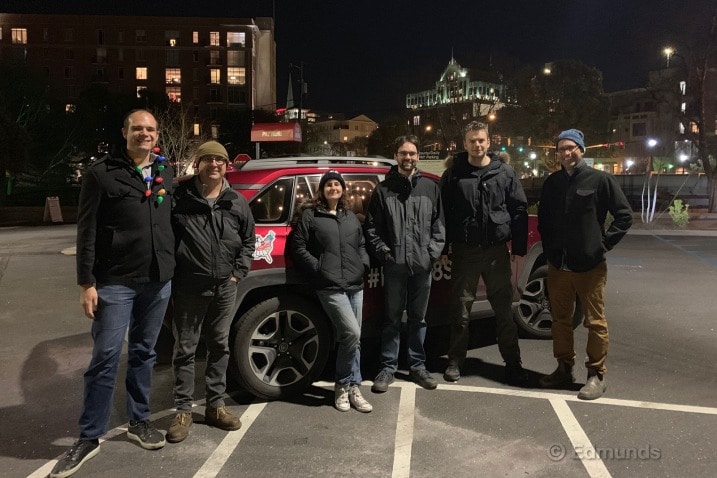
Team 2 reporting in for the first time! We (Elana, Scott and Cameron) met Team 1 in Greenville, South Carolina, where we've spent the last 24 hours sampling the local cuisine, sightseeing and generally prepping for the trip. The members of Team 1 looked remarkably fresh and coherent when they arrived in town, considering they'd spent the previous 30 hours running on coffee, Red Bull and sporadic sleep.
Our initial impressions of the new RAV4 are positive, revolving mostly around the much-improved interior materials. We've only been in the car for two hours, so expect updates with a little more detail as we progress further. Team 2, out! — Cameron Rogers
What's Been Happening?
We're now 23 hours into our journey, and we've covered 1,111 miles across 13 states. After a good run through the night, we're actually marginally ahead of schedule, but these are still early days. As I write, we're on the border of Ohio and West Virginia, with Kentucky our next stop.
We rotated the driving through the hours of darkness, taking turns to grab some sleep. While it's fair to say that the rear of the RAV4 makes a poor bedchamber, we all managed to get some shut-eye and spirits remain high. Our Toyota now looks like a proper road-trip vehicle, with a pleasing patina of dirt and debris. We've no intention of cleaning the exterior, although those of us with OCD tendencies are trying to keep the cabin litter-free.
Overall, the RAV4 is proving a fine road-trip companion. The driving position's much better than the old model and this 6-foot-plus triplet has more room than we might have expected. Our only major gripes so far concern a slightly gruff engine note when you ask it to perform and a ride that remains a bit firm and fidgety for our tastes.
We've another six hours of driving to go before we hand over to a new crew for Leg 2. It'll be interesting to see whether their experiences echo our own. — Alistair Weaver
What's Been Happening?
We've been on the road for nearly seven hours now, and reality has set in. Our point-by-point navigation system has led us astray a few times, necessitating a manual solution. Back at Edmunds HQ in Santa Monica, Director of Vehicle Testing Dan Edmunds noticed our missteps on the map and called to inform us that we're only averaging 30 mph, well shy of the 45-mph requirement to finish the drive in seven days. We had to cancel a quick bite in New York with some Edmunds colleagues because we're already a couple of hours behind. Plainly put, we've got our work cut out to make it to South Carolina on time — that's where we'll be handing off the keys to the next three-driver team tomorrow afternoon.
On the bright side, I just set Alistair straight about Worcestershire sauce — he thought it was "Worcester sauce," even though he is probably from a place in England called something-shire. And on the whole, we're enjoying our time in the RAV4 so far. It's quiet enough at speed, and while the front passenger seat lacks a height adjustment, at 6 feet 1 I have no complaints about my accommodations. I dig the new interior design, too — the rubber inserts on the climate-control knobs are a nice, adventurous touch, and whoever's designing Toyota's shift levers these days is doing great work. Like the latest Camry shifter, this one feels sporty and substantial in the hand. Now, to find a way to get those lost hours back.
We're going dark for the night, by the way, pressing on with yours truly at the helm while Alistair tells us how to pronounce things properly. Look for some bleary-eyed copy in the morning, filed under Day 2. — Josh Sadlier
We're off! At precisely noon EST we left Maine and headed for New Hampshire and Vermont. It's freezing cold but spirits are high and we're excited to be on the road. Only 7,000+ miles to go!
by EdmundsThe Edmunds content team brings you industry-leading vehicle reviews, news and research tips that make it easier for you to find your perfect car.