The New Tests
Originally scheduled for implementation on 2010 model-year vehicles, NHTSA announced a one-year postponement in December 2008 to give automakers extra time to prepare for the changes. The new tests are now scheduled for 2011 model-year vehicles. In addition to considering a new rear-collision test, NHTSA is devising changes to all three of its current tests.
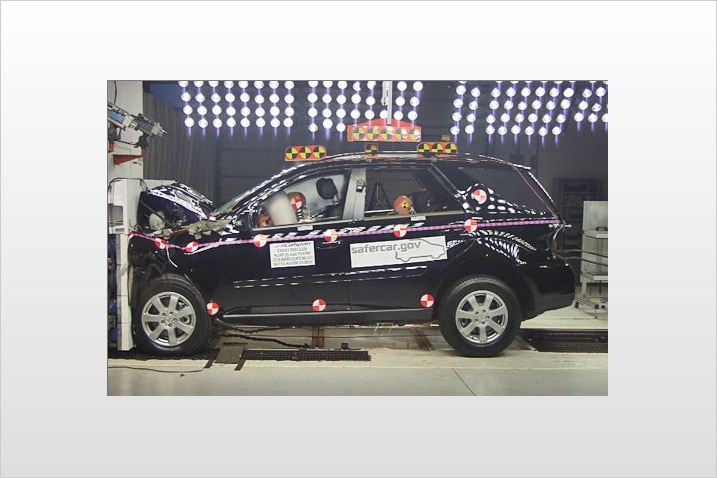
Under the current system, NHTSA's frontal impact test belts two adult-male-size crash test dummies into the front driver and passenger seats. The vehicle is then crashed into a fixed barrier at 35 mph head-on, measuring, in effect, the impact of two vehicles of similar weight hitting each other head-on.
Crash tests are also performed by the Insurance Institute for Highway Safety (IIHS), which conducts frontal offset tests by crashing the driver side of a vehicle's front end (40 percent of the total width) into a deformable barrier at 40 mph. The forces in the test are similar to those involved in a frontal offset crash between two vehicles of the same weight or size, each going just under 40 mph.
NHTSA will keep the current 35-mph frontal barrier test, but will revise its testing procedures to include smaller crash dummies, so women and larger children are represented. This new crash data will be used in calculating the frontal impact star rating.
Side-Impact
The current NHTSA side-impact test uses a 3,015-pound flat barrier with a deformable front end representing the front of a car. That barrier crashes into the side of a test car at a 90-degree angle, moving at 38.5 mph. The impact targets the driver and driver-side rear-seat occupant, using adult-male-size dummies.
Similar to improvements made to the frontal tests, NHTSA will keep the moving deformable barrier test, but will update its injury criteria for the chest, abdomen and pelvis. It will also add a new side-impact pole test that incorporates the smaller crash dummies. This test is designed to simulate wrapping a vehicle around a tree or lamppost. The side-impact safety rating will now be based on a combination of the pole and moving barrier test.
In real-world side impacts, women are more likely than men to suffer serious head injuries because they sit closer to the steering wheel, which positions their head in the middle of the side window. Men, who sit farther back, have a better chance of being protected by the B- (center) pillar. Using the smaller dummy will demonstrate the need for a side-airbag design that offers better protection for smaller drivers.
Rollover Testing
NHTSA conducts two rollover resistance tests that measure how a vehicle in a single-car crash responds when "tripped up" by a curb, guardrail or ditch. The so-called Static Stability tests measure the height of the car's center of gravity and the distance between the wheels. The results are a mathematical calculation of rollover risk for a tripped car — a car that goes off pavement into loose gravel or hits a curb. These are the most common causes of rollovers.
The dynamic maneuver test, also called the Fishhook test, measures rollover likelihood using a computerized steering program that gradually increases speed up to 50 mph. The exercise measures "tip up" (whether the wheels leave the ground when the car drives through a quick, tight turn), sort of a "dodge the deer" avoidance maneuver.
NHTSA will continue to test for rollovers under the new proposals, but will not revise its testing model until it gets more crash data on the effectiveness of electronic stability control in preventing rollovers. The new ratings program includes factors such as whether a vehicle has crash avoidance technologies such as electronic stability control, lane departure warning systems and forward collision warning systems. That data will be combined with the star ratings from the front, side and rollover tests to create a more comprehensive "Vehicle Safety Score."
What This Means to You
These testing procedures and their numerous changes may seem overwhelming, but they will reduce the inflated star ratings and lead to safer cars in the future. The enhancements to the NHTSA ratings will be reflected in vehicle window stickers, providing an easier way for consumers to compare the safety of vehicles they are considering.
Find safety features and crash test ratings for specific vehicles here on Edmunds.com or at Safercar.org.
" fill-opacity=".3" d="M0-111h1200v397s-252.211 51.289-538.449 54C375.312 342.711 0 292 0 292v-403Z"/%3E%3Cpath fill="url(%23b)" d="M1-114h1199v378s-252 51.289-538 54C376 320.711 0 270 0 270v-384Z"/%3E%3Cpath fill="url(%23c)" d="M0 60h1200v188s-327 63.289-613 66C301 316.711 0 273 0 273V60Z"/%3E%3Cpath fill="url(%23d)" d="M0 60h1200v188s-327 63.289-613 66C301 316.711 0 273 0 273V60Z"/%3E%3Cmask id="e" width="1201" height="255" x="-1" y="60" maskUnits="userSpaceOnUse" style="mask-type:alpha"%3E%3Cpath fill="%23EEF1F6" d="M0 60h1200v188s-327 63.289-613 66C301 316.711 0 273 0 273V60Z"/%3E%3C/mask%3E%3Cg mask="url(%23e)"%3E%3Cmask id="g" width="1438" height="328" x="-124" y="-13" maskUnits="userSpaceOnUse" style="mask-type:alpha"%3E%3Cpath fill="url(%23f)" fill-rule="evenodd" d="M-123.5 258.5-109-13h1395l27.5 245c-232.5 34.5-487.705 80.384-725.581 83-237.486-2.721-265.419-4-711.419-56.5Z" clip-rule="evenodd"/%3E%3C/mask%3E%3Cg mask="url(%23g)"%3E%3Cpath fill="%23FEF3C7" fill-opacity=".05" d="M774.502 1161.55c72.001-3.83 144.529-16.6 217.321-38.74C1514.56 964.017 1919.92 369.717 2099-392.74 1846.08 72.142 1341.28 313.096 774.502 323.314 207.726 312.671-296.808 72.141-549.998-392.74-370.919 369.717 34.449 964.017 557.181 1122.81c72.792 21.71 145.32 34.48 217.321 38.74Z"/%3E%3Cpath fill="%232070E8" fill-opacity=".25" d="M1243.34 184.225c102.44 30.548 204.48 74.055 305.68 131.036C2275.79 724.198 2778.24 1714.59 2935.35 2866.48 2634.05 2114.1 1943.59 1594 1134.58 1382.03 322.864 1199.88-429.69 1367.89-852 1944.02-497.039 916.86 159.636 208.787 927.603 163.907c106.887-5.677 212.247 1.329 315.737 20.318Z"/%3E%3Cpath fill="%23FEF3C7" fill-opacity=".05" d="M1232.5 70.76c104.07 5.535 208.91 23.986 314.13 55.967C2302.21 356.131 2888.15 1214.7 3147 2316.21 2781.41 1644.6 2051.75 1296.5 1232.5 1281.74 413.251 1297.12-316.027 1644.6-682.001 2316.21-423.151 1214.7 162.788 356.131 918.372 126.727 1023.59 95.361 1128.43 76.91 1232.5 70.76Z"/%3E%3Cpath fill="%23154A99" fill-opacity=".29" d="M421.155 420.269c113.733 46.994 226.413 108.503 337.53 185.053C1556.67 1154.75 2075.77 2329.98 2199.28 3644.03 1895.3 2761.18 1143.24 2091.29 243.733 1753.08c-903.919-305.05-1757.473-209.22-2258.663 386.12C-1568.66 1028.61-797.982 313.945 67.226 358.413c120.398 6.829 238.484 27.723 353.929 61.856Z"/%3E%3C/g%3E%3C/g%3E%3Cdefs%3E%3ClinearGradient id="a" x1="600" x2="600" y1="-92" y2="449" gradientUnits="userSpaceOnUse"%3E%3Cstop offset=".336" stop-color="%23007EE5"/%3E%3Cstop offset="1" stop-color="%2363D9EA"/%3E%3C/linearGradient%3E%3ClinearGradient id="b" x1="600.5" x2="600.5" y1="-114" y2="427" gradientUnits="userSpaceOnUse"%3E%3Cstop offset=".336" stop-color="%23007EE5"/%3E%3Cstop offset="1" stop-color="%2363D9EA"/%3E%3C/linearGradient%3E%3ClinearGradient id="c" x1="647" x2="647" y1="60" y2="319" gradientUnits="userSpaceOnUse"%3E%3Cstop offset=".052" stop-color="%23007EE5"/%3E%3Cstop offset=".514" stop-color="%231561D4"/%3E%3Cstop offset=".938" stop-color="%2300A0B5"/%3E%3C/linearGradient%3E%3ClinearGradient id="d" x1="647" x2="647" y1="60" y2="319" gradientUnits="userSpaceOnUse"%3E%3Cstop offset=".282" stop-color="%23007EE5" stop-opacity="0"/%3E%3Cstop offset=".822" stop-opacity=".3"/%3E%3C/linearGradient%3E%3ClinearGradient id="f" x1="588.5" x2="588.5" y1="-13" y2="499.532" gradientUnits="userSpaceOnUse"%3E%3Cstop stop-color="%23154A99"/%3E%3Cstop offset="1" stop-color="%2363D9EA"/%3E%3C/linearGradient%3E%3C/defs%3E%3C/svg%3E)