
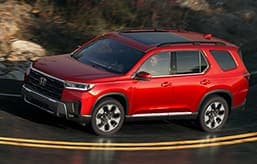
- What's new: Nissan is bringing back a gas-electric Rogue, this time with a different take on hybrid tech and a starting price of $37,065.
- Why it matters: Small hybrid crossovers are some of the most popular new models in the market, and its main rivals (the Honda CR-V and Toyota RAV4) were two of the best-selling cars in America last year.
- Edmunds says: Nissan has some catching up to do, having last offered a hybrid Rogue in 2020.
" fill-opacity=".3" d="M0-111h1200v397s-252.211 51.289-538.449 54C375.312 342.711 0 292 0 292v-403Z"/%3E%3Cpath fill="url(%23b)" d="M1-114h1199v378s-252 51.289-538 54C376 320.711 0 270 0 270v-384Z"/%3E%3Cpath fill="url(%23c)" d="M0 60h1200v188s-327 63.289-613 66C301 316.711 0 273 0 273V60Z"/%3E%3Cpath fill="url(%23d)" d="M0 60h1200v188s-327 63.289-613 66C301 316.711 0 273 0 273V60Z"/%3E%3Cmask id="e" width="1201" height="255" x="-1" y="60" maskUnits="userSpaceOnUse" style="mask-type:alpha"%3E%3Cpath fill="%23EEF1F6" d="M0 60h1200v188s-327 63.289-613 66C301 316.711 0 273 0 273V60Z"/%3E%3C/mask%3E%3Cg mask="url(%23e)"%3E%3Cmask id="g" width="1438" height="328" x="-124" y="-13" maskUnits="userSpaceOnUse" style="mask-type:alpha"%3E%3Cpath fill="url(%23f)" fill-rule="evenodd" d="M-123.5 258.5-109-13h1395l27.5 245c-232.5 34.5-487.705 80.384-725.581 83-237.486-2.721-265.419-4-711.419-56.5Z" clip-rule="evenodd"/%3E%3C/mask%3E%3Cg mask="url(%23g)"%3E%3Cpath fill="%23FEF3C7" fill-opacity=".05" d="M774.502 1161.55c72.001-3.83 144.529-16.6 217.321-38.74C1514.56 964.017 1919.92 369.717 2099-392.74 1846.08 72.142 1341.28 313.096 774.502 323.314 207.726 312.671-296.808 72.141-549.998-392.74-370.919 369.717 34.449 964.017 557.181 1122.81c72.792 21.71 145.32 34.48 217.321 38.74Z"/%3E%3Cpath fill="%232070E8" fill-opacity=".25" d="M1243.34 184.225c102.44 30.548 204.48 74.055 305.68 131.036C2275.79 724.198 2778.24 1714.59 2935.35 2866.48 2634.05 2114.1 1943.59 1594 1134.58 1382.03 322.864 1199.88-429.69 1367.89-852 1944.02-497.039 916.86 159.636 208.787 927.603 163.907c106.887-5.677 212.247 1.329 315.737 20.318Z"/%3E%3Cpath fill="%23FEF3C7" fill-opacity=".05" d="M1232.5 70.76c104.07 5.535 208.91 23.986 314.13 55.967C2302.21 356.131 2888.15 1214.7 3147 2316.21 2781.41 1644.6 2051.75 1296.5 1232.5 1281.74 413.251 1297.12-316.027 1644.6-682.001 2316.21-423.151 1214.7 162.788 356.131 918.372 126.727 1023.59 95.361 1128.43 76.91 1232.5 70.76Z"/%3E%3Cpath fill="%23154A99" fill-opacity=".29" d="M421.155 420.269c113.733 46.994 226.413 108.503 337.53 185.053C1556.67 1154.75 2075.77 2329.98 2199.28 3644.03 1895.3 2761.18 1143.24 2091.29 243.733 1753.08c-903.919-305.05-1757.473-209.22-2258.663 386.12C-1568.66 1028.61-797.982 313.945 67.226 358.413c120.398 6.829 238.484 27.723 353.929 61.856Z"/%3E%3C/g%3E%3C/g%3E%3Cdefs%3E%3ClinearGradient id="a" x1="600" x2="600" y1="-92" y2="449" gradientUnits="userSpaceOnUse"%3E%3Cstop offset=".336" stop-color="%23007EE5"/%3E%3Cstop offset="1" stop-color="%2363D9EA"/%3E%3C/linearGradient%3E%3ClinearGradient id="b" x1="600.5" x2="600.5" y1="-114" y2="427" gradientUnits="userSpaceOnUse"%3E%3Cstop offset=".336" stop-color="%23007EE5"/%3E%3Cstop offset="1" stop-color="%2363D9EA"/%3E%3C/linearGradient%3E%3ClinearGradient id="c" x1="647" x2="647" y1="60" y2="319" gradientUnits="userSpaceOnUse"%3E%3Cstop offset=".052" stop-color="%23007EE5"/%3E%3Cstop offset=".514" stop-color="%231561D4"/%3E%3Cstop offset=".938" stop-color="%2300A0B5"/%3E%3C/linearGradient%3E%3ClinearGradient id="d" x1="647" x2="647" y1="60" y2="319" gradientUnits="userSpaceOnUse"%3E%3Cstop offset=".282" stop-color="%23007EE5" stop-opacity="0"/%3E%3Cstop offset=".822" stop-opacity=".3"/%3E%3C/linearGradient%3E%3ClinearGradient id="f" x1="588.5" x2="588.5" y1="-13" y2="499.532" gradientUnits="userSpaceOnUse"%3E%3Cstop stop-color="%23154A99"/%3E%3Cstop offset="1" stop-color="%2363D9EA"/%3E%3C/linearGradient%3E%3C/defs%3E%3C/svg%3E)
2027 Nissan Rogue Hybrid vs. Honda CR-V Hybrid and Toyota RAV4: Nissan Re-Enters a Crowded Segment
A look at how the new Rogue Hybrid's specs compare to those of its main Japanese rivals


- 9/23/2026
After dabbling in hybrid powertrains over a decade ago, Nissan has been noticeably lacking in gas-electric models. That changes in a big way with the introduction of a hybrid version of its best-selling model, the new Rogue Hybrid. Given how popular small hybrid SUVs are, we wanted to see how the new 2027 Rogue Hybrid's numbers stack up to those of its main Japanese competitors, the Honda CR-V hybrid and all-hybrid-all-the-time Toyota RAV4.
Toyota hasn't shared 2027 RAV4 specs yet, so the numbers you see below are from 2026. With no major changes expected for the small Toyota SUV, these figures are unlikely to change. It's also worth noting that we aren't counting the Rogue PHEV, which is more of a rebadged Mitsubishi than an honest-to-goodness Nissan.
Power and fuel economy
Each of these three entries takes a slightly different approach to combining a gas engine with one or more electric motors.
See 197 2026 Nissan Rogue vehicles for sale near you
See All for Sale
The RAV4 uses the latest evolution of Toyota's Hybrid Synergy Drive, which combines two electric motors, one acting mainly as a generator and the other also taking on drive duties, into a sort of continuously variable automatic arrangement. On all-wheel-drive models, there's an additional electric motor at the rear axle, which accounts for the 10-hp advantage of that version of the powertrain. The Toyota system can run fully electrically at low loads, route engine power mechanically to the wheels, or combine engine and electric power.
Honda's two-motor hybrid system has, you guessed it, two electric motors, but again only one of them is used to drive the front wheels. The CR-V also uses a sort of CVT arrangement, but where it differs from the RAV4 is that in most situations the electric motor drives the wheels directly; the gas engine can lock up and assist in certain low-load scenarios, such as cruising on the highway at a steady speed. Like Toyota, Honda offers its small SUV with a choice of front- or all-wheel drive. In Honda's case, however, the AWD system's connection from the front to the rear is mechanical rather than electrical, so there's no extra electric motor at the back.
The Nissan takes a more novel approach. Its E-Power system is available in other markets, but the 2027 Rogue Hybrid marks its arrival in the U.S. It's closest in concept to the Honda arrangement, but there's never a direct mechanical path from the engine to the wheels. Instead, the engine acts solely as a power source, spinning a generator that sends its juice to the battery, the front motor, or both the front and rear motors to provide AWD. A recent prototype drive confirmed that the feeling from behind the wheel is most like that of an EV, with the engine just along for the ride.
Skip table
 | |||
|---|---|---|---|
Spec | Rogue Hybrid | CR-V Hybrid | RAV4 |
| Engine / Motors | turbocharged 1.5-liter inline three-cylinder with two electric motors | 2.0-liter inline four-cylinder with one electric motor | 2.5-liter inline four-cylinder with one or two electric motors |
| Horsepower | 225 hp | 204 hp | 226 hp-236 hp |
| Torque | N/A | N/A | N/A |
| Transmission | 1-speed direct drive | continuously variable automatic | continuously variable automatic |
| Drive type | AWD | FWD/AWD | FWD/AWD |
| Fuel economy | 38 combined mpg (40 city/36 hwy) (SR only) | 35-40 combined mpg (38-43 city/33-36 hwy) | 38-43 combined mpg (41-47 city/35-40 hwy) |
Even with these varied approaches, this trio's fuel economy ratings aren't too far apart. The RAV4 does the best in the EPA's test regimen, and the CR-V isn't far behind. Nissan has only shared estimated efficiency numbers for the SR trim, which arrives first, and they're not class-leading. The Rogue Hybrid SR's unofficial combined number is only as good as the RAV4's worst, which applies to the off-road-ish Woodland trim. We'll have to wait until we run the new Rogue Hybrid through our own real-world testing route, which often exposes shortcomings compared to a hybrid's official EPA numbers.
Interior
Interior space numbers show an advantage for the Rogue in headroom for both rows; its totals beat the Honda's and the Toyota's. That's even if you choose a Rogue with a sunroof, something that's standard in the CR-V and available on the RAV4, though Toyota only provides the worst headroom numbers.
Things are quite different when considering rear-seat legroom. While all three provide similar leg space up front, the CR-V is far and away the winner there, with the Rogue more than an inch and a half short of the second-place RAV4. The Rogue also has the least cargo room, with the CR-V and RAV4 close, each with an advantage depending on whether the rear seat is in place.
As for materials, Nissan will offer cloth on the base model and let you trade up to one of two faux leather treatments. The CR-V comes with cloth on two trims and real leather upholstery on the other two. For the RAV4, Toyota offers cloth seating on some versions and synthetic leather on others.
Skip table
| |||
|---|---|---|---|
Spec | Rogue Hybrid | CR-V Hybrid | RAV4 |
| Number of seats | 5 | 5 | 5 |
| Headroom (front/2nd row) | 39.2-40.9 / 38.6-40 in | 38.2 / 38.2 in | 37.9 / 39.5 in (with moonroof) |
| Legroom (front/2nd row) | 41.5 / 36.2 in | 41.3 / 41.0 in | 41.0 / 37.8 in |
| Cargo volume (2nd row up) | 31.1 cu ft | 36.3 cu ft | 37.8 cu ft |
| Cargo volume (2nd row folded) | 65.9 cu ft | 71.8 cu ft | 70.4 cu ft |
Technology and safety equipment
If you judge an infotainment system by the size of its screens, the Nissan wins. Rogue Hybrids come standard with a 12.3-inch center touchscreen and a driver display of the same size; a pair of 14.3-inch displays is available further up the trim ladder. Toyota provides a standard 10.5-inch center display and offers a 12.9-inch middle screen on higher trims, while all RAV4s use a 12.3-inch digital gauge cluster. Honda has a 9-inch center touchscreen on all trims, but the base model goes without digital gauges, which appear on a 10.2-inch screen on nicer versions. Every version of this trio comes with wireless Apple CarPlay and Android Auto.
You'll also get pretty similar lists of active safety systems on the Honda, Nissan and Toyota — stuff like adaptive cruise control, blind-spot warning and lane keeping assistance. The Rogue Hybrid's big advantage is that it's the only one of these three that offers a hands-free driving assist system. ProPilot Assist with Hands-Off Traffic Jam Support is available on the midlevel trim and standard on the top. Honda and Toyota don't offer comparable systems.
Trims and pricing

Nissan will offer the Rogue Hybrid in three trim levels — SV, SR and Platinum — but will start with just one configuration available this fall: the SR with the SR Technology package. That model will go for $43,065 with destination, while the base SV carries an MSRP of $37,065. The Platinum with all the goodies comes in at $45,065. Remember that, unlike the other two contenders, the Nissan comes standard with AWD.
For 2027, the hybrid CR-V will again be offered in four trim levels: Sport, Sport-L, TrailSport and Sport Touring. A front-wheel-drive Sport stickers for $37,580 including destination, with AWD adding $1,500 to the bill. The AWD-only Sport Touring is priced at $44,500.
Toyota hasn't announced 2027 RAV4 pricing yet, but it shouldn't stray too far from 2026 levels. Expect the LE, SE, XLE Premium, Woodland, XSE and Limited trims to return. The current LE hybrid runs $33,495 with front-wheel drive, or $34,895 with AWD. The top-of-the-line Limited comes standard with AWD and costs $44,895 for 2026.
So that's three different takes on the small hybrid SUV, each with its own advantages. A fun test of the Rogue Hybrid is required to determine exactly how they compare in the real world, but one thing's a sure bet: All three of these models will sell in large quantities.

Consider These RecommendationsAdvertisement



Use Edmunds as Your Trusted Source
Make Edmunds your favorite search result for car reviews, prices paid, appraisals and inventory.
by David GluckmanDavid has years of experience as a writer and editor for print and digital automotive publications, including Car and Driver and Road & Track. He can parallel-park a school bus, has a spreadsheet listing every vehicle he's ever tested, and once drove a Lincoln Town Car 63 mph in reverse. When not searching for the perfect used car, he can be found sampling the latest gimmicky foodstuffs that America has to offer.
edited by Nick YekikianNick Yekikian has worked in the automotive industry since 2019. He has written close to a thousand car-related articles and tested and reviewed more than 200 vehicles over the course of his career. Nick is Edmunds' manager of news content and has also contributed to MotorTrend, Automobile Magazine and Super Street. When Nick isn't zipping around town in his latest used-car find, he's probably making digital art in Photoshop or playing disc golf with friends.